
National Black HIV/AIDS Awareness Day!
Background:
As we entered into the 21st century, alarming, distressing, and potentially fatal statistics continued to confront us all as the HIV/AIDS epidemic grew in both intensity and number globally. Here in the USA, African-Americans constituted slightly over 14% of the total population, yet they represented almost 50% of all categories in HIV/AIDS-related statistics reported by the US Centers for Disease Control and Prevention (CDC). The disproportionate impact indicated an approaching catastrophic outcome.
The first two decades of the HIV/AIDS crisis, in addition to the ignorance and neglect of then-president, Ronald Reagan, was likewise ignored and condemned by African-Americans as well. The blame and cause of the disease was the “white homosexuals and their sinful ways!” At long last, Black Americans were able to point their fingers at the White community and condemn them for “inventing” a disease that was fatal.
By this time, it was evident to all – health professionals, legislators and in particular, the American public – that more decisive, effective and resourceful actions and measures were needed to combat the alarming rates of infection with HIV/AIDS.
In 1999, concerns and fear over the effects of the disease on the Black American population led the CDC, the US Public Health Service, executive representatives of nationwide organizations serving African-Americans and communities of faith met to address issues with the rising infection conditions. One of the results of these meetings was the decision to observe February 7, annually, as National Black HIV/AIDS Awareness Day (NBHAAD).
With excitement, athletic and celebrity endorsements, fanfare and media attention, the very first NBHAAD was held from coast-to-coast on February 7, 2000.
HIV Infection:
The human immunodeficiency virus (HIV), the virus that causes AIDS, is transmitted (spread) from one person to another through contact with one or more of four (4) human body fluids. These four fluids are: blood, semen, vaginal fluid breast milk. Other body fluids such as tears, saliva, mucus (congestion), urine do not spread HIV. Remember the four: blood, semen, vaginal fluid, breast milk. Avoid all contact with those four body fluids.
Any contact with one or more of these body fluids contact your local health department immediately for treatment! The earlier treatment begins, the greater chances are for success.
Latex, a synthetic material, has been proven repeatedly to significantly reduce (lower) the risk of HIV infection. Latex is used to make condoms and gloves because it prevents the exchange of bodily fluids. The latex product must be intact – no puncture or tear. Dispose (throw away) latex products in a marked biohazard container.

Testing:
A simple blood test can determine if a person is infected with HIV (the virus that causes AIDS). Persons are encouraged to get tested for HIV regularly. In the USA, test results are supposed to be confidential (private) even though the data is reported to the health department for statistical purposes.
When test results are given, information is also provided on services available and possible treatment options. Counseling is also offered.
Major challenge:
Despite all of the advances in HIV testing, counseling treatment options and massive HIV/AIDS public education/treatment efforts, it remains estimated that almost 25% (one quarter) of persons who are infected with HIV (HIV+) are honestly unaware of their personal HIV status. They have not been tested. This factor represents not only a failure of education and outreach efforts nationwide, but also the serious potential for a major health crisis. Get tested! Know your status!

Key components:
NBHAAD guidelines mandate four (4) key components that must be present in order for an awareness campaign to be considered a success. Each component is designed to build individual and community strengths in combatting HIV/AIDS. The four essential elements are:
Get educated: Know and learn the facts about transmission and prevention of HIV/AIDS.
Get involved: Explore opportunities available in individual and community prevention efforts.
Get tested: Know your HIV status and encourage/empower others to do the same.
Get treated: Receive proper healthcare and support needed to successfully live as HIV+.
Analysis proves that people learn and retain knowledge most effectively from people they perceive as most like themselves. NBHAAD is an African-American based to provide direction, guidance and implementation to the Black population specifically. It represents a resource that is both accessible, authentic and dependable.

Knowledge is power:
The more that we know, the better we become in enjoying not only good health but also successful living. NBHAAD and sponsored programs increase the amount of knowledge within a community and the opportunities for discussions concerning issues surrounding HIV/AIDS that individuals may face. It helps to create an environment where the virus that causes AIDS is a comfortable topic without fear of judgment.
Recently, the coronavirus COVID-19 and variants have received attention in health circles that have surpassed the attention focused on HIV/AIDS. Both infections need our attention and because HIV/AIDS has been with us longer, it still is prevalent and warrants action and continued education. Our health deserves all the attention we can offer to it!
Endorsements:

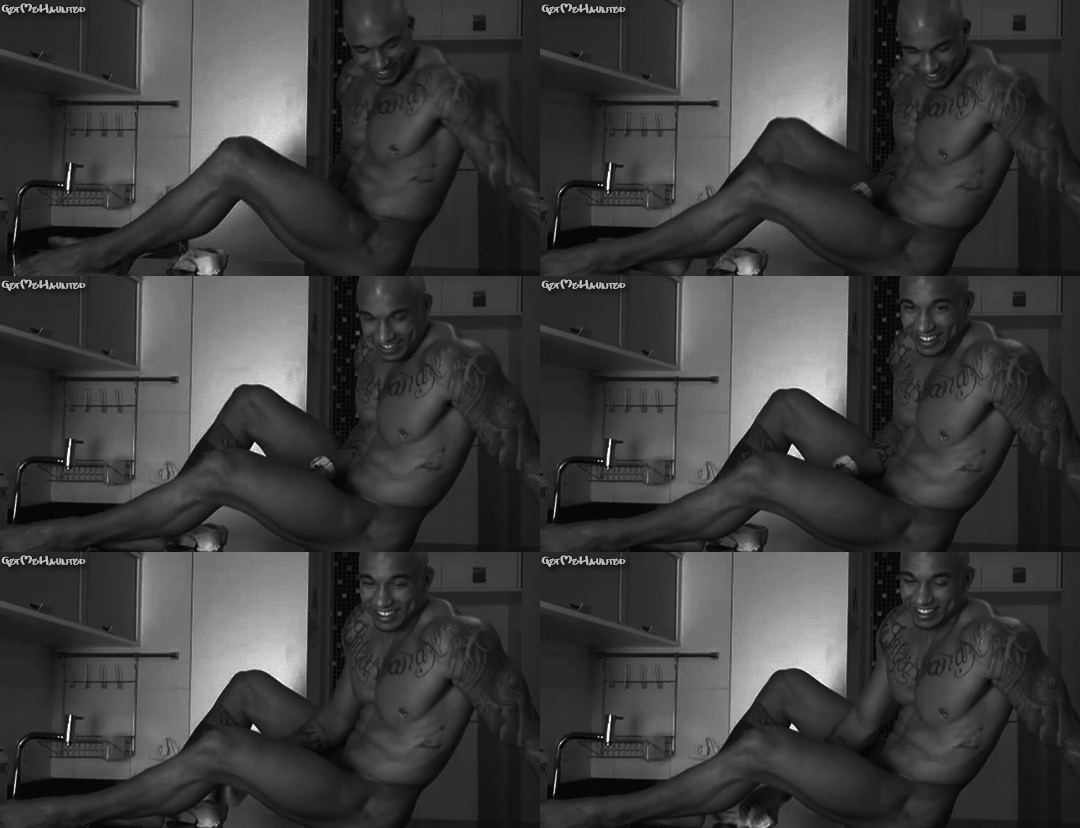
Now retired from his career in the gay porn industry, proud bare practitioner, Kory Mitchell, himself a certified American Red Cross prevention education instructor trainer (as myself) has visual tattoos to accentuate his status as HIV+ and in support of NBHAAD. We both collaborated on several HIV/AIDS prevention education projects for the Red Cross nationally. Early in his film career, Kory had “blessed” tattooed on his shoulder and a cross inked on his abdomen to remind his fans of his Christian faith.

Shortly after his diagnosis as HIV+ and just before his retirement, he had the word “hope” tattooed on his neck. Instead of the letter “o” in hope, he had a red HIV/AIDS awareness ribbon substituted instead. Very creative and imaginative, Kory!

Phoenix Fellington, as documented in the previous post entry here on Monday, 3 February, 2025, “Bare Is Real!” We are truly fortunate to offer his reasoning for being employed in the gay porn industry not once but twice in the same week! His message compliments NBHAAD!
“Why do I do gay porn? To teach men how to have sex. Responsibly and safely!” ~ Phoenix Fellington ~ openly gay pornography actor, ReNude Pride spokes-model

Now retired NBA professional player, Jason Collins, formerly of the Brooklyn Nets. Jason was the very first NBA professional to “come out” as gay while still playing in the NBA. His sentiments here reflect prejudice, whether over a person’s sexuality or over their HIV status.
“Openness may not completely disarm prejudice, but it’s a good place to start.” ~ Jason Collins ~ openly gay NBA professional, Brooklyn Nets
Naked hugs!
Roger Poladopoulos/ReNude Pride

Author’s Note: The next post entry here is planned for Monday, February 10, 2025, and the proposed topic is: “Posing Bare: Part 3!”

 ReNude Pride: Guys Without Boxers!
Thank you for the very informative post.
LikeLiked by 1 person
Glad that you liked it. I hope all is better for all of you. BTW: you just might appreciate an observation that will post here on 17 February! 🙂 It might put a smile on your face! Naked hugs!
LikeLike
Important and informative.
Thank you.
LikeLiked by 1 person
Thank you! We all need to stay current! 🙂 Naked hugs!
LikeLike