Title Explanation:
SGL, as repeatedly referenced here, is the anacronym for same gender love (bisexual or gay). SNL represents the popular USA television series: Saturday Night Live, a show that forcefully, hilariously and magnanimously ridicules and rebuffed the sorry state of affairs of American culture: actions, attitudes, beliefs, concepts, prejudices and values. Race Cooper confidently, defiantly and proudly does the same here for ReNude Pride: Guys Without Boxers!
Race Cooper: Our Man:

Prelude:
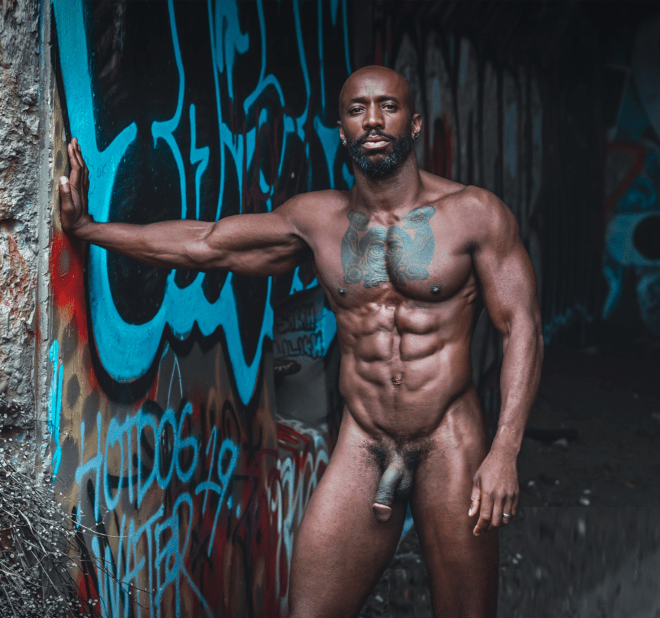
“Canadian-to-his-core (soul)!” is an ideal description of loyalist Race Cooper, now retired SGL and nakedness adult film industry role model and star. Race Cooper is his professional (stage) name, his birth and legal name is Joseph Ross Anderson. He was born in Toronto, Ontario, Canada on 5 December 1973. He received his introduction into the US gay adult film industry as a casting director at the studio office and worked diligently for a number of years. Then, in 2009, at the tender age of 36 years old, he performed his first role in front of the camera and graciously offered his buttocks to the world!
While pursuing his growing popularity while acting, he simultaneously became an advocate for film actors regarding studio executives, management and film investors concerning gross racial and ethnic disparities in practices, roles, pay scale and other matters. In his time working at the studio, he observed discrimination and marginalization against Blacks, Hispanics and surprising, fellow gay employees!
The purpose of reminding everyone of the dire need of review of the discriminatory protocols some of our same gender loving (SGL) and nakedness cohorts in the adult film industry allow, through the observations of “industry insider” Race Cooper (one of our own community and culture) is that before we point fingers outward, we all need to look inward and ensure that we are on the platform of equality, freedom and justice. Our need for respect and understanding enables us to search for accountability and truth everywhere – even among ourselves!
We need the insight of our fellow bare practitioner, bare celebrity Race Cooper, to lead us from the darkness and into the light!
“Racism and discrimination take many forms and our focus and thoughts on racism, sexuality and nudity need to change.” ~ Joseph Ross Anderson (Race Cooper) The Pink News SGL News Service, London, UK, 10 June 2020
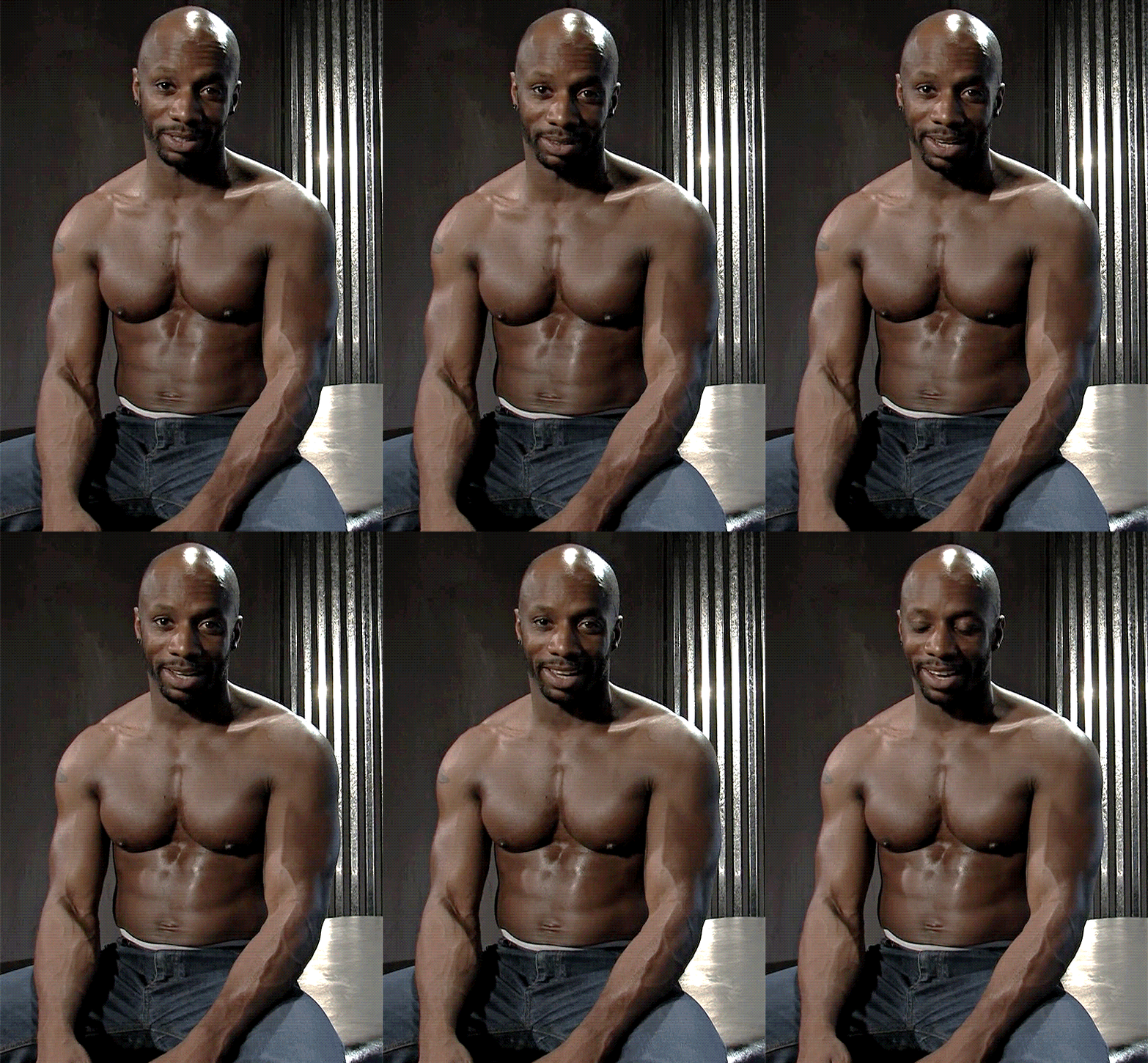
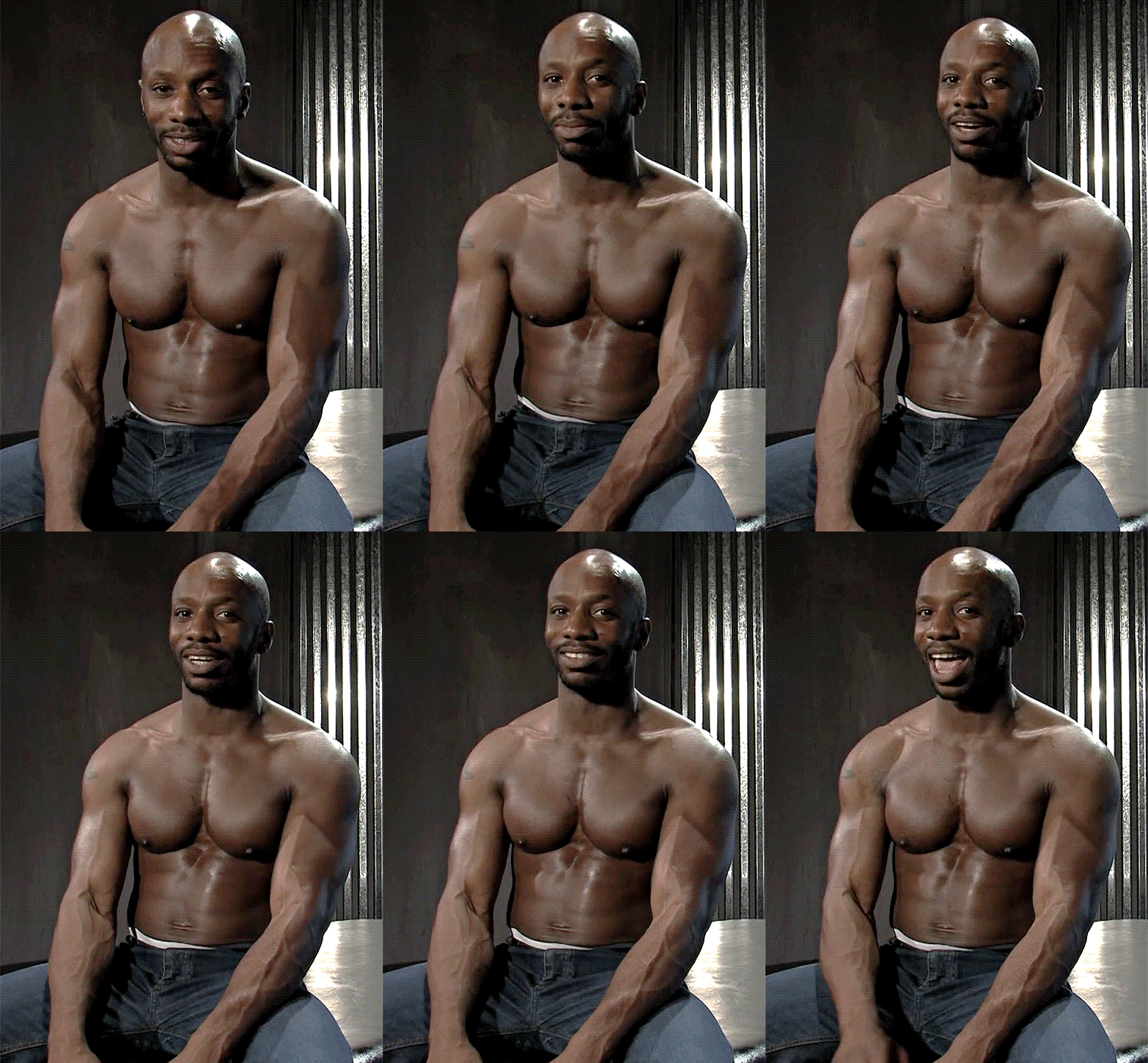
Footnote: Race could not appear fully nude for his interview. Instead, he conducted the session shirtless, as close to nakedness as possible!
The examination and exploration of the topic of “race” extends beyond the limited concepts of of just Black people and White people. It includes all of us, no matter our skin tone, ethnicity, or racial heritage. “Race,” unfortunately, is also aligned with community, culture, politics, religion and value systems.
Regrettably, racism (racial bigotry and/or hatred) is a “learned” (taught) behaviour passed from one generation to the next – often without any basis of proof or scientific fact. Unchallenged, it is frequently misunderstood as the “norm” (normal) – the regular routine standard.
My spouse, Aaron, and I both offer this posting in the hope of overcoming our need to be reminded of the importance of fact and reality in our lives.
Introduction:
Joseph R. Anderson (Race Cooper) didn’t begin his film career until 2009 at the tender age of 36 years! An age when most openly bisexual or gay porn film actors are ready to retire from performing live! His acting career spanned a total of five years. He retired from the industry in 2014.
In the same year that he started live acting, after years in the studio’s casting office, Race started publicly blogging on blogger.com, promoting his acting career and sharing information about fellow porn stars and their preferences. He swiftly acquired notoriety as “a-man-who-tells-it-all!” He also began to encourage and endorse the expansion of the “alpha” (top-man) and the “beta” (bottom-man) SGL identities to include “versatility” (both traditional SGL sexual positions)!
Vital Statistics:
Height: 6′ (183 cm)
Weight: 180 lbs. (82 kg)
Hair: head – shaved; body – armpit, pubic
Penis: 8″ (20 cm) circumcised
Sexuality: gay
Sexual position: versatile (preference: beta (bottom-man)
Clothing status: bare (naked,nude)
Porn Career: Mid-level management (casting); live (2009-2014)

“I’m an African-Canadian. Growing up in Toronto, I got to see how lots of White Americans reacted to Black people, from Canada or the USA. Working in gay pornography, I personally saw how Black men were treated by White men with no difference between gay or straight.” ~ Race Cooper ~ The Pink News 10 June 2020
Race, based on his own experience, views racism as “a daily constant in the USA.” He acknowledges that he – at first – was paid considerably less than his Caucasian colleagues and regularly and repeatedly had his work ethic and intelligence questioned. He honestly believes that he was only hired initially in order for the studios to appear “less racist.”
“Homophobia and racism in the USA is the reasoning for discrimination and prejudice. It is part of the legacy of institutionalized slavery. In Canada, race is just a difference. You shave your pubic hair, I let mine grow naturally. We’re both gay men, we’re just different in some ways.” ~ Race Cooper ~ The Pink News 10 June 2020
Canada had slavery in the 1600s only. It was never a permanent social institution like in the USA. As a slave, you were bought, you worked a couple of years, earned your freedom and then you moved on. Like an indentured servant. Enslavement was never a source of distrust, mistreatment and hatred. You worked, earned freedom and then became a neighbour – equal -not inferiour or subserviant.
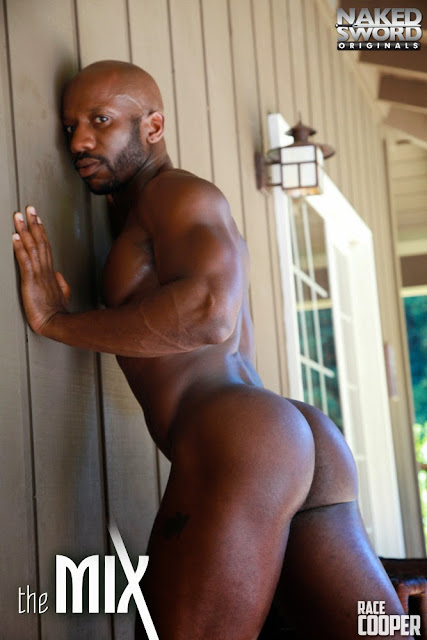
“As a Black gay man, I know and have witnessed bias, hatred and prejudice because of nakedness, race and sexual orientation. It is unfair and unjust. It is wrong. As a performer in the porn industry, I’ve never experienced criticism for being publicly or for being socially naked. But I do know of fellow nudists who are judged because of their nudity. Clothes freedom is part of who we are. Just like race and sexuality, we don’t have a choice.” ~ Race Cooper ~ The Pink News 10 June 2020
Race was interviewed by The Pink News, a SGL news service in London, England, United Kingdom on 10 June 2020 for his views on racial inequality in the bisexual or gay film profession in light of the killing of the late George Floyd in Minneapolis, Minnesota, USA and the resurgence of the Black Lives Matter movement. He also wants the porn industry to openly admit that many White men – straight – have been cast into roles catering to SGL African-American audiences instead of actual Black gay men.
As a path forward, he’d like to see studios hire “diversity mentors” to help with casting and hopefully these mentors could advance the careers of porn actorsof colour. He also advocates the ending of “gay-for-pay” and an immediate end to the shunning of HIV+ porn actors.
All of us welcome and embrace Race in full nakedness as a man of our community and culture! His attitude that true equality is a basic human right for us all is one we can all agree!

Thank you, Race, for your honesty and integrity!
Naked hugs!
Roger Poladopoulos/ReNude Pride: Guys Without Boxers!
Author’s Note: The next post entry here is planned for Friday, February 20, 2026, and the proposed topic is: “Bare + Black = Queer!”



 ReNude Pride: Guys Without Boxers!