Since 2019, bare practitioners have observed today, 14 July, annually, as Bare Practitioner’s Day! A date that is not that widely known outside of our own community and culture but an occasion that has a growing base of observers. A single day for us to all be confident and proud of we are: same gender loving (SGL) and nakedness enthusiasts! Prior to 2019, this date was promoted as Gay Nudist Day.
The Gay Nudist Day distinction was adopted in the mid-1980s as the growing number of bisexual and gay nudist social clubs sought a separate observance from the discriminating naturist/nudist society. Some of the earliest bisexual/gay nude social clubs were: Males au Naturel (MEN) of New York City, Los Angeles Nude Guys (LANG), San Francisco Kindred Nudists (SKINS), Greater Atlanta Naturist Group (GANG) and Lambda Soleil of Washington, D.C.
This year, 2025, our day happens the day after the National Skinny-Dipping Day, the official final day of National Nude Recreation Week – a valid reason for us to extend our observation for at least an extra 24 hours! As if any of us actually require a reason for body and clothes freedom!
Same gender loving!
Following SIR (Stonewall Inn riots) in 1969, bisexual and gay naked participants experienced first-hand the very deliberate and obvious discriminatory regulations and rules adopted by the existing naturist/nudist facilities and organizations to discourage our participation. We also suffered similar reaction from our GLBTQ+ culture who were seeking to distance themselves from our “depraved” lifestyle of bare as opposed to being textile (clothed).
Directions for nudity!
In a brief summary: the naturist/nudist proponents rejected our nakedness due to our acceptance of ourselves as bisexual, gay or lesbian – the despicable species now claiming equality. Their homophobia forced them to reject us.
The emerging and growing bisexual, gay and lesbian movement, already militant in addressing challenges to their very existence, truly believed that our preference for nudity damaged their image of decency and normalcy.
In reality, we were social outcasts totally rejected and marginalized. No one wanted us!
Rather accept a double negative judgment, we instead remind ourselves of our very special and unique roles in being what and who we really are! On this day, 14 July, we commemorate our dual nature through being us!
Being ourselves!
Instead of continuing having to live with the bias and segregation of the broader naturist/nudist society and the general GLBTQ+ population conveniently “setting” us aside from them, we decided to celebrate this day in our own way by choosing among ourselves to honour ourselves by just simply being ourselves. Our choice to be us!
Thus, in creating our own solution to the problem, we completely avoided the issue altogether! We reacted and responded long before the need was even recognized. Therefore, nothing ventured, progress gained! Gay Nudist Day was inaugurated! Taking responsibility for ourselves as bare practitioners was an important step forward for us as a community and culture unto ourselves!
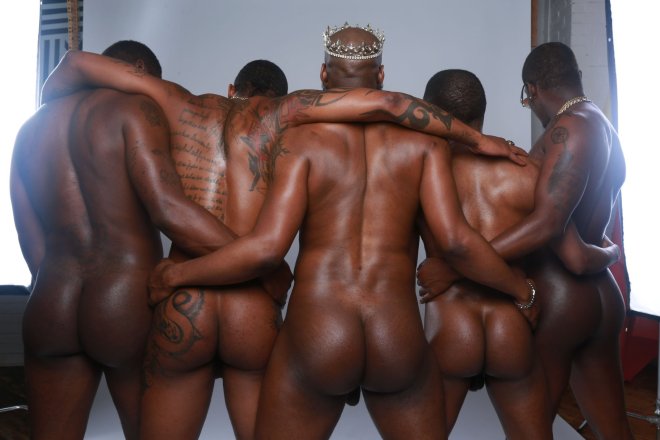
All together!
This year, observing Bare Practitioner’s Day/Gay Nudist Day, Aaron, my spouse, and I had family joining us in our home in Richmond, Virginia, for the weekend. My Twin, Alex and his partner, Dante; our first cousin, Michael and his partner, Ropati; and Aaron’s older brother Paul and his boyfriend, Sudhir. Our skinny-dipping excursion to the James River and our “unofficial” gay nude beach was a daily undertaking. We took advantage of the Bare Practitioner Day/Gay Nudist Day occasion and extended our holiday to include today and tonight.
Aaron took the day off from hospital and should the weather cooperate,another day of skinny-dipping in Alex and my “old” nudist resort (unofficial) – a public park located along the riverfront inside Richmond city. Monday evening, my bare practitioner buddy from my youth, Paul Turner and his new “significant other” are joining us for dinner and we’re watching an old movie classic from 1999 – “The Wood” – that features nothing same gender loving but it does have some naked fun! This film is a favourite of Aaron, Paul Turner, Michael and me!
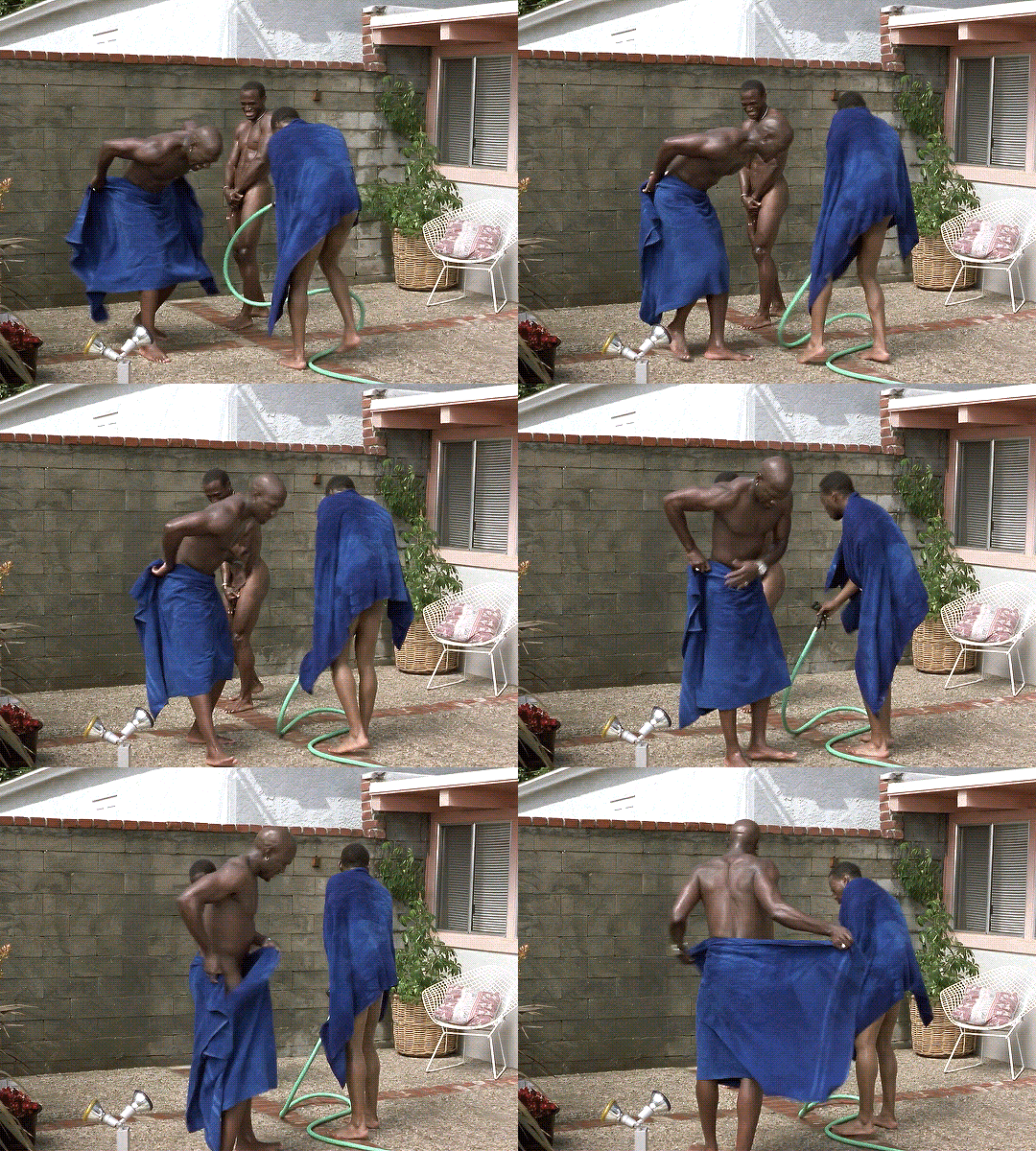
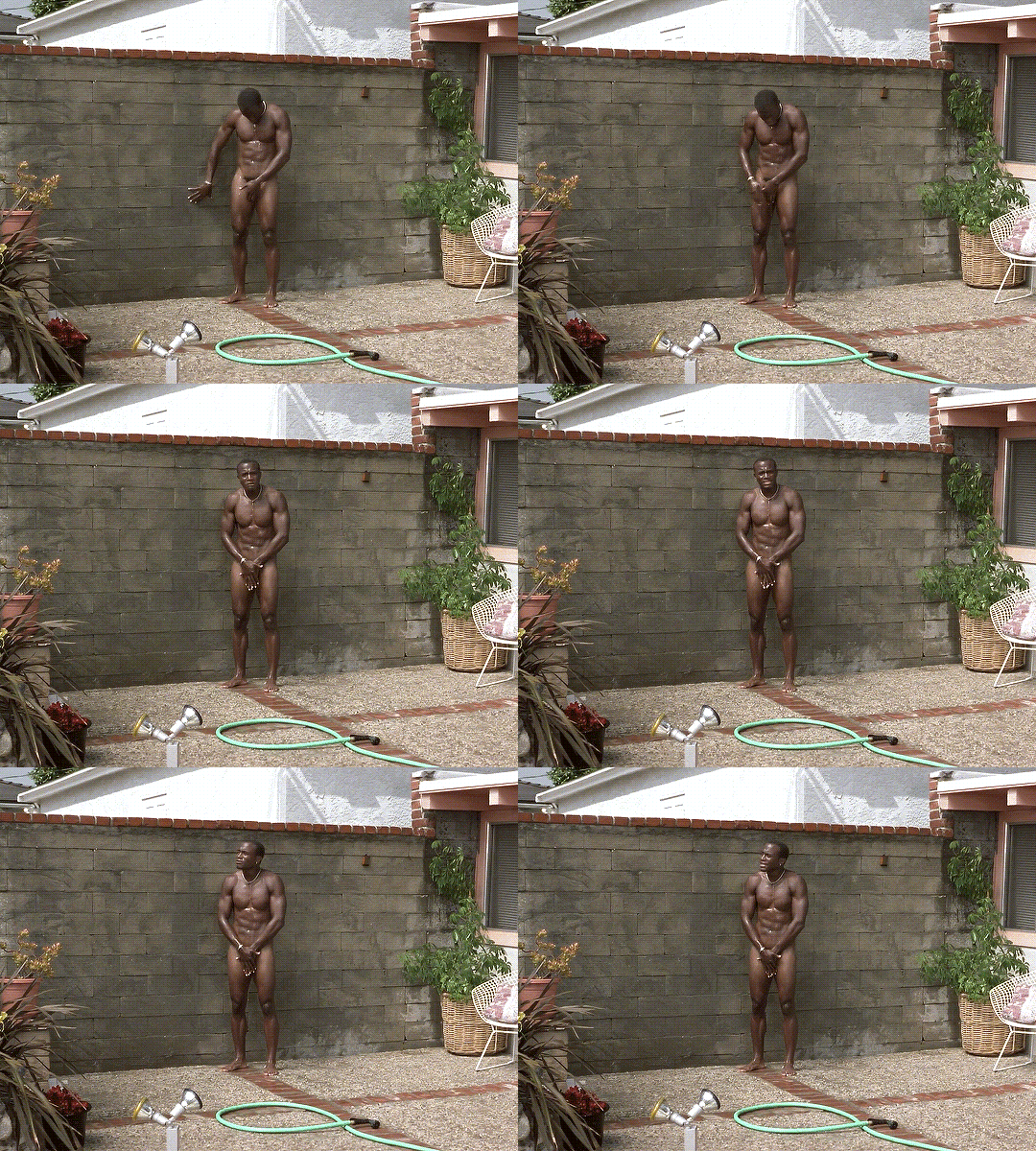
“The Wood” Taye Diggs is modestly naked!
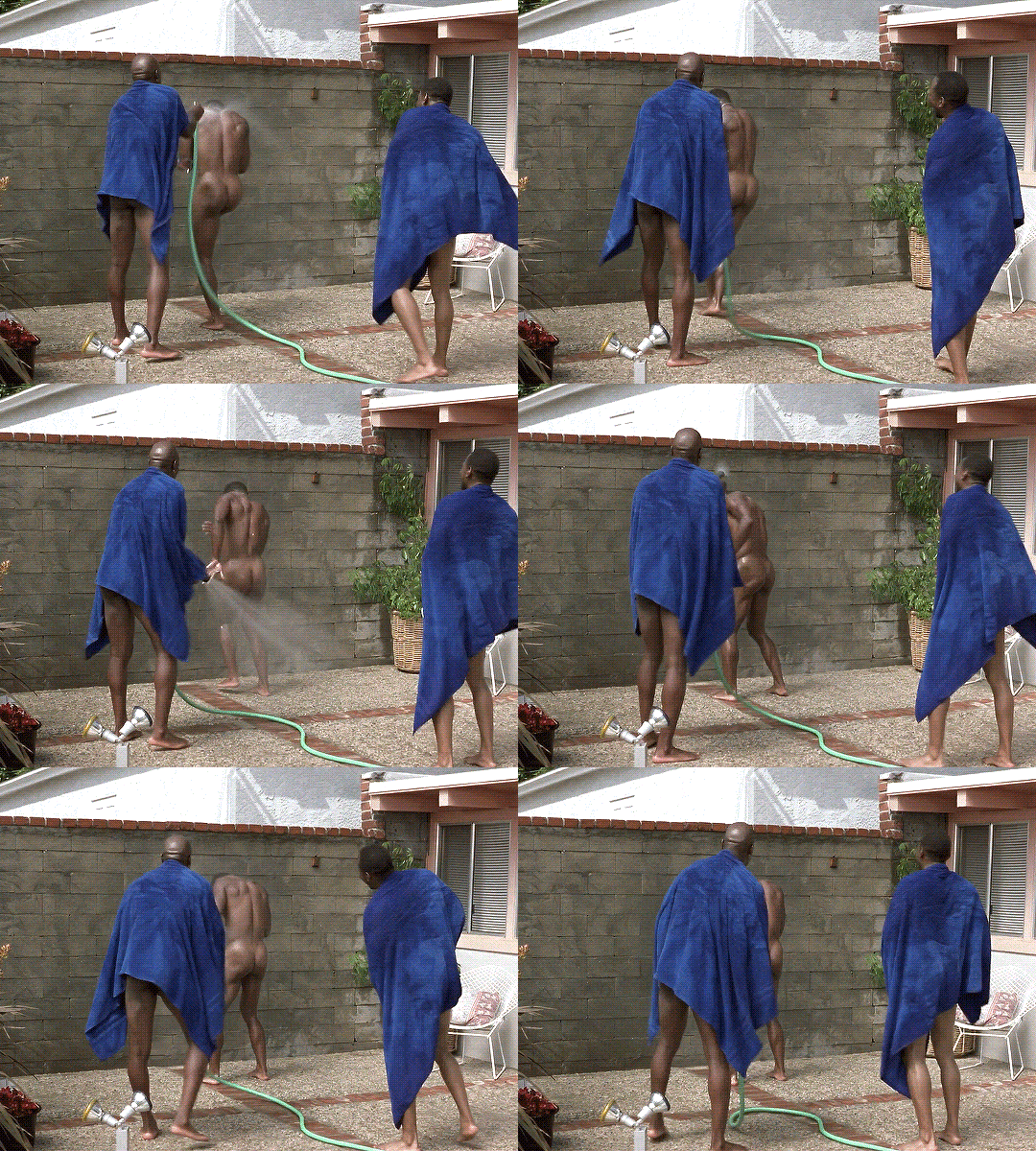
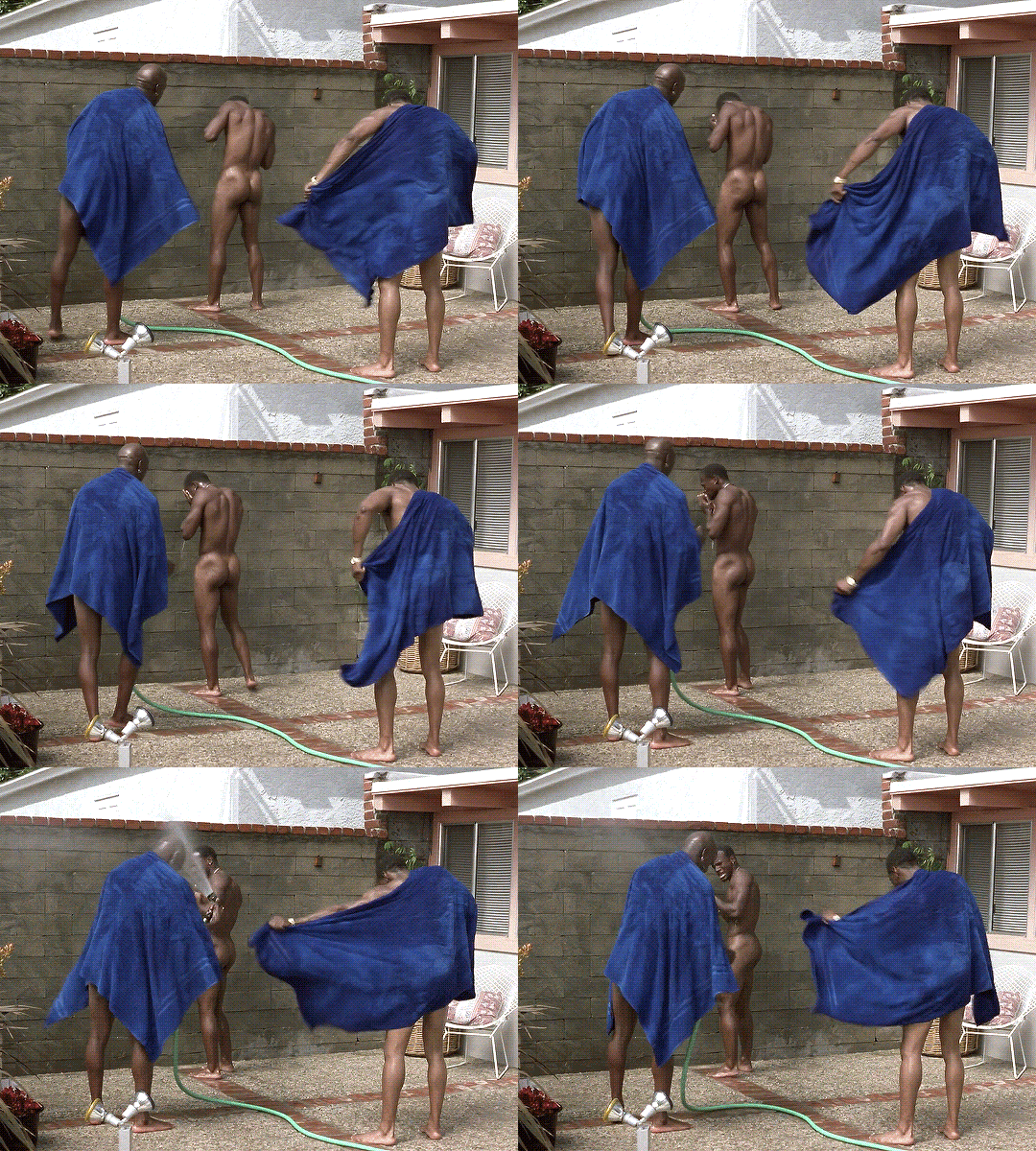
The film stars Taye Diggs who’s completely – but modest – naked in the above .gif along with his co-stars covered in only blue towels: Omar Epps and Richard T. Jones.
Although the starring trio are all (supposedly) heterosexual, their hosing antics in the clothes free scene above do cause us to wonder as to their bare practitioner status!
Taye Diggs appears to be comfortable with his nakedness!
The trio are friends from their teen years and have recently recovered Roland (Taye Diggs) from his disappearance prior to his wedding.
Hosing as punishment!
The decision to spray Roland (Taye Diggs) with a garden hose as punishment for disappearing is lost on me. It has been at least five years since I last watched the film in its entirety!
Eventually, Roland is perturbed over his outdoor “shower!”
The three naturists in the backyard scene have been best friends since growing up together in Inglewood, California – hence the movie title: “The Wood.” The comedy-drama deals with the peculiarities of young adult men and their issues.
Taye Diggs as Roland in his solo nude scene!
The irony of watching a bare heterosexual cast perform on bare practitioner’s day was duly noted by all when we came together.
Richard T. Jones gives Taye Diggs a final hose squirt!
I need to thank my friend, Paul Turner, for emailing to me the .gif clips from The Wood so that I could share them with all of you here!
Naked hugs!
Roger Poladopoulos/ReNude Pride: Guys Without Boxers!
Author’s Note: The next post entry here is planned for Friday, July 18, 2025, and the proposed topic is: “Excessive Evidence!”
The exterior view of The Stonewall Inn, Christopher Street, New York City, New York, USA, where history happened the evening of 27/28 June, 1969!
Background:
Friday, 27 June, 1969, was a very hot and humid day in New York City. Everyone was anxiously awaiting the approaching weekend and the freedom from having to struggle for relief from the oppressive weather.
At that time, the same gender loving people were known, at least in “polite” society, as “homosexuals” (a name now considered derogatory). The popular nickname was “homos.” This segment of the New York City population was not only oppressed by the weather but also by the bias, discrimination, hatred, marginalization and violence of the general population against all persons seen as homos.
There were laws prohibiting homosexuality socially on record in 49 of the fifty states of the USA. Illinois had repealed its anti-homosexuality legal restrictions in 1961. All segments of society: general, government, legal and religious were united against the “deviant” (homosexual) peoples.
It was unlawful for homosexuals to gather together in public. They were fired from their jobs for being thought of as being homosexual without any legal recourse. They were ridiculed and attacked publicly often without any consequence for those assaulting them. Simply being a homosexual was considered a criminal act.
Everyone was required, by law, to wear clothing appropriate to their birth gender. The only legal exception was for Halloween.
The Stonewall Inn:
The Stonewall Inn (it was never a hotel) opened as a bar catering to the homosexual community in 1967. Prior to that, it had been a stable (for horses), a French bakery, a tearoom and lastly a restaurant that had burned out of business. Upon renovation, it opened as a tavern (bar) on 18 March, 1967, under Mafia-affiliated management and owned by the Genovese crime family.
The establishment consisted of two main rooms, each with its own dance floor. The front room was popular with older clientele and the back room attracted the younger ones.
“The door of the Stonewall had wrought-iron bars across this little “peephole,” a little wooden thing that slid open. The man inside would look at you and, it you looked like you belonged there, he would let you in.” ~ Chris Babick ~ describing the entrance to the Stonewall Inn
*************************
Friday evening, 27 June 1969:
Most of the patrons gathered inside the Stonewall Inn were looking forward to a night of dancing with their friends, relaxing with watered-down cocktails and enjoying a summer’s Friday night in New York City in a place relatively comfortable and safe for homosexual acquaintances. They had no idea that they were about to witness an historical event that would change their lives – and the homosexual world – forever.
Both the dance floors at Stonewall Inn were full of dancing homosexual couples. It was now just after midnight and 28 June, 1969, was now in its infancy. Suddenly, the music stopped. The lights that were dimmed to enhance the atmosphere came back on in a bright glare that caught everyone by surprise. Almost simultaneously, the realization dawned on the festive crowds: New York City police were raiding the bar!
The New York City Police Department was long familiar with conducting raids on homosexual bars (both female and male). Their process for the procedure was fairly routine and standard. They recognized homosexuals as a relatively compliant and passive crowd. For this reason, only one police transport vehicle (“paddy-wagon”) and one marked police squad car were involved in the raid.
Less than a dozen officers were assigned the task of managing and segregating the clientele, confiscating all the alcohol and arresting the Stonewall Inn employees.
Patrons outside Stonewall Inn, early evening, Friday, 27 June, 1969!
Early Saturday morning, 28 June, 1969:
“The police weren’t letting us dance! If there’s one place in the world where you can dance and feel yourself fully as a person and that’s threatened with being taken away, those words are fighting words!” ~ Tommy Lanigan-Schmidt ~ Stonewall Inn patron and participant
The arrival of the police raiding force caused pandemonium to erupt inside the Stonewall Inn. Customers searched in vain for an escape route or for a place to hide. The police immediately began confiscating both liquor and beer as evidence against the establishment and segregating the bar crowd: bar employees, cross-dressers (transgender persons) and the “regular” homosexuals.
The bar employees and cross-dressers were to be arrested for their individual violating the law. The “regular” homosexuals, once they showed officers their proper identification, were to be given citations and then permitted to leave.
The year, 1969, was at the end of a decade that had witnessed massive social unrest. The African-American protests for civil rights, the birth of the feminist and women’s rights movements, the anti-Vietnam war and peace demonstrations and the equal pay marches for primarily Latino/Latina immigrant farm workers were underway during this time. The homosexuals who had participated in some of these public unrests were energized and many wondered when their time for equality would happen. Little did they, and the police raiding the Stonewall Inn, realize that moment had arrived!
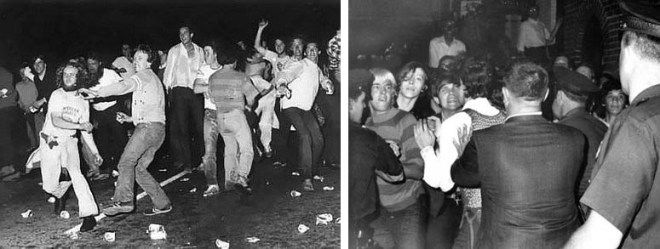
As the police began checking the identities of those inside the Stonewall Inn, those with proper credentials were released and herded outside the bar. Only this time, instead of simply leaving the premises, they congregated on the sidewalks and across the street at the Christopher Street Park. Once law enforcement attempted to disperse them, they grew confrontational and belligerent.
Unaccustomed to homosexual defiance, the police continued to press the order to vacate the area. The growing crowd, emboldened by their frustration with being treated as “deviants” and second-class citizens, began to chant and to empty nearby trash cans and hurl the garbage at the officers.
By this time, passers-by, curious as to what was happening, joined the upset homosexuals to express their dissatisfaction with the raid. The crowd outside the Stonewall Inn began to grow in both number, anger and curiosity. When word of what had transpired inside the tavern began to spread, even more homosexuals started to descend into the inn’s neighborhood and amass in the bar’s vicinity.
Angry crowd outside Stonewall Inn, early Saturday morning, 28 June 1969!
SIR: Stonewall Inn Riot commences:
By now, the police, trapped inside the facility by the large crowd outside, understood that the situation had gotten beyond their control. They tried to call for reinforcements but were unable to reach any source for assistance. They had secured the bar but were confined inside and the crowd outside was swelling in both size and fury. A few hundred bar patrons had now increased into an angry mob of several thousand and more were joining by the minute.
“You could hear screaming outside, a lot of noise from the protesters, and it was a good sound. It was a real good sound that, you know, you had a lot of people out there pulling for you.” ~ Raymond Castro ~ Stonewall Inn customer detained inside the bar under siege
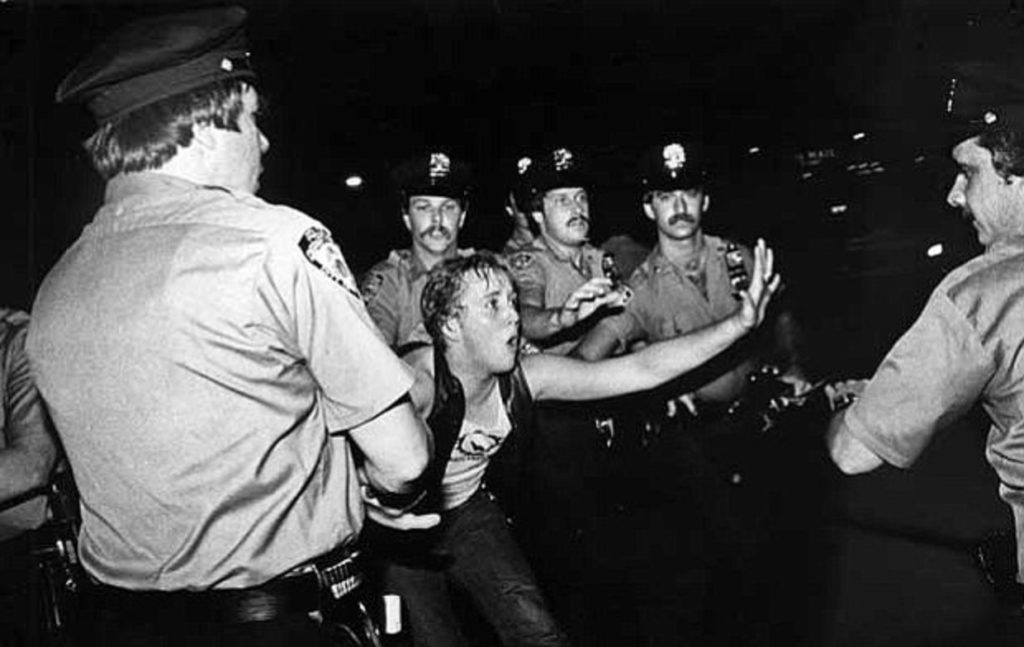
No one in the New York City Police Department had anticipated the homosexuals, always believed to be “meek and mild,” would fight back. The years of abuse, neglect, oppression, and ridicule had taken their toll, and the frustration had now become revolution; the time for retribution was at hand. Unfortunately for law enforcement, the pent-up anger toward the police was now being released and returned in kind. They were now prisoners inside the Stonewall Inn.
Two hours after the raid was initiated, the raiders and their detainees were trapped and no immediate relief was available. The two-way communication devices between the raiding party and their office weren’t working and the only public telephone inside the tavern wasn’t able to connect with any local police precincts. The “passive” homosexuals had finally achieved a “first” in their spontaneous riot: the police were contained, surrounded and they were all very nervous. By now, the mob outside the Greenwich Village bar numbered several thousand with a full-fledged riot underway.
SIR: Stonewall Inn Riot!Multiple police attack a protester early Saturday morning, 28 June, 1969!
In an effort to relieve the inflammatory predicament, the isolated police decided to send the detainees and half the officers trapped inside the tavern, using the two police vehicles on site, to the closest local precinct. There, the detainees would be formally charged with arrest, and the officers could make arrangements for a police riot force to assemble and rescue the remaining law enforcement personnel. This relief effort finally returned to the bar and eventually dispersed the angry mob of homosexuals and curious onlookers several hours later.
Saturday evening, 28 June, 1969:
Despite damage to the Stonewall Inn, the bar opened for business (dancing and socializing) the following night, Saturday, 28 June. by then, word of the disturbance the previous evening had spread throughout the city’s largely closeted (anonymous) homosexual community (primarily by word of mouth). The city officials and law enforcement superior officers were hesitant to release information that would encourage more aggressive reaction.
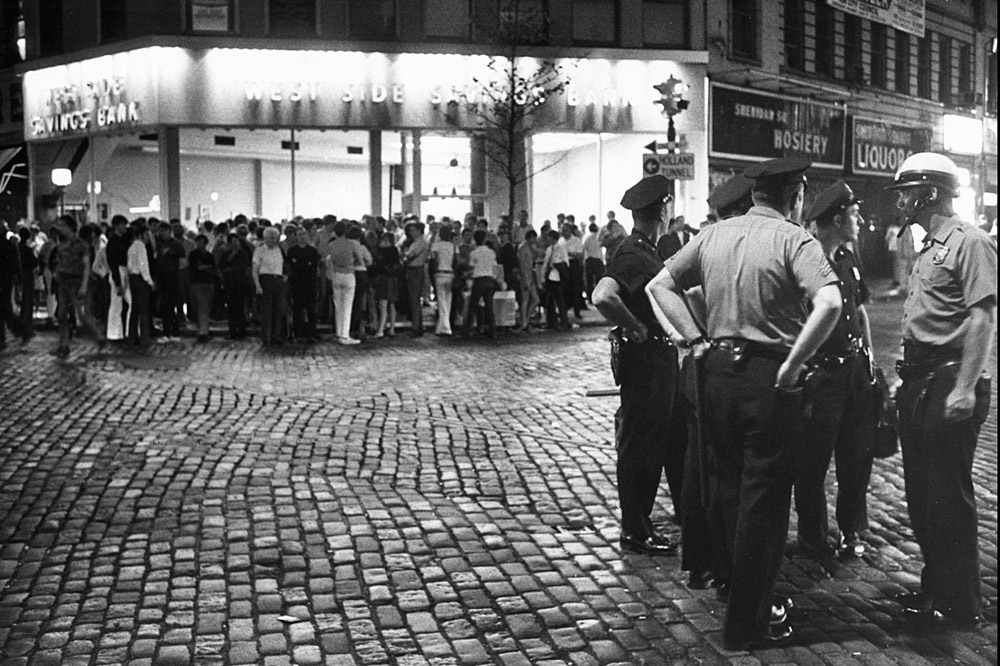
A larger than usual crowd gathered both inside and outside the Greenwich Village establishment. Most didn’t expect a repeat raid of the night before and a significant number of those in attendance mainly wanted to inspect the damage. The police, however, had different ideas. They were strictly outside the facility in full force with a large number in riot gear. They had learned their lesson and were determined to remain in complete control should the patrons become unruly again.
The homosexuals and the neighbourhood residents had been empowered by the riot the night before and of the mindset not to bullied into submission again. As the large police presence attempted to disperse those gathered outside the Stonewall Inn, they were confronted by verbal insults and an array of street-savvy tactics that set law enforcement chase off onlookers, only to have them run around the city block and return again.
Silent obedience to uniformed policemen was no longer a fact of life for New York City’s homosexuals. They were tired of suffering abuse, disrespect, ridicule and treatment as second-class citizens.
A crowd lining the sidewalk on the Stonewall Inn city block watched by police, Saturday evening, 28 June, 1969!
The second night of the Stonewall Inn congregation wasn’t as aggressively disruptive as the previous night. No further damage was done to the tavern facility. However, an awakening consciousness was raised within the municipal homosexual community that would change the way society viewed them and – most importantly – the way they perceived themselves.
For the first time, the often assumed obedient and passive homosexuals joined together and defended their rights and demonstrated that they, as a community, had finally and long last, “had enough!”
“There was no gay pride before Stonewall. Only gay fear and gay isolation and gay distrust and gay self-hatred.” ~ Edmond White ~ American gay novelist and Stonewall witness
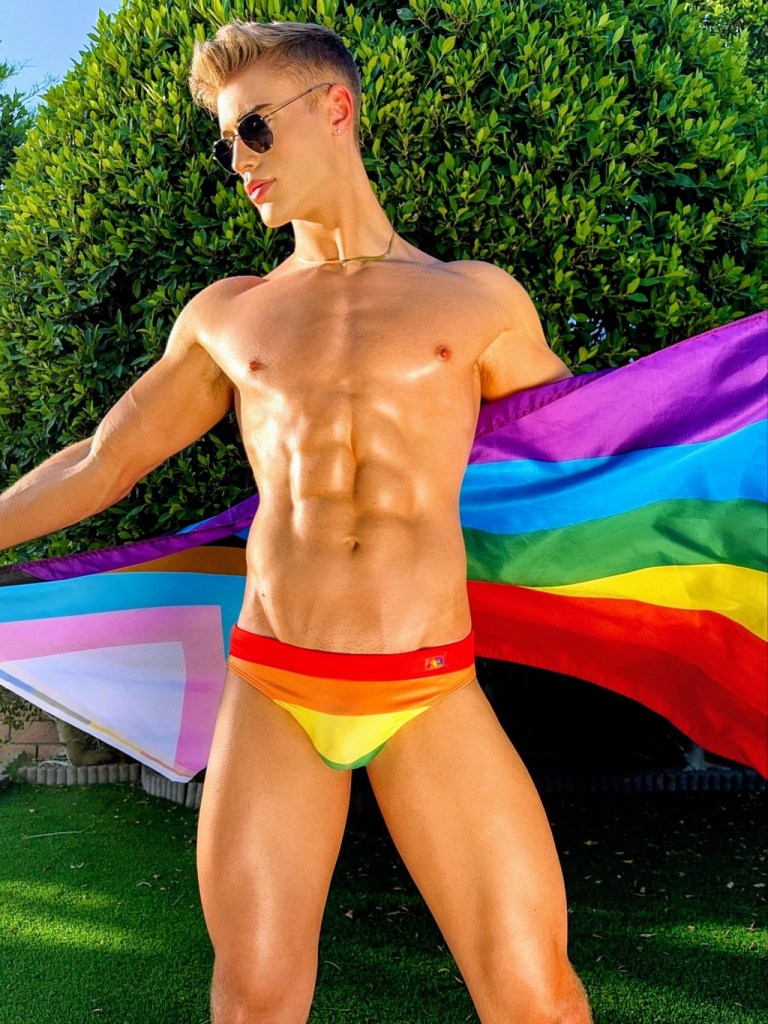
Our GLBTQ+ Progress Pride flag!
Footnote: This posting entry was from a research paper that I composed for class distribution that I taught at my university, 2015 – 2018.
Sources:
Bausman, Ann “Stonewall: Breaking Out for Gay Rights”
Doberman, Martin F. “Stonewall: A History”
Naked hugs!
Roger Peterson-Poladopoulos/ReNude Pride: Guys Without Boxers!
Author’s Note: The next post entry here is planned for Monday, June 30, 2025, and the proposed topic is: “Bottoms-Up! June, 2025!
As we are, this week, approaching the actual dates of the Stonewall Inn riots of 1969, my spouse, Aaron, and I agreed that a look at the historic site of SIR (Stonewall Inn riots) that ignited our movement for equality and justice was appropriate and fitting. A sense of irony that the dates of 2025 coincide in reality with the corresponding days and dates of SIR in 1969!
The purpose of this posting entry today is to offer a visual image of the facilities that played an important role in the SIR event, 1969. It may serve as a reference for those traveling to New York City in the future. A scene from our shared past as it appears today: a glimpse of our history. One that was ignored and overlooked for decades!
The Stonewall Inn, June, 2016!
The image above is of The Stonewall Inn as it was decorated for Pride Month, 2016. The facility was renovated, both externally and internally, in 2007. The Stonewall Inn and surrounding area was designated as a national monument by then-President Barack Hussein Obama on 24 June, 2016. It was the first such designation associated with the GLBTQ+ community and culture.
Footnote #1:The current gay, lesbian, bisexual, transgender, queer+ (GLBTQ+) flag was not created nor adopted until June, 2018. The above flag was displayed in honour of then-President Obama’s signing of the Stonewall Inn National Monument status two years earlier.
The Stonewall National Monument is the very first site in the USA exclusively dedicated to the commemoration of anything specifically related to the GLBTQ+ community and culture. The fact that the site underscores the beginning of the struggle for the equality, freedom and justice of that particular community and culture keeps it within the supposed national tradition of all persons being equal under the guise of this country, this government and the law.
Footnote #2: On 13 February, 2025, the National Park Service eliminated all references to transgender persons from the Stonewall National Monument facilities and website. This action was taken so public park facilities would comply with the felon-in-chief executive order denying the history of the Stonewall Inn riots. What was originally promoted as GLBTQ+ is now simply GLB (gay, lesbian, bisexual).
Inresponse, the Stonewall Gives Back Initiative and The Stonewall Inn replied with an appropriate, mature and respectful statement immediately following the issuance of Executive Order #14168:
“This blatant act of erasure not only distorts the truth of our history, but it also dishonors the immense contributions of transgender individuals – especially transgender women of color – who were at the forefront of the Stonewall Riots and the broader fight for GLBTQ+ rights.”
The Stonewall National Monument!
The Monument Property:
The monument includes and surrounds Christopher Park (formerly known as the Christopher Street Park) that was originally owned by the New Netherlands Director-General, Wouter van Twiller, as a tobacco farm from 1633 until his death in 1638. When he died, the property was divided into smaller farms.
European immigration to New York City (following the Netherlands ceding the New Netherlands colony to the British) magnified and streets and neighborhoods developed. In 1835, the Great Fire of New York City burned the area known as Greenwich Village. The new Christopher Street Park opened in 1837 on the land of the old tobacco farm. The Stonewall Inn, which consisted of two adjacent stables, was built across the street from the park in 1843.
Entrance to Christopher Park, Stonewall National Monument!
The Stonewall National Monument is located in the West Village neighbourhood of Greenwich Village in lower Manhattan, New York City. The site includes the actual Stonewall Inn, Christopher Street and Christopher Park (formerly known as the Christopher Street Park).
Then U. S. President, Mr. Barack Obama
“But the arc of history is clear – it’s an arc of progress. And a lot of that progress can be traced back to Stonewall. So, this week, I’m designating the Stonewall National Monument as the newest addition to America’s national park system. Stonewall will be our first national monument to tell the story of GLBT rights.” ~ President Barack Obama ~ Weekly Address, The White House 25 June 2016
Stonewall National Monument, Christopher Park statues!
Naked hugs!
Roger Poladopoulos/ReNude Pride: Guys Without Boxers!
Author’s Note: The next post entry here is planned for Thursday, June 26, 2025, and the proposed topic is: “HIV Testing Day!”
The proper name of this date is Juneteenth National Independence Day. It is the most recent federal (national) holiday in the USA, first enacted by then-President Joseph Biden in 2021. It is an annual celebration observed on 19 June (exempt from the Monday holiday policy) to commemorate the formal and official emancipation (freedom) from slavery of the African-American and Indigenous Peoples (Native Americans) in the USA.
The name of this occasion is a combination of the words “June” and “nineteenth” (in the vernacular of the populations freed) because on this exact date, 19 June 1865, Major General Gordon Granger ordered the official enforcement of the declaration of the Emancipation Proclamation of the late President Lincoln. This enactment occurred throughout the entire state of Texas at the end of the U.S. Civil War.
Introduction:
The initial celebrations of this happening began as early as 1866 throughout the state known as Texas. Initially, because of the shortages and financial burdens of the civil war and the Union occupation, the events were in the format of local church sponsored community gatherings often featuring a large communal meal with each family/household contributing a special food. Observances soon spread beyond the borders of Texas and into surrounding former slave-owning states, still limited to the liberated enslaved peoples.
Once the Reconstruction (military occupation and administration of the South by the Union army) Period ended, a period known as “Jim Crow” government (racial oppression and legal segregation) ensued throughout the former Confederacy. During this time, the continued unofficial celebrations of the Juneteenth date were held under the auspices of local churches but gradually expanded from food festivals to include music and dancing.
Juneteenth Expansion:
The exceptionally large number of former slaves and their families continued to live in the South due to limited financial resources and travel availability. The U.S. involvement in The Great War (World War I) in 1917 allowed Blacks a chance to improve their economic circumstances by fighting in France. Following the war ending in 1918, The Great Migration happened with hundreds of thousands of African-Americans moving from the rural Southern sharecropping to Nothern and Western industrial factories and a regular paycheck.
This reality opened the doors to introduction and expansion of Juneteenth festivities to local church communities in both northern and western areas of the U.S. The growth increased awareness of and observances of the occasion and its importance to this particular population. Gradually, among churches, statewide and soon national recognition of this event followed.
The success of the civil rights struggle and the repeal of systemic segregation policies in the 1970s and 1980s, a movement emerged urging support of a Juneteenth official observance. This culminated finally in then President Biden signing into law the Juneteenth National Independence Day Act in 2021.
Togetherness!
Juneteenth Myth:
A popular myth/rumor surrounding the earlier observances of the Juneteenth event was the fact that Confederate General Robert E. Lee surrendered his Army of Northern Virginia to Union General Ulysses Grant on 9 April, 1865, in the town of Appomattox, Virginia, many hundreds of miles from Texas.
The Southern plantation/slave owners were extremely reluctant to inform their enslaved “property” that they were now free. The myth evolved that the news of the emancipated slaves receiving liberation was only orally repeated from plantation-to-plantation. The Texans were the last to learn of their terminated bondage on 19 June, 1865. Hence the Juneteenth designation.
This word-of-mouth only conveying of the news of freedom from slavery was how many justified the delay in the information of Lee’s surrender to Grant two months earlier.
A Closer Look:
Given the speed of internet, social media and technological marvels, it is almost impossible to comprehend the validity of the myths/rumours of delayed news transmission concerning freedom. However, with the timeline and the reality that the exclusive Southern “upper class” was totally Caucasian, slave-owning and severely financially impacted by the defeat of the rebellious Confederacy, there’s a possibility of some vague truth here.
In addition, the wealth of plantation owners and the upper level of Southern society was frequently based on and measured by the values of those held in servitude. The eradication of slavery as a legality would and did bankrupt an empowered class of that society. Combined with the conclusion of a five-year-long devastating Civil War in which an overwhelming number of battles – and destruction – occurred in the strictly segregated South, this provided circumstances that could lead to some verification of the unsubstantiated Juneteenth myth.
The Unanswered Question:
Why did it take 156 years to designate a holiday to commemorate a major event in this nation’s history? A country that was built for democracy and freedom.
Happy Juneteenth holiday and naked hugs to all!
Roger Poladopoulos/ReNude Pride: Guys Without Boxers!
Author’s Note: The next post entry here is planned for Saturday, June 21, 2025, and the proposed topic is: “Summer, 2025!”
24 April, annually, is the Armenian Genocide Remembrance Day
This date is recognized as the first modern genocide of the 20th Century.
Genocide is the crime of intentionally destroying part or all of a national, ethnic, racial or religious group by killing people. It is understood by most people to be the gravest crime against humanity.
Prologue:
The presence of the Armenian peoples in Anatolia, the region in modern Turkey that borders Iran and the Caucus) has been documented since the sixth century BCE – about 1,500years prior to the arrival of the Turkmens (first Turkish immigrants) under the Seljuk dynasty. The independent Kingdom of Armenia adopted Christianity as its national religion early in the fourth century CE.
The Genocide:
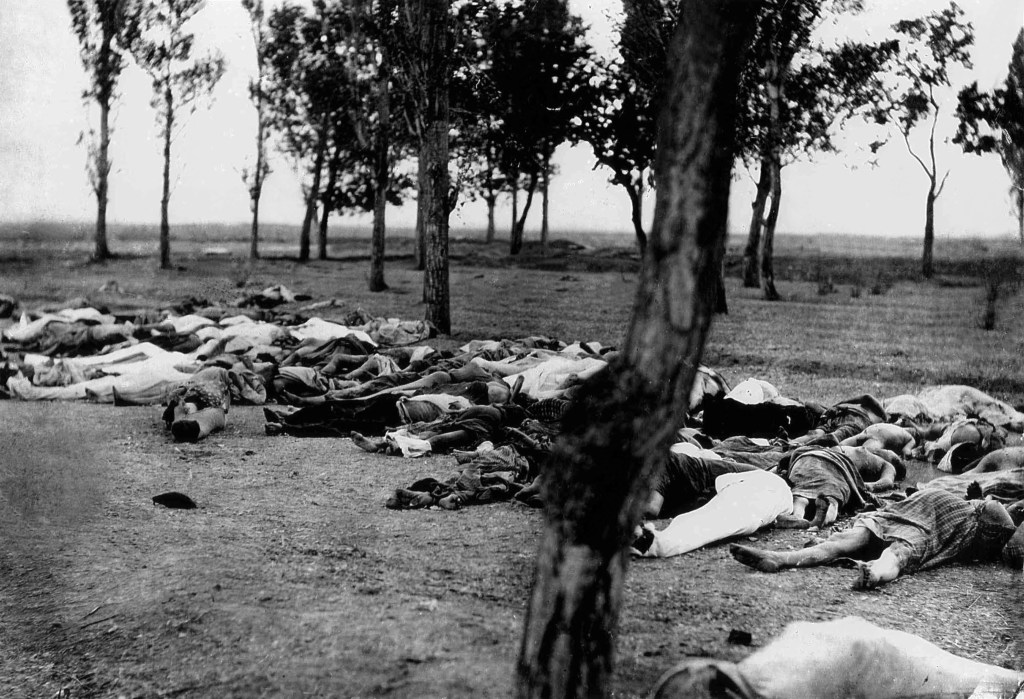
Photograph by U.S. Ambassador Morganthau of Armenian corpses left roadside.
Before the Great War (World War I; 1914 – 1918), there were limited exterminations of Armenian inhabitants of Turkey during the 1890s and in 1909. During World War I, The Ottoman Empire (Turkey) allied itself with Austria-Hungary, Bulgaria and Germany. This led to the power transfer to the Committee of Union and Progress (CUP) by the civilian authorities.
On 24 April, 1915, the CUP ordered the deportation and expulsion of Armenian residents in the Ottoman capital, Constantinople. Soon, this order was extended throughout all the Ottoman Empire and massive crowds were forced to march into the Syrian Desert, without food and water. They were raped, robbed and brutally beaten.
Soon, the extermination of the Armenian residents throughout the Ottoman Empire was endorsed and enforced. The massive deportations and deaths became real and prevalent. The involvement in the Great War and the political instability which followed prevented the Western powers from monitoring the conditions within the former Ottoman state.
The overthrow of the monarchy and the division of the lands formerly occupied by the CUP allowed atrocities against the Armenians and other religious minorities until almost midway through the 1920s. By that time, an estimated 1.6 million Armenians had been exterminated. The emerging Turkish country had reduced the population of Armenians from almost 2.5 million to less than 400,000.
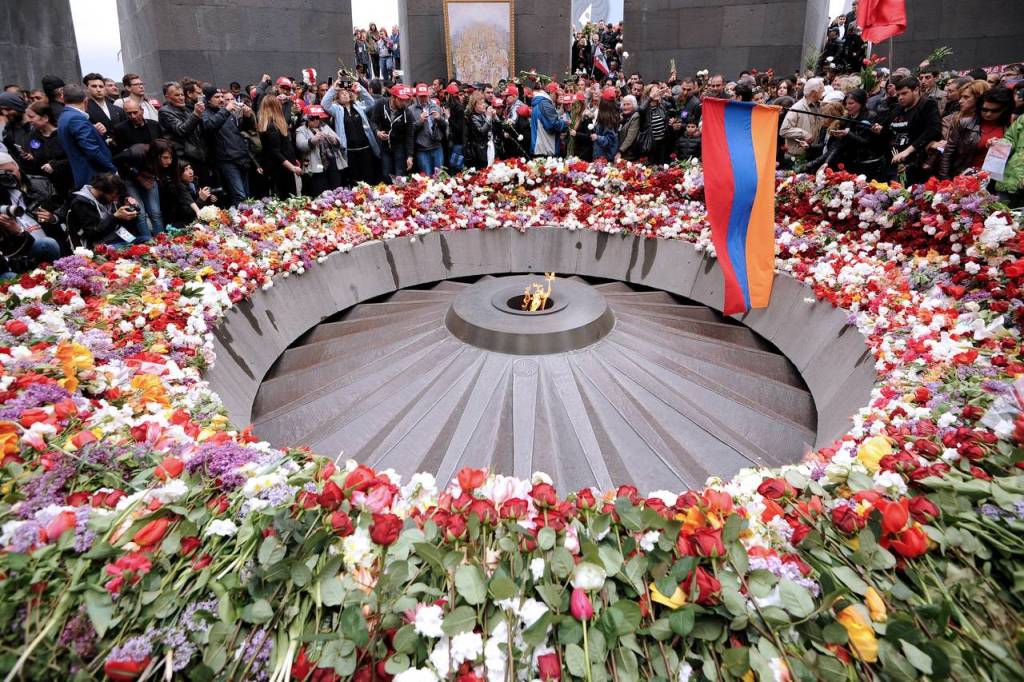
The Genocide Memorial, Yerevan, capital city of Armenia
Tsitsernakaberd: Armenian Genocide Memorial
The Genocide Memorial was built in 1967 on the hill of Tsitsernakaberd, just outside the capital city of Yerevan, Armenia. The Genocide Memorial Museum-Institute was added later and officially opened in 1995.
Every year, on 24 April, the complex hosts the national Remembrance Day Ceremony, where hundreds of thousands line for hours to place floral and prayer tributes to the victims.
Remembering those murdered.
A profile of prayer
Personal Connection:
My maternal grandfather was half-Armenian. His mother was a resident of the Ottoman Empire. He remembered the Turkish soldiers congregating the Armenian population – including all of his family – inside their village church prior to setting the entire structure on fire. He and several friends were being absent from school that day and they climbed trees when they witnessed the soldiers assaulting the village.
A Turkish family helped them escape to safety.
My mother doesn’t remember his discussing the incident when she and her siblings were growing up. It was only when his grandchildren were born that he felt the need to share his past.
Naked hugs!
Roger Poladopoulos/ReNude Pride: Guys Without Boxers!
Author’s Note: The next post entry here is planned for Monday, April 28, 2025, and the proposed topic is: “Charge!”
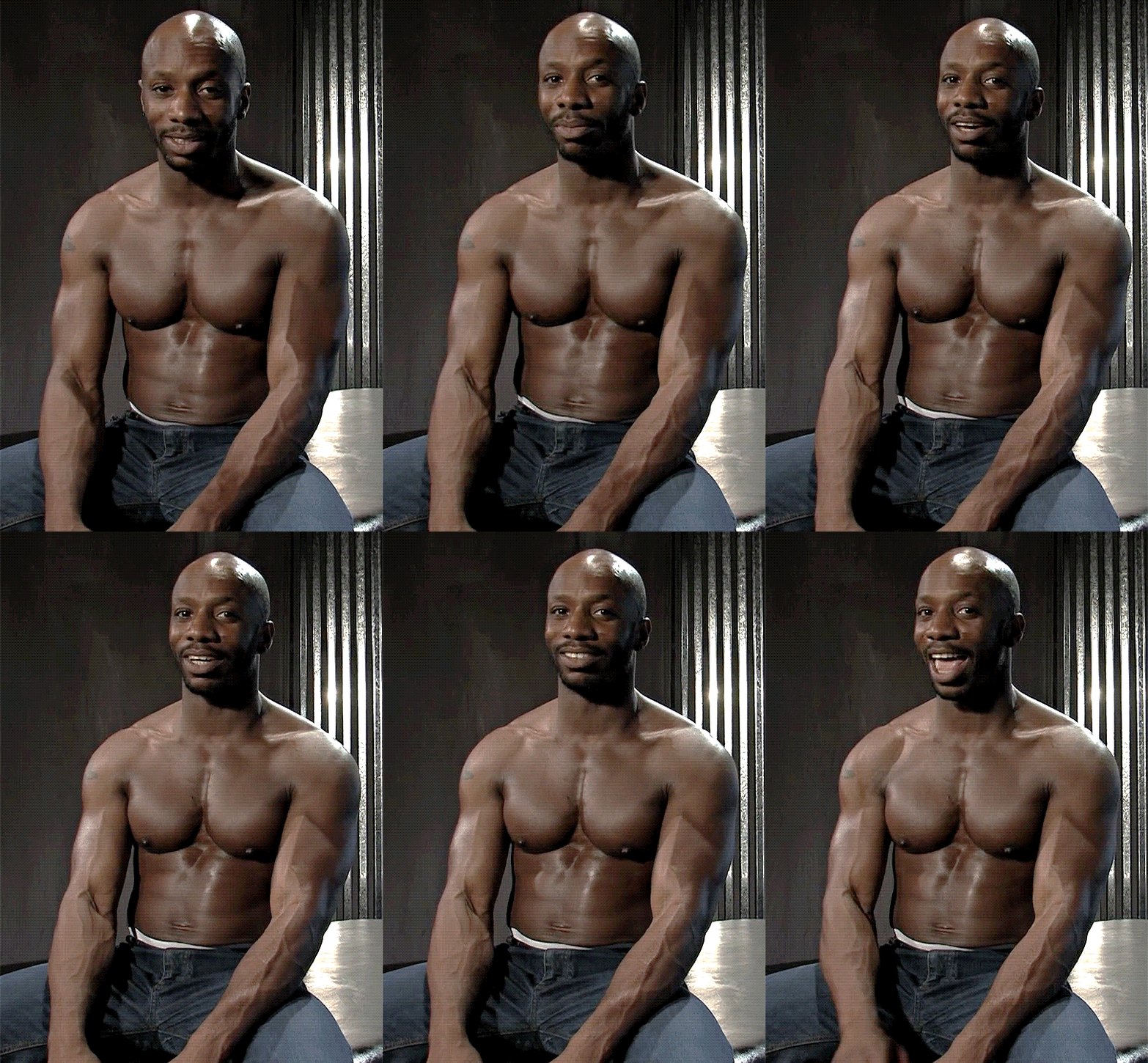
In an examination and exploration on the policies and practices of race and racism in the United States gay porn industry, The Pink News, a GLBTQ+ news service in the United Kingdom and Commonwealth, interviewed Race Cooper, a Canadian subject of Her Late Majesty, Queen Elizabeth II. Race had worked several jobs at a gay porn studio, the last being as an actor which he retired from in 2014. In the interview, Mr. Cooper could not appear naked. He opted for appearing shirtless, as close to being nude as possible!
Theinterview was exceedingly popular. Curiosity concerning USA racism in the gay pornography business generated a sizeable audience! Race’s interview was informative and insightful!
While he was acting in films, Race Cooper posted online at Blogger.com. I honestly am unable to remember the exact title of the blog. I discovered the site shortly after he made his film debut in 2009. His blog became a personal favourite of mine and many other followers. Race had the distinct habit of keeping no secrets from his fans and followers, consistently posting of his experiences with his fellow actors, both flattering and…real!
His descriptions and observations of their intimate abilities and their anatomical attributes made his blog a success for multitudes and a regular “must read” for not only his fans but his peers in the film industry as well!
Race was often reprimanded by studio executive for his blog as being “too revealing!” A typical Race answer: “Yes! I reveal! You pay me to be naked! You expect me to reveal! That’s why I sell movies. People by the porn to watch me reveal!”
Race: animated interview subject!
Race’s writing skills hastened to dispel the stereotype of the gay porn actor as all effeminate, egotistical, “flakey” and self-obsessed. He wasted no time denying his preference for the “bottom” role and he openly and rigorously advocated for equality for Black gay performers in pay, ratings and in roles offered!
Background:
The topic of “race” extends beyond the limited concepts of just Black people and White people. It includes all of us, no matter our skin tone, ethnicity or racial heritage. Race, unfortunately, is also aligned with community, culture, politics, religion and value systems, and beyond!
Regrettably, racism (discrimination and/or hatred) is often a “learned” (taught) behaviour – usually passed down from one generation to the next – without any basis of proof or scientific fact. Unchallenged, it is frequently misunderstood as the “norm” – the routine standard.
ReNude Pride published a post entry here, Race On Race, two years ago on 6 March, 2023. Click the title to link. My spouse, Aaron, and I both offer this expanded version of that posting in the hope of overcoming our need to be reminded of the importance of this reality into our lives. For this reason, ReNude Pride does not restrict the issue or topic of race exclusively to the period of Black History Month.
Race Cooper, casual!
Introduction:
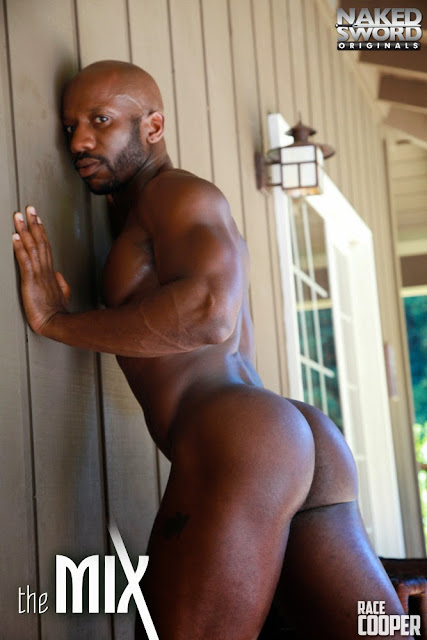
“Race Cooper” is the stage name – performance name – (pseudonym) of Joseph Ross Anderson, a talented and thoughtful star of same gender loving (SGL) – bisexual or gay – pornography and outspoken advocate for bare (naked/nudist) rights, sexuality rights and racial equality. He was born in Toronto, Ontario, Canada, on 5 December, 1973.
Amazing, he didn’t begin his film career (porn) until 2009 – he was 36 years old! An age when many openly gay porn actors are considering retiring from performing live! In the same year that he launched his film performing, he began blogging on blogger.com about his newfound job as appearing in gay porn and his encounters with his fellow performers. He very quickly acquired notoriety as “a-man-who-tells-it-all!”
He also became a very spirited advocate for the expansion of the gay sexual identities to encourage the acceptance of versatility (both alpha and beta) as an option. This was especially relevant as actors were often limited in the roles they were offered professionally because of sexual labelling.
Additional realities of Race Cooper are summarized below:
Race gives a fellow a kiss!
Race Cooper
Birthname: Joseph Ross Anderson
Birthdate: 5 December, 1973
Birthplace: Toronto, Ontario, Canada
Height: 6 ‘ (183 cm)
Weight: 180 lbs (82 kg)
Hair: Head: shaved
Body: armpit, pubic, natural
Sexuality: Gay
Sexual position: Versatile (preference: beta)
Clothing status: Bare
Porn acting career: 2009 – 2014
“I’m an African-Canadian. Growing up in Toronto, I got to see how lots of White Americans reacted to Black people. Working in gay pornography in the USA, I personally saw how Black men were treated by White men with no difference between gay or straight.” ~ Race Cooper ~ Pink News Interview
Race Cooper, based on his personal experience in the SGL pornography industry, views racism as “a daily constant in the USA.” He initially began working as a casting director for the exclusively SGL studio – Raging Stallion – before he moved to performing in front of the camera lens. He readily acknowledges that he was paid considerably less than his White peers and regularly and repeatedly had his work ethic and intelligence questioned by executives – all White. He honestly believes that he was only hired initially in order for the studio to appear “less racist.”
Race: film star!
“Homophobia and racism in the USA is the reasoning for discrimination and prejudice. It is part of the legacy of slavery. In Canada, race is just a difference. You shave your pubic hair, I let mine grow naturally. We’re both gay men, we’re just different in some ways.” ~ Race Cooper ~ The Pink News
Author’s Notation: Another aspect that both my spouse, Aaron, and I have in common with today’s interview subject, the talented Race Cooper is our appreciation of body hair, abundant (profuse) or sparse. In the above quote, Race references his keeping his pubic hair natural. Gay men have the option to either remove retain their body hair. It is their decision. We just prefer to let it all grow!
Canada had slavery in the 1600s only. It was never a permanent institution like in the USA. As a slave, you were bought, you worked a couple of years, earned your freedom, and then you moved on. Like an indentured servant. Enslavement was never a source of distrust and hatred. You worked, earned freedom, and then became a neighbor – equal – not inferior or subservient.
“As a Black gay man, I know and have witnessed bias, hatred, and prejudice because of nudity, race and sexual orientation. It is unfair and unjust. It is wrong. As a performer in the gay porn industry, I’ve never experienced criticism for being publicly or for being socially naked. But I do know of fellow nudists who are judged because of their nudity. Clothes freedom is part of who we are. Just like race and sexuality, we don’t have a choice.” ~ Race Cooper ~ The Pink News Interview
The interview with The Pink News Service was conducted as part of an investigation on racial inequality in the USA gay porn industry in conjunction with the killing of the late George Floyd in Minneapolis, Minnesota, USA and the resurgence of the Black Lives Matter movement. Although a Canadian subject, his years involved in the gay porn career and living in San Francisco, California, USA, provided Race with both foresight and history.
He also wants the gay porn industry to openly admit that many White men – straight (heterosexual) – have been cast into roles designed for SGL African-American men with no regard as to the impact on gay Black actors.
Race on race!
As a path forward, Race advocates the studios hire “diversity mentors” to help with casting concerns and issues as well as advance the careers of porn actors of colour. He also pursues for the ending of the “gay-for-pay” policy of movie studios and for the immediate cessation of the policy that allows studios to terminate the careers of HIV+ actors.
In the conclusion of his interview with The Pink News, Race offered – in my own humble opinion – his most daring and profound argument against bigotry, discrimination and judgment based not only just upon race but sexuality and nudity as well. This statement was made on his own initiative and observation and not in response to a specific question.
“I’ve made numerous naked appearances at gay studio event socials. The newcomers to our profession are often intimidated by us who’ve been around. Usually, fellow Black actors are gathered, made to strip out of their apparel and to parade through the White guests who are fully or partially clothed only to be ridiculed, teased and tormented and not allowed to get dressed until the social is done.” ~ Race Cooper ~ The Pink News Interview
Race Cooper: contemplating!
Joseph Ross Anderson (a.k.a. Race Cooper) has undeniable and unique experiences that qualify his assessments and observations on the existence of racial practices and stereotyping within the gay pornography profession. It is important to note that these judgmental instances are not restricted solely to the gay porn business. They occur frequently and regularly throughout the USA in both personal and professional circumstances.
His perspectives on the effects of racism are determined not only from personal experience but also from shared observations with not only African-Americans but other Black Canadians. These reflect learned behaviours that are repeated, without thought, endlessly with little or no consequence. The sad reality is that these occasions of discrimination and marginalization happen not only against Black people but against others of a differing heritage than White Americans.
Will the effects and energies of Race Cooper have any impact on the tolerance of racism in the growing gay porn industry? One positive result is that the actions are now bringing closer media attention to the matter. That publicity is not going to disappear or evaporate overnight. Studio executives and their investors are “less” than pleased when revenue is affected and negative focus is generated.
The levels of consciousness raised when issues of racial impropriety are addressed benefit not only African-American performers but also others of varying racial, ethnic and social abilities. The fact that inequality was applicable in one instance justifies the question: “How many more suffered the same?”
Not a consideration studio executives want pursued!
Naked hugs!
Roger Poladopoulos/ReNude Pride
Author’s Note: The next post entry here is planned for Monday, February 24, 2025, and the proposed topic is: “Stories!”
As we entered into the 21st century, alarming, distressing, and potentially fatal statistics continued to confront us all as the HIV/AIDS epidemic grew in both intensity and number globally. Here in the USA, African-Americans constituted slightly over 14% of the total population, yet they represented almost 50% of all categories in HIV/AIDS-related statistics reported by the US Centers for Disease Control and Prevention (CDC). The disproportionate impact indicated an approaching catastrophic outcome.
The first two decades of the HIV/AIDS crisis, in addition to the ignorance and neglect of then-president, Ronald Reagan, was likewise ignored and condemned by African-Americans as well. The blame and cause of the disease was the “white homosexuals and their sinful ways!” At long last, Black Americans were able to point their fingers at the White community and condemn them for “inventing” a disease that was fatal.
By this time, it was evident to all – health professionals, legislators and in particular, the American public – that more decisive, effective and resourceful actions and measures were needed to combat the alarming rates of infection with HIV/AIDS.
In 1999, concerns and fear over the effects of the disease on the Black American population led the CDC, the US Public Health Service, executive representatives of nationwide organizations serving African-Americans and communities of faith met to address issues with the rising infection conditions. One of the results of these meetings was the decision to observe February 7, annually, as National Black HIV/AIDS Awareness Day (NBHAAD).
With excitement, athletic and celebrity endorsements, fanfare and media attention, the very first NBHAAD was held from coast-to-coast on February 7, 2000.
Subtle manner!
HIV Infection:
The human immunodeficiency virus (HIV), the virus that causes AIDS, is transmitted (spread) from one person to another through contact with one or more of four (4) human body fluids. These four fluids are: blood, semen, vaginal fluid breast milk. Other body fluids such as tears, saliva, mucus (congestion), urine do not spread HIV. Remember the four: blood, semen, vaginal fluid, breast milk. Avoid all contact with those four body fluids.
Any contact with one or more of these body fluids contact your local health department immediately for treatment! The earlier treatment begins, the greater chances are for success.
Latex, a synthetic material, has been proven repeatedly to significantly reduce (lower) the risk of HIV infection. Latex is used to make condoms and gloves because it prevents the exchange of bodily fluids. The latex product must be intact – no puncture or tear. Dispose (throw away) latex products in a marked biohazard container.
The important message!
Testing:
A simple blood test can determine if a person is infected with HIV (the virus that causes AIDS). Persons are encouraged to get tested for HIV regularly. In the USA, test results are supposed to be confidential (private) even though the data is reported to the health department for statistical purposes.
When test results are given, information is also provided on services available and possible treatment options. Counseling is also offered.
Major challenge:
Despite all of the advances in HIV testing, counseling treatment options and massive HIV/AIDS public education/treatment efforts, it remains estimated that almost 25% (one quarter) of persons who are infected with HIV (HIV+) are honestly unaware of their personal HIV status. They have not been tested. This factor represents not only a failure of education and outreach efforts nationwide, but also the serious potential for a major health crisis. Get tested! Know your status!
Knowledge is power!
Key components:
NBHAAD guidelines mandate four (4) key components that must be present in order for an awareness campaign to be considered a success. Each component is designed to build individual and community strengths in combatting HIV/AIDS. The four essential elements are:
Get educated: Know and learn the facts about transmission and prevention of HIV/AIDS.
Get involved: Explore opportunities available in individual and community prevention efforts.
Get tested: Know your HIV status and encourage/empower others to do the same.
Get treated: Receive proper healthcare and support needed to successfully live as HIV+.
Analysis proves that people learn and retain knowledge most effectively from people they perceive as most like themselves. NBHAAD is an African-American based to provide direction, guidance and implementation to the Black population specifically. It represents a resource that is both accessible, authentic and dependable.
Elimination of the unknown!
Knowledge is power:
The more that we know, the better we become in enjoying not only good health but also successful living. NBHAAD and sponsored programs increase the amount of knowledge within a community and the opportunities for discussions concerning issues surrounding HIV/AIDS that individuals may face. It helps to create an environment where the virus that causes AIDS is a comfortable topic without fear of judgment.
Recently, the coronavirus COVID-19 and variants have received attention in health circles that have surpassed the attention focused on HIV/AIDS. Both infections need our attention and because HIV/AIDS has been with us longer, it still is prevalent and warrants action and continued education. Our health deserves all the attention we can offer to it!
Endorsements:
Kory Mitchell, cross on his lower left abdomen!
Now retired from his career in the gay porn industry, proud bare practitioner, Kory Mitchell, himself a certified American Red Cross prevention education instructor trainer (as myself) has visual tattoos to accentuate his status as HIV+ and in support of NBHAAD. We both collaborated on several HIV/AIDS prevention education projects for the Red Cross nationally. Early in his film career, Kory had “blessed” tattooed on his shoulder and a cross inked on his abdomen to remind his fans of his Christian faith.
“Blessed on his shoulder, “hope” on his neck!
Shortly after his diagnosis as HIV+ and just before his retirement, he had the word “hope” tattooed on his neck. Instead of the letter “o” in hope, he had a red HIV/AIDS awareness ribbon substituted instead. Very creative and imaginative, Kory!
Phoenix Fellington, bare, smiling and on the right!
Phoenix Fellington, as documented in the previous post entry here on Monday, 3 February, 2025, “Bare Is Real!” We are truly fortunate to offer his reasoning for being employed in the gay porn industry not once but twice in the same week! His message compliments NBHAAD!
“Why do I do gay porn? To teach men how to have sex. Responsibly and safely!” ~ Phoenix Fellington ~ openly gay pornography actor, ReNude Pride spokes-model
Jason Collins, first openly gay NBA athlete, Brooklyn Nets!
Now retired NBA professional player, Jason Collins, formerly of the Brooklyn Nets. Jason was the very first NBA professional to “come out” as gay while still playing in the NBA. His sentiments here reflect prejudice, whether over a person’s sexuality or over their HIV status.
“Openness may not completely disarm prejudice, but it’s a good place to start.” ~ Jason Collins ~ openly gay NBA professional, Brooklyn Nets
Naked hugs!
Roger Poladopoulos/ReNude Pride
Author’s Note: The next post entry here is planned for Monday, February 10, 2025, and the proposed topic is: “Posing Bare: Part 3!”
The use of the Liberation Tricolour (above) is appropriate for this post entry here on ReNude Pride. Today, 1 February, marks the first day of Black History Month in the USA. I am legally married to a Black man, Aaron, who is African-Canadian. His heritage is with the Yoruba Tribe of west Africa. As my spouse, we are both co-administrators of this site.
We both reside here in the USA and have dual citizenships and passports: Aaron/Canada and myself/Greece. We both celebrate Black History Month not just during February but throughout the entire year. We cordially invite you to join with us!
Introduction: Black History Month, 2025
The USA’ s Black History Month represents the bold and brave official determination and recognition of a concept and ideal that historically evolved from the racial community and culture which it honours: African-American.
Carter G. Woodson, “Father of Black History Month, USA”
The founder of this occasion, Carter G. Woodson, was himself an inspired, insightful, and proud Black man. When first initiated, it was a new, provocative and radical concept. At that time, all of the entire continent of Africa, with the exception of Ethiopia and Liberia, was under colonial rule. The United Kingdom, France, Belgium, Portugal, Spain and Italy controlled the land, the people and their destinies.
In the USA, Black people lived and worked under segregation (separateness), second-class citizenship and worse. There were no Black pride, Black lives matter nor Black civil rights movements. Discrimination and marginalization were in effect without recourse, nationwide, of the then 48 states by law. It was also practiced nationally (by social custom) until the very late 1950s.
African heritage!
Despite the practically universal global policy of being marginalized (set aside as inferior) and oppressed (dominated), the history of the Black people’s accomplishments and achievements in the USA exceeded and surpassed imaginations. From enslavement to triumphant, African-Americans have not only survived, they have thrived to become a remarkable example of glory, integrity and success.
Black History Month is a time of reflection and rejoicing due to the dreams, efforts and ideals of Carter G. Woodson, affectionately and respectfully known as the “Father of Black History.” Through his dedication and tireless promotion, the foundations (seeds) of history and knowledge were planted and nourished within the minds of old and young, poor and rich throughout the USA. Because of him, Black history is now synonymous with American history and the two are now united.
Carter Godwin Woodson, later in life!
Dr. Carter Godwin Woodson was an African-American author, historian, journalist and the founder of the Association for the Study of African American Life and History (ASAALH). He was among the first scholars to to study the African diaspora, especially African-American experiences and history.
Carter Godwin Woodson
Born: December 19, 1875
Birthplace: New Canton, Virginia, USA
Died: April 3, 1950
Deathplace: Shaw neighbourhood, Washington, D.C., USA
Education: Harvard University, Berea College, University of Chicago
Organizations founded: Association for the Study of African American Life and History (ASAALH)
Aware of pre-existing commemorations of Black history, organized locally by primarily Black churches and schools, Woodson created Negro History Week around traditional days of honouring the Black American past, the birthdays of Abraham Lincoln (February 12) and Frederick Douglass (February 14). He encouraged people to extend their focused study of African-American history, not to create a new tradition. Woodson believed that history was made by the people, not simply or primarily by great men.
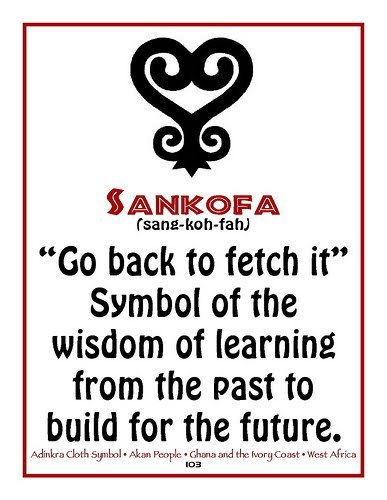
“Sankofa” Adinkra symbol!
The Sankofa Adinkra symbol is an appropriate conclusion for this posting, “Black History Month, 2025!” We are indeed wise to learn from our past, as often as necessary, in order to face our future!
Naked hugs!
Roger Poladopoulos/ReNude Pride
Author’s Note: The next post entry here is planned for Monday, February 3, 2025, and the proposed topic is: “Phoenix: Our Man!”
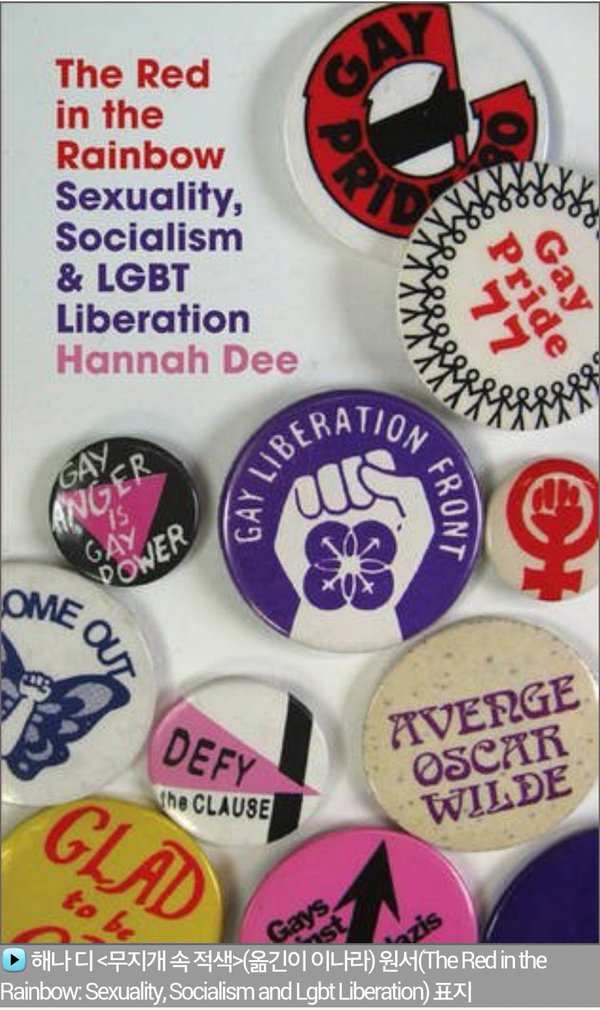
For numerous decades, the term “homosexual” was used to describe same gender loving people as both a definition and as a term synonymous with despicable and/or perverted. The late 1950s and early 1960s marked the transition of the meaning of the word “gay” from that of being “carefree and happy” to that meaning “homosexual” in British usage. The British interpretation slowly began to make its way into American language. By the time of the Stonewall Inn riots (SIR) of 1969, the British term was embraced by the same gender loving rioters and other protesters. For far too long and for too many, “homosexual” was too degrading and too prejudicial.
Vintage buttons proclaiming “gay!”
*************************
Lambda!
Lambda:
The Greek alphabet letter “lambda” was designated in December, 1969, by the graphic artist of the Gay Activist Alliance (GAA), founding member Tom Doerr. Doerr chose it because in chemistry it was the sign for “catalyst.” In this context, Doerr offered that the lambda involved the complete exchange of energy. Tom Doerr also felt that the Greek lambda was symbolic of self-identification, unity and pride. Others argue that lambda denotes synergy of the growing gay movement: the idea that the whole is greater than the sum of its parts.
In 1970, the lambda was adopted by New York City’s GAA as the emblem of their growing movement for gay liberation. In 1974, it was subsequently proclaimed by the International Gay Rights Congress at their meeting in Edinburgh, Scotland, UK, as their symbol for gay and lesbian civil rights. Following their designation, lambda became internationally popular and recognized globally with the same gender loving community.
Unfortunately, many women viewed the lambda symbol as relevant for males only.
*************************
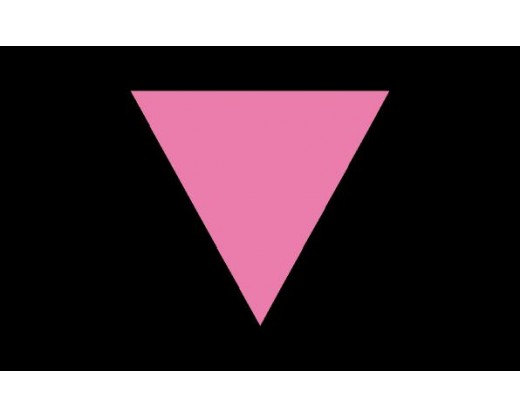
The Pink Triangle!
The Pink Triangle:
Just as the Nazi’s forced Jewish people to wear a yellow star of David, they forced men they identified as homosexual to wear an inverted pink triangle (die Rosa-Winkel) to identify their male gender preference. Those forced to do so were treated as the “lowest of the low in the concentration camp hierarchy.” It is estimated that 65% of those incarcerated as homosexuals died in captivity. Adolph Hitler perceived gay men as an impediment to purify Germany and as a serious threat to Aryan superiority.
After the concentration camps were liberated at the end of World War II, men imprisoned for homosexuality remained locked up. East Germany (communist) didn’t rescind the criminality of homosexuals until 1968. West Germany (democracy) didn’t repeal Nazi laws against homosexuality until 1969. Reunited Germany removed the illegality of homosexuality in 1994.
In 2002, the German government issued an official apology to all gay men who were imprisoned during the war. Rudolph Brazda, the last known concentration camp survivor who wore a pink triangle, died on August 3, 2011, at the age of 98.
Notation: The inverted Pink Triangle, located inside a green circle, is frequently used today to designate “safe” (protected) environments, facilities and spaces for GLBTQ+ persons.
A designated comfort zone for GLBTQ+ persons!
*************************
The Rainbow Pride Flag!
Notation: The Rainbow Pride flag consists of six rainbow stripes. The colours are red, orange, yellow, green, blue and purple. The red stripe is always the top, the purple the bottom. When first flown, it held eight stripes but was soon revised to six stripes only. The colours represent the ideals below:
The Rainbow Pride Flag:
This flag was first publicly raised on June 25, 1978, in San Francisco, California, USA. It was unfurled over the city’s United Nations Plaza in honour of gay pride at the 1978 San Francisco Gay Freedom Day Parade. The original flag contained eight coloured stripes and was designed for the event and the occasion by Gilbert Baker. The initial banner was hand-stitched and dyed by Baker with the help of volunteers and friends Lynn Segerblum, James McNamara, Glenne McElhinney, Joe Duran and Paul Langlotz.
The original flag was reconfigured after the unveiling as the banner soared in popularity and the demand became widespread. The new design featured six stripes matching the natural rainbow. The flag discontinued the stripes pink (symbolizing “sex”) and turquoise (“art and magic”) as those two colours were unavailable in flag fabric.
Gilbert Baker conceived the flag would “empower his tribe” (the growing GLBTQ+ community) into a “rainbow of humanity.” The motif represented the movement’s diversity.
*************************
The new Progress Flag among Rainbow Pride Flags!
Evolution: Pride to Progress:
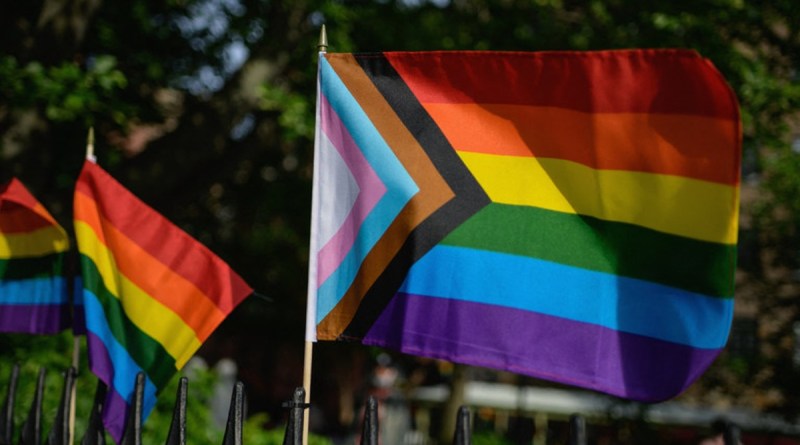
Forty years after the appearance of the Rainbow Pride flag, the Progress Flag debuted as the new banner of the worldwide GLBTQ+ community and culture. The Progress flag incorporated the six stripes of the Rainbow Pride flag along with colours and designs that depict our movement as we march together into the future.
*************************
The Progress Flag!
The Progress Flag of the GLBTQ+ Community and Culture
The Progress Pride flag was developed by non-binary (not conforming gender identity) artist and designer Daniel Quasar in 2018, forty years after the initiation of the Rainbow Pride flag. Based on the six stripes of Gilbert Baker’s 1978 Rainbow Pride flag, Quasar’s redesign celebrates the expanded diversity of today’s GLBTQ+ community and culture and encourages a more inclusive general society. The banner has increased the representation of discriminated minority identities covered by the GLBTQ+ umbrella.
Quasar’s creation placing black and brown stripes (emblems representing peoples of colour) and light blue, pink and white stripes (representing transgender and non-binary persons) in the shape of an arrow on the left of the Progress Pride flag. In Daniel Quasar’s own words “…the arrow points to the right to show forward movement and illustrates that progress towards inclusivity still needs to be made.”
In the Progress Pride flag, the black stripe has a double meaning as it, in Quasar’s intent, to represent not only the African race and their descendants but also “those living with HIV/AIDS and the stigma and prejudice surrounding them as well as all those who have succumbed to the disease.”
On the evening of June 6, 2018, Quasar posted the design for the Progress Pride flag on social media. When he woke up the following day, he discovered that the posting had gone viral. It was an immediate success!
Progress Pride flying over the University of Nottingham!
Naked hugs!
Roger Poladopoulos/ReNude Pride
Author’s Note: The next post entry here is planned for Thursday, October 17, 2024, and the proposed topic is: “Spirit: Stop Bullying Day!”
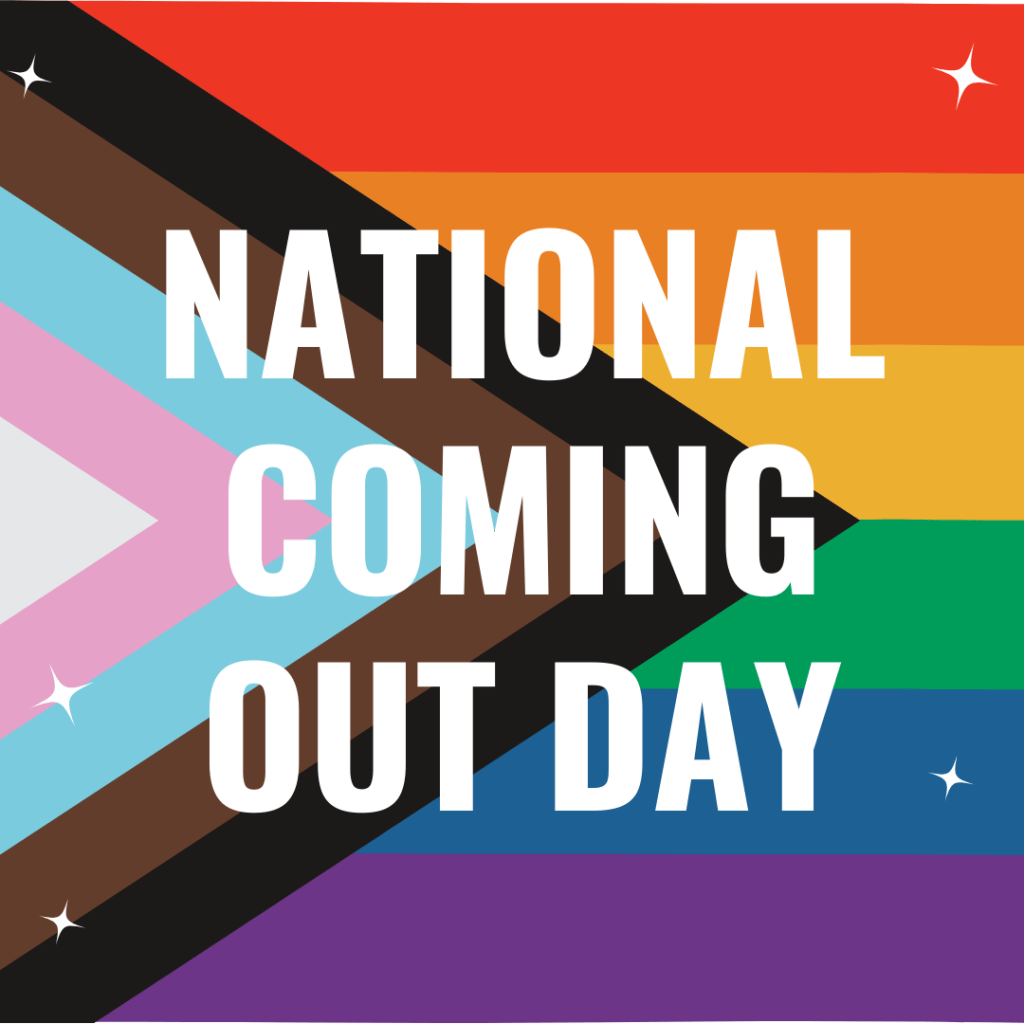
Gay, Lesbian, Bisexual, Transgender and Queer+ Awareness Day!
October 11, annually!
Introduction:
Coming Out Day was first observed in 1988 during the critical and tragic years of the onset of the HIV/AIDS pandemic. For far too many men, their diagnosis with the disease often was their “official coming out” of the proverbial closet to family, friends and co-workers. Unfortunately, the beginning of their coming out process was also the fatal and sad beginning of their farewell process.
National Coming Out Day was scheduled on the very first anniversary of the 1987 National March on Washington for Gay and Lesbian Civil Rights. It was also the occasion of the first complete public display of the NAMES Project AIDS Memorial Quilt.
Origins of the Phrase:
For centuries, persons who today constitute the GLBTQ+ community and culture were intentionally and legally marginalized (set aside) and segregated (separated) from the remainder of society. They were condemned and judged by church, clerics, government, law, legal enforcement, etc. as “homosexuals,” “perverts,” “queers,” and “sexual deviants.” These were among the more acceptable social labels.
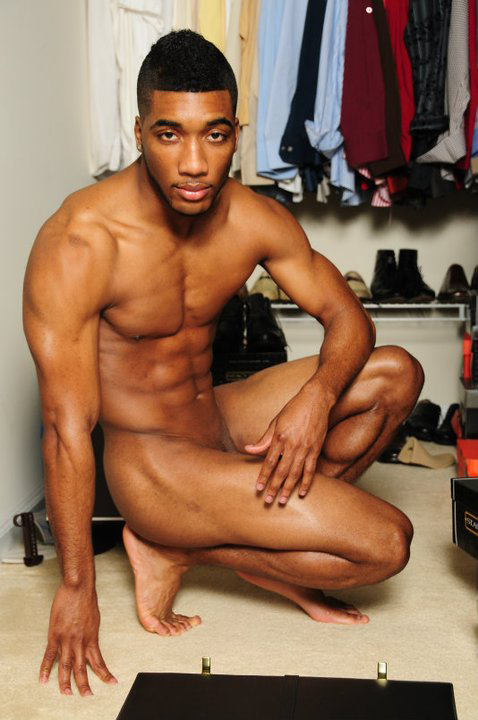
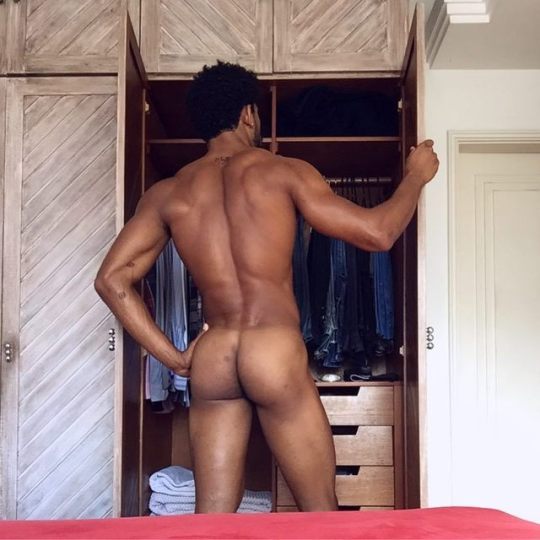
Closets are for clothes only!
Many of “our kind” lived their entire lives without ever sharing exactly what and who they really and truly were with anyone. Some even led a life that was totally false, they married and raised families without revealing their honest identity. This anonymous, concealed, obscure and secretive way of living was colloquially referenced as “being closeted” or as “living in the closet.” The closet being behind closed doors, thus hidden and unavailable for others to see or witness.
Purpose:
Coming out day was the signal for the post Stonewall Inn Riot (SIR) folks to openly and proudly accept, acknowledge and own their identity, their sexual orientation, the what and the who they indeed are. To step “out of the closet and into their life!” As previously mentioned, regrettably, the HIV/AIDS crisis was happening simultaneously.
“Closets are for clothes” was an expression used by body and clothes freedom enthusiasts who were also same gender loving (SGL) – bare practitioners today – to encourage and empower our community and culture in recognizing ourselves for being ourselves; there’s nothing wrong with us!
Artist Keith Haring created this art for the first Coming Out Day, October 11, 1988!
The late world renown artist, Keith Haring, himself an openly gay man living with AIDS, designed the above artwork in honour of the occasion. It remains prominent today as the globally recognized symbol for bravely, confidently, openly and proudly coming out about individual sexuality and for us bare practitioners, our position on body and clothes freedom.
The original concept for Coming Out Day was to combine the personal notification of sexuality with the political message that individual sexual preference was no longer a secret admission of disgrace and shame. There was nothing degrading about sexuality and consequently, there is nothing abnormal or guilty concerning nakedness. In reality, it’s okay for me to be me!
The emphasis on making the personal act of coming out into a political statement is a basic form of activism. Openly coming out (self identification) to family, friends and colleagues and then living life as a confident person publicly refuting bias and marginalization was in the eyes and minds of many as an extension of the SIR. The fact that homophobia (fear of same gender lovers) thrives in an atmosphere or environment of silence and/or ignorance was reality. Once people realize they either know or are related to someone who is indeed GLBTQ+ they are less than willing to remain with discriminatory, hateful and repressive individuals. “Familiarity breeds the seeds of tolerance.”
Coming out of the closet!
Coming Out Day was extensively reported in the media of the 1980’s (broadcast and press). Keith Haring’s art created attention and notice; overall, the response was well received and several noted celebrities did indeed “come out” themselves and/or encouraged their fans and followers to do the same. However, it did not reach the projected multitudes as hoped. The HIV/AIDS dilemma continued to devastate and even mainline Christian fundamentalist clergy began to involve themselves and their faithful in disease care, education and protection efforts. Slowly and hesitantly, the GLBTQ+ population began to identify with the necessity of the campaign to step forward and to “come out!”
Opening doors!
Evolution:
Since the very first National Coming Out Day on 11 October, 1988, so much has happened in our world, specifically in the attainment of GLBTQ+ civil rights, equality and freedoms. In the USA, the removal of the military ban/restriction on service, marriage equality and broad non-discrimination policies and protocols (just to name a few). There is now an almost general acceptance and acknowledgment of our existence and our humanity.
The struggle against HIV/AIDS is no longer seen as an absolute fatality. With proper treatment and care, it is now widely interpreted as a now “manageable” condition. It is not necessary for avoidance and/or isolation.
The purpose of National Coming Out Day has, in keeping with the progress, evolved into a GLBTQ+ awareness day, reminding our general society that we’re still here and yes, we’re still queer! Our sexuality no longer forces us to remain anonymous, invisible and obscure. We have the freedom and the right to be exactly what and who we truly are! The days of guilt and shame are in the past, gone but not forgotten!
For us bare practitioners, our next step forward is that our proclivity for our nakedness is no longer a concern nor a judgment to be determined by others. As long as we respect others, we should expect the equal and same respect for ourselves! Equality works both ways for everyone!
Out and proud!
Naked hugs!
Roger Poladopoulos/ReNude Pride
Author’s Note: The next post entry here is planned for Monday, October 14, 2024, and the proposed topic is: “Cultural Imagery!”





































 ReNude Pride: Guys Without Boxers!