
The Pink Triangle:
The downward-pointed pink triangle was used in Nazi Germany during the 1930s and 1940s as a badge of shame. It was sewn onto the shirts of “deviant” men (homosexuals) in concentration camps to identify and to dehumanize them. Sexual deviancy was made illegal in Germany in 1871 with the creation of the German Empire, but the statute was rarely enforced.
When the national socialists (Nazi) seized control and power in 1933, it was made a priority in order to culturally and racially “purify” Germany. The Nazis arrested and incarcerated thousands of “deviant” men and sent them into concentration camps, where many perished. They viewed them all as degenerate and impure.
The pink triangle has been reclaimed as an empowering symbol for the GLBTQ+ community and culture. It is also serving as a reminder to remember the past – and to recognize the persecution GLBTQ+ people continue to suffer around the world.
The pink triangle on a black banner was the first “flag” to signify the gay and lesbian movement.

The above depiction of the pink triangle inside a green circle represents a safe space where GLBTQ+ people will not be harassed, ridiculed or shamed. This identification was necessary due to the threats against our community and culture by homophobic individuals who operated with the unofficial endorsement of law enforcement during the emerging HIV/AIDS epidemic.

The Lambda:
The lambda was first designed in December, 1969, by Tom Doerr, a graphic artist and one of the founding members of the emerging Gay Activists Alliance. Doerr selected it because in chemistry, the lambda represented catalyst. Later, it was argued that the lambda denoted synergy of the growing gay and lesbian movement; the idea of the whole being greater than the sum of its parts.
The Lambda image from the Greek alphabet was first chosen as a gay symbol when, in 1970 – one year after the Stonewall Inn riots (SIR) – it was adopted by the then New York City’s Gay Activist Alliance as the emblem of their growing movement of gay liberation. In 1974, it was subsequently adopted by the International Gay Rights Congress at their international conference in Edinburgh, Scotland, UK. As their symbol for gay and lesbian civil rights, the lambda became globally popular and recognized.
Many interpreted the lambda symbol as for males only.

The Rainbow Pride Flag:
First raised on June25, 1978, in San Francisco, California, USA! It was designed and created in honour of gay pride at the 1978 San Francisco Gy Freedom Day parade in honouring the annual anniversary of SIR. The very original flag consisted of eight coloured stripes and was designed by Gilbert Baker and hand-stitched and dyed with the help of friends and volunteers Lynn Segerblum, James McNamara, Glynne McElhinney, Joe Duran and Paul Langlotz.
The eight-stripe original was soon revised to six stripes with pink (symbolizing “sex”) and turquoise (symbolizing “art and magic”) eliminated as the colours were unavailable in flag fabrics.
Baker conceived the flag would “empower his tribe” in a “rainbow of humanity” motif to represent the GLBTQ+ movement’s diversity.
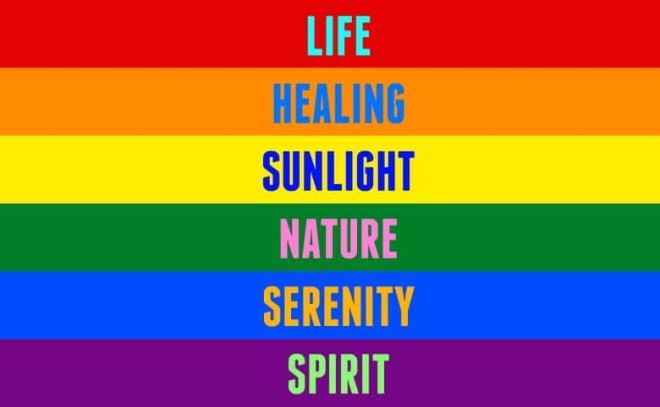
Above are the stripes and the meanings associated with each one of the rainbow-based colours.
The Progress Pride Flag:
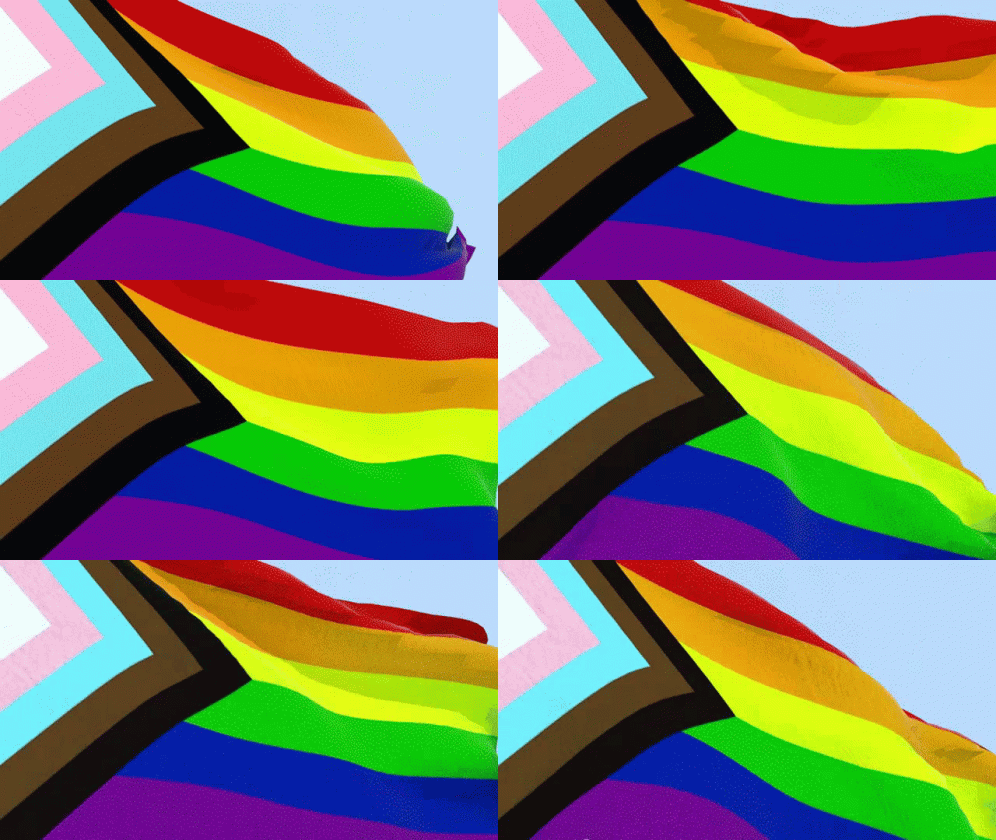
The Progress Pride Flag was developed by non-binary artist and designer Daniel Quasar in 2018. Based on Gilbert Baker’s 1978 rainbow flag, Quasar’s redesign celebrates the continued growing diversity of the GLBTQ+ community and culture and encourages a more inclusive general society. The improved design increased the representation of discriminated minority identities covered by the GLBTQ+ umbrella.
Quasar’s creation placing black and brown stripes (emblems representing peoples of colour) and light blue, pink and white stripes (representing transgender and non-binary persons) in the shape of an arrow on the left of the Progress Pride flag. In Daniel Quasar’s own words “…the arrow points to the right to show forward movement and illustrates that progress towards inclusivity still needs to be made.”
The black stripe has multiple meanings as it is also intended for “…those living with HIV/AIDS and the prejudice and stigma surrounding them in addition to those who have died from the disease.”
On the evening of 6 June, 2018, Quasar posted the design on social media and went to bed. He woke the next day and discovered that it had viral! It was an immediate success!
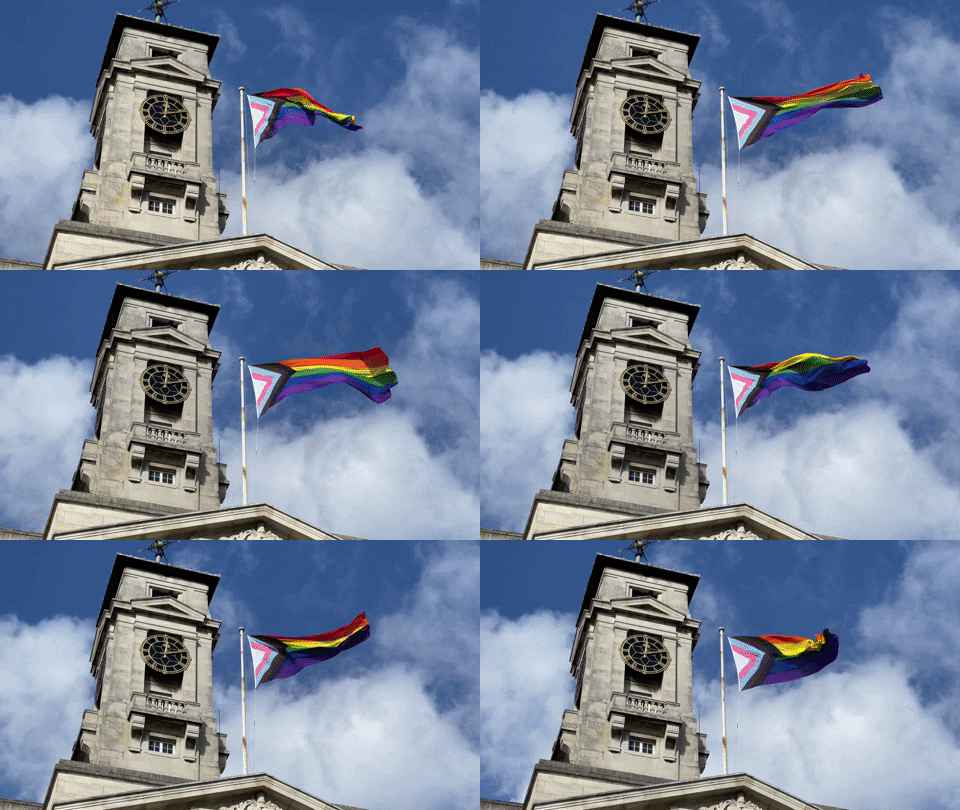
The Progress Pride flag is currently internationally recognized as representing the global LGBTQ+ community and culture. It is now flown at the United Nations. The inclusive design and nature of this flag have received the commendation of many.
Naked hugs!
Roger Poladopoulos/ReNude Pride: Guys Without Boxers!

Author’s Note: The next post entry here is planned for Friday, October 10, 2025, and the proposed topic is: “NCOD: Closets Are For Clothes!”

 ReNude Pride: Guys Without Boxers!