

Great and Holy Easter, Sunday, 12 April 2026!
Great and Holy Easter celebrates and commemorates the triumph of good over evil and of love over hate. The Resurrection is the promise of eternal life!
Background:
The Eastern Churches (Armenian, Chaldean, Coptic, Orthodox, etc.) follow the older calendar effective during the time of Jesus. The Western Churches follow a revised calendar thus the two different dates for most holy days.
Great Friday, 10 April, 2026:

In the Eastern Orthodox Church today is known as Great Friday, the Day of Sorrow. In the liturgical year, it commemorates the last day of Jesus alive here on earth and the sorrows he endured: the beating at the pillars of the Jerusalem Temple, the crowning of thorns, and having to carry his cross and then his crucifixion. When he expired, his body was placed in a tomb that belonged to St. Joseph of Arimathea.
Annually on this day, believers remember the agonies and pains that Jesus experienced. The shroud of the icon of the Crucifixion is placed in a tomb that is carried through the church in the epitaphios (tomb). As it is carried, the faithful chant the Lamentations hymns that recount the events of Great Friday. In the churches inside Greece, the epitaphios is bourne by active members of the military: army. navy or air corps.
After sunset on Friday evening, there is a candlelight service in churches where the icons have been covered in mourning. The Divine Liturgy is not sung again until midnight on Easter morning. The prayers offered reinforce the sadness and suffering of the occasion.
The Great Lent:
Anticipating the Glorious Resurrection, the six weeks before the arrival of the Holy Feast are spent in a period known as the Great Lent – a time of extreme fasting and sincere prayer. Growing up, my parents would direct the discussion topics to the importance of faith, prayer and service to all in our lives, our obligation to our church (Greek Orthodox) and to our family.
The fasting aspect of Great Lent involves abstinence from all meat, seafood, dairy products and eggs. The focus is on receiving nutrition naturally from nature’s resources. The fast is in effect during the entire season of the Great Lent.

The Great and Holy Easter!
The only offering of the Divine Liturgy (the principal prayer service in Holy Orthodox Churches) is always at Midnight on the Feast of Pascha (Easter). This allows for an entire day of celebration and feasting. The service begins outside the church (weather permitting) when the candles of the Resurrection are lit, and the priest leads the entire congregation to circle the church three times. While processing, the people sing the Resurrection hymns (Christ is Risen! Indeed, He is Risen!).
After the third encirclement, the procession then moves inside the church as the deacons uncover the holy icons, and believers light candles and offer prayers. The Resurrection hymns continue as the clergy, deacons, and servers line up for the offering of the Divine Liturgy.
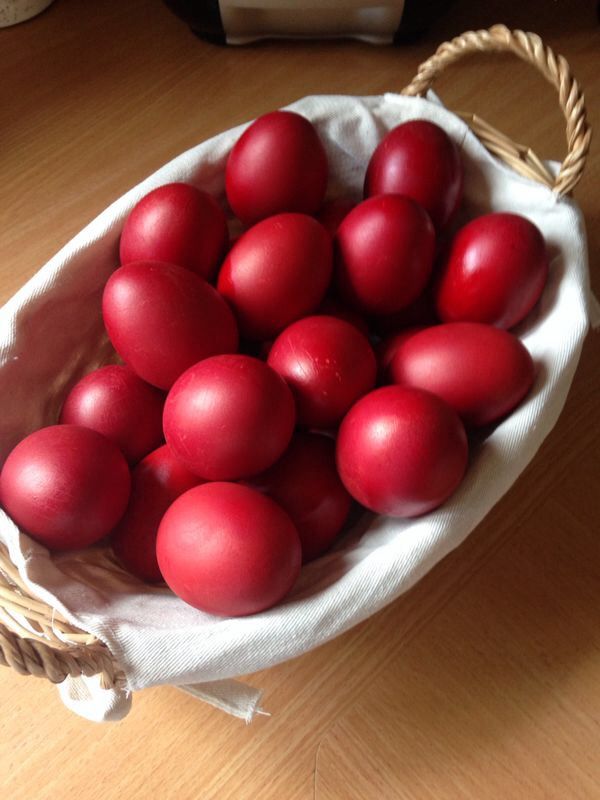
Among all the popular treats for the Easter feasting, the most recognized is the egg which also represents the rebirth of the spring season. The hard-boiled egg is dyed red to recall the blood lost by Jesus during the crucifixion. The Lenten Fasting removed the availability of eggs from people’s diets but gave them notoriety as an Easter treat!
In the early hours of Easter morning, following the conclusion of the Resurrection Liturgy, the faithful exit the ecclesiastical sanctuary of the churches and encounter baskets and trays of traditional dyed Easter eggs ready to be consumed. The festive spirit of the holy day continues with all participating in the classical custom of greetings.
Holding the egg in the palm of the hand, one salutes another with the phrase, “Christos anesti!” (Christ is risen!). The other responds: “Alithos anesti!” (Indeed He is risen!). The two then collide their open-palmed eggs together with the victor emerging as the one with their egg-shell uncracked or intact. Multiple eggs are devoured in this manner and the Great fast of Lent is officially over!
Families – and sometimes multiple households – after the greetings and egg-breaking hurry home for an early morning Easter meal!
Tsoureki:
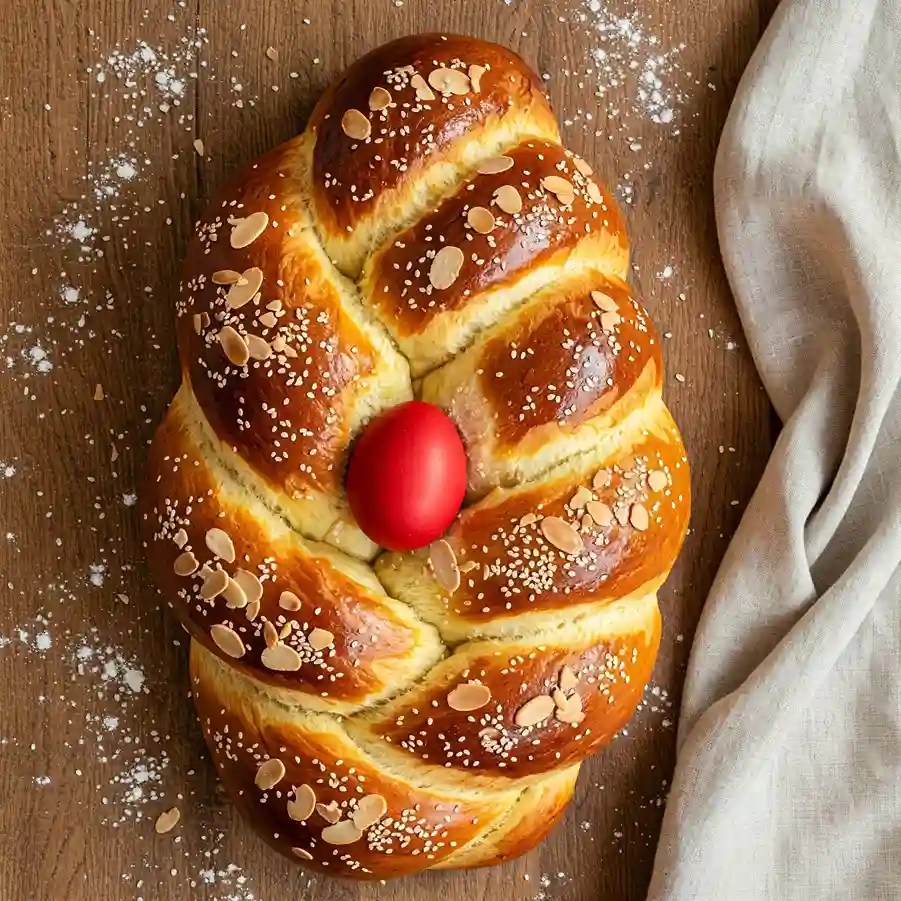
The widely and wildly delicious Easter delicacy that is a favourite of all – both the religious Greeks and those who are indifferent to faith. My spouse, Aaron, is the chef of our household and has my paternal yaya’s (grandmother’s) recipe for this special bread. He is the culinary commander and even though he never met any of my grandparents, he has spiritually inherited yaya’s ability, skill and talent in tsoureki baking. My siblings extol his exceptional perfection of her triumph! Aaron has even framed her handwritten recipe (in Greek) and it hangs in a place of honour in our kitchen!
Yaya’s tsoureki recipe generally takes approximately 18 – 19 hours to mix, prepare and to rise and over an hour to bake. After years of experience, Aaron has not been able to alter the process.
The tsoureki (in my family custom) is served with the main feasting that occurs in the late afternoon on Easter Sunday. One loaf usually serves about twenty-four (24) people and multiple loaves are served.
Kala pascha! Happy Easter!
Naked hugs!
Roger Poladopoulos/ReNude Pride: Guys Without Boxers!

Old Faithful!
Author’s Note: The next post entry here is planned for Monday, April 13, 2026, and the proposed topic is: “Budding Season!”

Francois:
Francois is excited to have some of Aaron’s tsoureki again!

 ReNude Pride: Guys Without Boxers!