Great and Holy Easter!

Icon of the Resurrection!

Great and Holy Easter, Sunday, 12 April 2026!

Great and Holy Easter celebrates and commemorates the triumph of good over evil and of love over hate. The Resurrection is the promise of eternal life!

Background:

The Eastern Churches (Armenian, Chaldean, Coptic, Orthodox, etc.) follow the older calendar effective during the time of Jesus. The Western Churches follow a revised calendar thus the two different dates for most holy days.

Great Friday, 10 April, 2026:

The epitaphios procession through the churches.

In the Eastern Orthodox Church today is known as Great Friday, the Day of Sorrow. In the liturgical year, it commemorates the last day of Jesus alive here on earth and the sorrows he endured: the beating at the pillars of the Jerusalem Temple, the crowning of thorns, and having to carry his cross and then his crucifixion. When he expired, his body was placed in a tomb that belonged to St. Joseph of Arimathea.

Annually on this day, believers remember the agonies and pains that Jesus experienced. The shroud of the icon of the Crucifixion is placed in a tomb that is carried through the church in the epitaphios (tomb). As it is carried, the faithful chant the Lamentations hymns that recount the events of Great Friday. In the churches inside Greece, the epitaphios is bourne by active members of the military: army. navy or air corps.

After sunset on Friday evening, there is a candlelight service in churches where the icons have been covered in mourning. The Divine Liturgy is not sung again until midnight on Easter morning. The prayers offered reinforce the sadness and suffering of the occasion.

The Great Lent:

Anticipating the Glorious Resurrection, the six weeks before the arrival of the Holy Feast are spent in a period known as the Great Lent – a time of extreme fasting and sincere prayer. Growing up, my parents would direct the discussion topics to the importance of faith, prayer and service to all in our lives, our obligation to our church (Greek Orthodox) and to our family.

The fasting aspect of Great Lent involves abstinence from all meat, seafood, dairy products and eggs. The focus is on receiving nutrition naturally from nature’s resources. The fast is in effect during the entire season of the Great Lent.

The Great and Holy Easter!

The only offering of the Divine Liturgy (the principal prayer service in Holy Orthodox Churches) is always at Midnight on the Feast of Pascha (Easter). This allows for an entire day of celebration and feasting. The service begins outside the church (weather permitting) when the candles of the Resurrection are lit, and the priest leads the entire congregation to circle the church three times. While processing, the people sing the Resurrection hymns (Christ is Risen! Indeed, He is Risen!).

After the third encirclement, the procession then moves inside the church as the deacons uncover the holy icons, and believers light candles and offer prayers. The Resurrection hymns continue as the clergy, deacons, and servers line up for the offering of the Divine Liturgy.
The traditional Easter greetings!

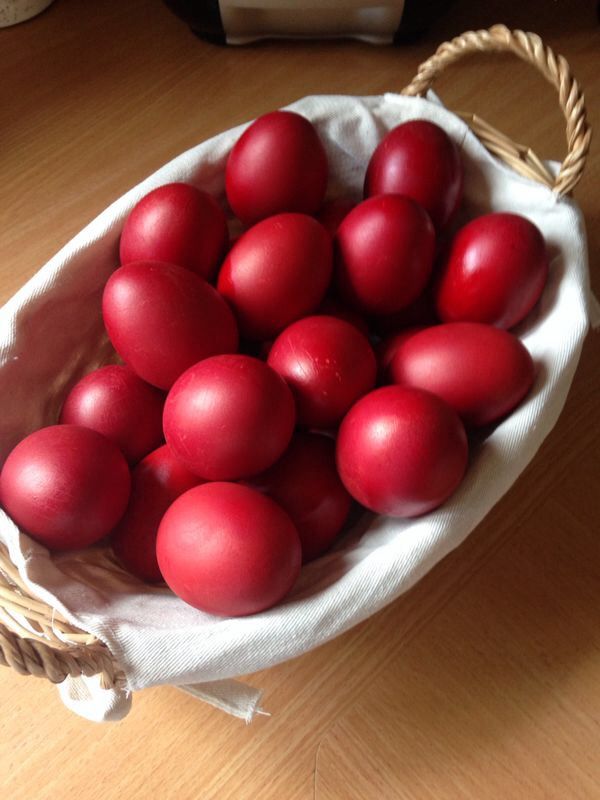
Among all the popular treats for the Easter feasting, the most recognized is the egg which also represents the rebirth of the spring season. The hard-boiled egg is dyed red to recall the blood lost by Jesus during the crucifixion. The Lenten Fasting removed the availability of eggs from people’s diets but gave them notoriety as an Easter treat!

In the early hours of Easter morning, following the conclusion of the Resurrection Liturgy, the faithful exit the ecclesiastical sanctuary of the churches and encounter baskets and trays of traditional dyed Easter eggs ready to be consumed. The festive spirit of the holy day continues with all participating in the classical custom of greetings.

Holding the egg in the palm of the hand, one salutes another with the phrase, “Christos anesti!” (Christ is risen!). The other responds: “Alithos anesti!” (Indeed He is risen!). The two then collide their open-palmed eggs together with the victor emerging as the one with their egg-shell uncracked or intact. Multiple eggs are devoured in this manner and the Great fast of Lent is officially over!

Families – and sometimes multiple households – after the greetings and egg-breaking hurry home for an early morning Easter meal!
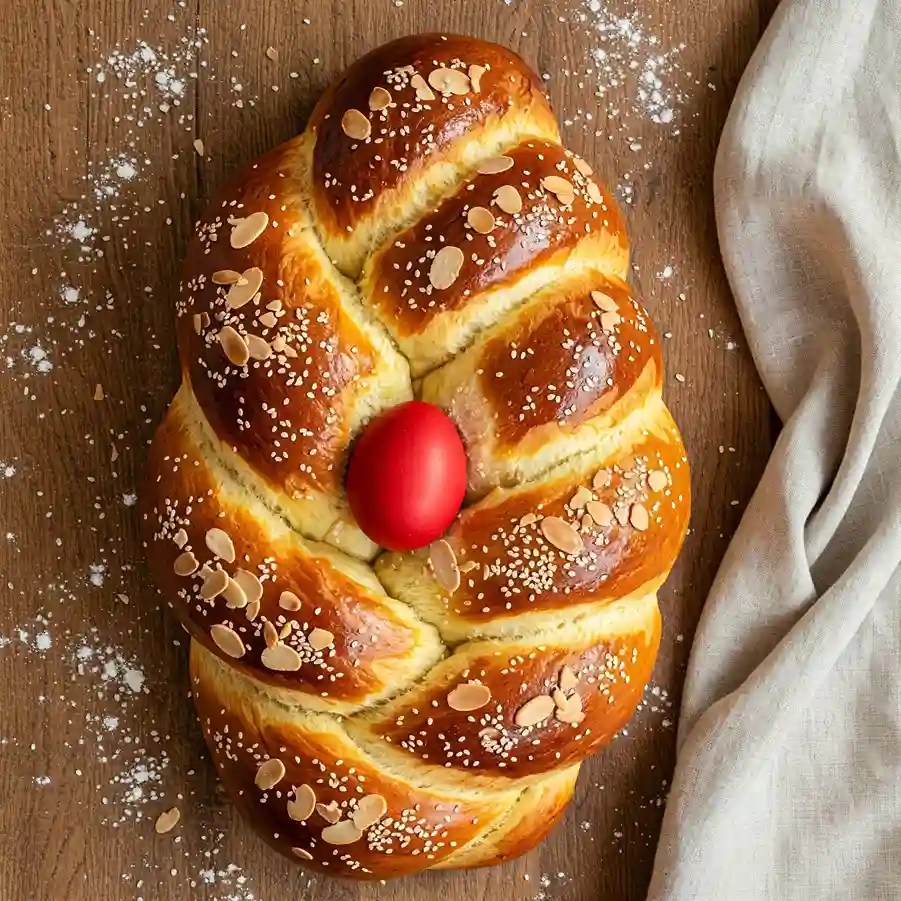
Tsoureki: Greek Sweet Easter Bread!

Tsoureki:

The widely and wildly delicious Easter delicacy that is a favourite of all – both the religious Greeks and those who are indifferent to faith. My spouse, Aaron, is the chef of our household and has my paternal yaya’s (grandmother’s) recipe for this special bread. He is the culinary commander and even though he never met any of my grandparents, he has spiritually inherited yaya’s ability, skill and talent in tsoureki baking. My siblings extol his exceptional perfection of her triumph! Aaron has even framed her handwritten recipe (in Greek) and it hangs in a place of honour in our kitchen!

Yaya’s tsoureki recipe generally takes approximately 18 – 19 hours to mix, prepare and to rise and over an hour to bake. After years of experience, Aaron has not been able to alter the process.

The tsoureki (in my family custom) is served with the main feasting that occurs in the late afternoon on Easter Sunday. One loaf usually serves about twenty-four (24) people and multiple loaves are served.

Kala pascha! Happy Easter!

Naked hugs!

Roger Poladopoulos/ReNude Pride: Guys Without Boxers!

Old Faithful!

Author’s Note: The next post entry here is planned for Monday, April 13, 2026, and the proposed topic is: “Budding Season!”

Francois:

Francois is excited to have some of Aaron’s tsoureki again!

Great and Holy Easter, 2025!

Lighting candles!

The Feasts of Great and Holy Easter in the Orthodox Churches and Western Easter in the Protestant Churches are observed simultaneously on Sunday, 20 April, 2025.

Kala Pascha!

Happy Easter!

The joint celebration of the Easter Holy Day is not a regular event as the churches all follow different calendars. Easter is a moveable feast day – always celebrated on Sunday however, it changes dates annually. There is no designated date for the observance of the Easter feast.

Aaron, my spouse, is Roman Catholic. I am Greek Orthodox. Our Easter celebrations are usually on different dates. Unfortunately, this year, we have only one single Easter observance. A reduction by half of all our Easter treats!

The Epitaphios: the tomb of Jesus in the Greek Orthodox Church!

Throughout Greece, in the larger cities and ports, the Army, Navy and Air Corps provide the bearers of the Epitaphios to churches. The state church is legally allowed to demand this duty from local military personnel. The only time such a request may be denied is during time of war. I imagine the military attendance is representative of the Roman guards lining the route of Jesus as he carried himself and his cross to the scene of the Crucifixion.

The Easter Ikons!

The ikon is a representation (mural, mosaic or a painting on wood) depicting sacred events or a sacred individual (Jesus, the Blessed Virgin Mary or a saint). It is used as an object of veneration and prayer or as a visible tool of instruction. In western churches, statues are used. Ikons are found predominately in Orthodox Churches. For the Orthodox people, ikons remind us of our duties and obligations.

The ikon of the Crucifixion of Jesus!

At the noon hour on Great Friday (Good Friday in the Western Church) – which happens to be today, – the ikon of the Crucifixion is placed inside the Epitaphios (Tomb) and carried around the church a total of three (3) times. The Ikon rests inside the Epitaphios until the hour of midnight on Great Saturday. It is then replaced with the Ikon of the Resurrection of Jesus and then encircles the Church three times for the jubilation and veneration of the peoples. Easter is the Feast of the Resurrection!

The Ikon of the Resurrection!

For the Eastern Orthodox faithful (Greek, Russian, Bulgarian, Roumanian, Armenian, Syrian, Coptic, Ethiopian, Palestinian, Serbian, etc.), Easter is the paramount feast of the liturgical (church) year. My paternal papou (grandfather) always noted that in Greece, even the communists were in church on Easter Sunday!

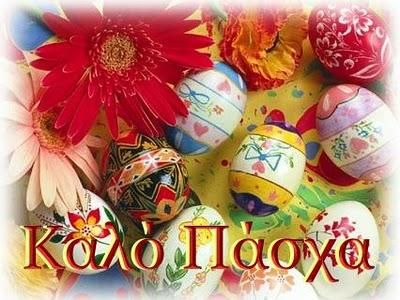
Flowers and “Happy Easter” (Greek)!

Easter Eggs!

In Greece and throughout much of the Eastern Orthodox Church world, egg dying is very popular and involved. In our culture, all eggs are dyed red – the colour that represents both rebirth and renewal. Red is also symbolic for the blood of Christ which was shed during the Crucifixion. The elaborate decorations of eggs used in Russia and the Ukraine are not popular with the remainder of the Orthodox communities.

There are many contests and games utilized with the red eggs and related to the Easter holy day. The four weeks prior to the arrival of Easter is known as the Great Lent, a period of fasting and prayer, during which the consumption of eggs is restricted. It is customary to eat all of the festive eggs prior to the arrival of Easter Monday.

There are numerous ways of dying eggs for Easter. The majority of dying is done within the individual homes and households. Commercially, for large groups, dyed eggs can be purchased in advance. There are dyes available for families to shop. My mother recalls using a very traditional method of dying. They would peel the skins off of red onions and boil the skins mixed with some olive oil and vinegar. We dyed eggs this way growing up, the colour was not as bright as the manufactured dyes but a hard-boiled egg tastes the same, regardless of how it is dyed!

Commercially dyed Easter eggs!

Bare Practitioners!

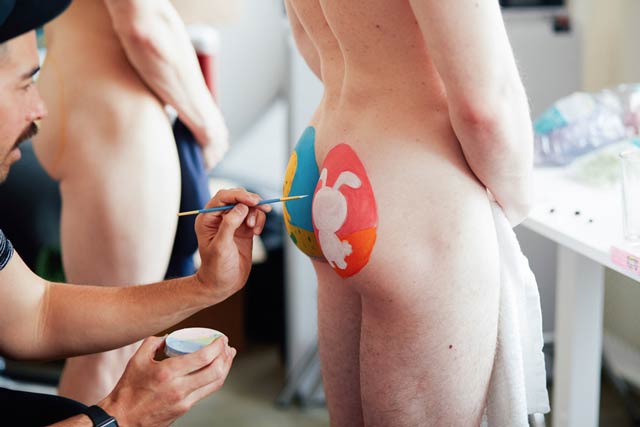
For those of us who are committed and devoted bare practitioners, our observance of the Easter holiday includes the colourful decorating of our bodies in addition to eggs. Using various varieties of body paint, we are not restricted to simply using the red option.

Body painted adornment!

In celebrating the holiday, many decide to have their buttocks painted to resemble the eggs decorated for the occasion. This process also involves the cooperation of friends and talented (artistic) acquaintances in creating festive images. The most popular anatomical “canvas” (object painted) of course are the buttocks! For many, they do resemble an egg!

Detailed expression!

Some of the hand painted eggs are very awesome and intricate in the creativity and design employed. We can only wonder what is awarded to the first place winners and their artists! Imagine the crowds in line if the buttocks were displayed live in a museum!

*************************

Tsoureki!

“Tsoureki” – Easter bread!

The Easter Bread – a sweetened and renowned baked treat that is a significant tradition of Greek Easter – is baked in the home according to family recipes, passed from generation-to-generation. I have my paternal yiayia (grandmother) recipe. My culinary skills are practically nonexistent so in our home, Aaron prepares our bread, and it is praised by all who eat it. My copy of the recipe was made in my own handwriting when I spent Easter with yiayia and step-by-step we made a total of nine loaves.

Yiayia’s recipe was her very own version of the one given to her by her mother. These recipes are guarded as family treasures and as a rule not shared with others. Frequently, each family has a slight variation in the traditional recipe due to the individual cooks.

The preparation of the bread takes between 18-24 hours and yiayia never used an alarm to remind her of the time. The preparation, after adding all the ingredients, involves allowing the dough to sit for eight hours to rise before punching down, then repeating the same process again before the final rise of six hours, another punch down time and then baking. She loved making this treat and everyone loved devouring her finished product! Aaron enjoys mixing and baking the tsoureki just as much as yiayia did!

Although Aaron never met her, his following her recipe brings back many special memories!

Happy Easter to all!

Naked hugs!

Roger Poladopoulos/ReNude Pride: Guys Without Boxers

Author’s Note: The next post entry here is planned for Monday, April 21, 2025, and the proposed topic is: “April Environment!”

Bottoms-Up! Easter, 2024!

Painted buttocks!

A very special occasion, indeed! The holiday of western Easter and the observation of Bottoms-Up! coinciding together for one Spring-time celebration! All the more reasons for everyone of us to joyfully bare our buttocks, grab the supply of body paint and design away!

Artists being artistic!
Western Easter themes!
Creativity!

For this year, 2024, Holy Easter occurs on Sunday, May 5. It is the time of the year for the celebration of hope for all of us and our futures!

“Easter bottoms-up!”
The rooftops!

Happy bottoms-up! to all! Happy western Easter!

Naked hugs!

Roger Poladopoulos/ReNude Pride

Author’s Note: The next post entry here is planned for tomorrow, Monday, April 1, 2024, and the proposed topic is: “April Fool’s Day!”

Holy Easter, 2022!

A Paschal (Easter) Angel!

At midnight tomorrow night, the bells on Greek Orthodox churches (actually, all Orthodox churches) will begin to ring and the congregations will commence to transmit the flame of light from one paschal candle to another while chanting “Kristos anesti” (Christ is risen). The Easter liturgy for 2022 will start; continuing a tradition that began almost 2,000 years ago.

Afterwards, the congregants will exchange the greeting “Kala Pascha” (good Easter)! While sharing best wishes, they will hold red-dyed eggs in the palm of their hand tapping the eggs of others, in the attempt to crack open the shells of every egg they encounter and emerge with their own egg unscathed and intact!

The egg champion!

Everyone then hurries home for the opening of gifts, the devouring of the Easter breakfast and the mad rush to crawl into bed before sunrise! The Easter feast begins at 4:30 p.m., on Sunday afternoon! Of course, all are completely famished by the time that comes to pass!

Of course, the family gathering is sparse for us. Aaron, my spouse, and I will host Twin (Alex) and his partner Dante, and our first cousin, Michael Poladopoulos and his soon-to-be spouse, Ropati. The remainder of our families all reside in Greece so we do the best that we can to ensure that Easter is a memorable event.

All of us are bare practitioners so there is most definitely a hasty drive from St. Sophia’s Cathedral in northwest Washington, D.C., to our condominium in Arlington, Virginia. We’ll all need to remove our church attire – pronto! Aaron and I have a one bedroom unit, therefore, space is limited. Fortunately, clothing concerns are not an issue for any of us! We avoid a grooming disaster by shaving/showering as a couple and not individually.

Lambropsomo – Easter Bread!

Everyone plans on arriving this afternoon (Friday). In making the Lambropsomo (Easter Bread), we use ya-ya’s (paternal grandmother’s) recipe which both Alex and Michael (as well as myself) own. My culinary skills are nonexistent; however, I do posses the handmade wooden rising bowl that belonged to ya-ya’s mother (our great-grandmother). It is an antique. The Lambropsomo is an eighteen hour process so preparation starts tonight. Ropati has no interest in baking so the two of us plan to play backgammon (tavloo) while the remainder work in our kitchen. As my Aaron so aptly determined: “We’ll keep the R’s (Roger and Ropati) out of our space so we can handle (complete) our business (cooking)!” Rest assured, Ropati and I both intend to comply with those wishes!

Easter feast preparation!

I don’t know for certain if Ropati’s kitchen skills are as poor as mine – however, as long as the majority of our guests are content with the food preparation, I am content to accede to their every desire and need! Too many in our tiny kitchen space can only create chaos, confusion and disaster!

Our Easter Sunday plans are to be laid back and relaxed for most of the day. With the bulk of the meal preparation completed in advance, our 4:30 p.m., dinner will be followed by our guests departing for their homes. Aaron and I prefer doing our own clean-up after the meal as our time to “calm” after a condominium full of family for the entire weekend. Monday is a full day at work for the both of us!

Decorated buttocks!

And a very depressing thought: almost all of my fellow professors at university observed Western Easter the week before. Their holiday recovery is very complete! I have yet to go through the motions!

Kala Pascha to everyone!

Naked hugs!

Roger Poladopoulos/ReNude Pride

Author’s Note: The next post entry here is planned for Monday, April 25, 2022, and the proposed topic is: “April Appeal: Fantasy!”

Happy Easter!

Today is Easter Sunday in the Churches of the Eastern Orthodox tradition. To everyone who observes this holy feastday, I send best wishes for a Happy Easter! “Christos anesti!” (The Christ is Risen)! 

Aaron, my husband, and I are celebrating by hosting a traditional Greek luncheon in our tiny little condo with two couples who are also Greek same gender loving bare practitioners (naturist/nudist). We don’t require our guests to decorate their buttocks as the guys above, but we don’t discourage it either! We haven’t yet decided on whether we’ll decorate our own buttocks but we do have the body paint available in one of our closets!

Continue reading Happy Easter!