Rohan, the Nubian-Ikigai, featured here in and interview on November 25, 2022, and a guest author here on December 1, 2022: World AIDS Day has officially opened and is now publishing his blog: Crossing the Styx! The site features an About Me page and his initial post entry.
The title “Bare-dom” and posting were originally planned for today’s entry here. However, the feeling on my part, as the author of ReNude Pride is that this particular posting is more prominent and more relevant. “Bare-dom” is now planned for publication in February, 2023. I apologize for any confusion!
Background:
The term political correctness is a concept that began with the advent of the first inauguration of then-incoming President Bill Clinton in the 1990’s. The phrase was synonymous with the words “thoughtfulness,” “sensitivity” and basically “polite.” It essentially implied “respect and treat others as you expect them to treat and respect you.”
Unfortunately, the idea was never accepted or followed by the religious-right extremists nor the U.S. republican political party. Once George Bush #2 came into power, the principle rapidly fell into disfavor then totally abandoned.
The election of President Barack Obama brought the theory but not the original phrase back into practice. Regrettably, when he retired, the practice did also. Now even the thought of such a notion as decency has disappeared from the ideals and minds of the American public. The thinking these days is now: nogooddeedgoesunpunished!
The context and point here is simple: we need to return to the basic “ground rule” of decency for everyone. This country, especially, is now too multicultural and varied for us to automatically assume that all the people who live here have identical beliefs and values. That path of thinking is now misinformed, obsolete and no longer relevant. Probably, it is something that is no longer true even within the same family, much less the neighborhood, community, city and state.
Even within the same religion, there exist varying traditions. For example, within Christianity, there are differences in when certain holidays are celebrated and/or observed. One assumption doesn’t apply to everyone anymore.
Observation: not included on the above listing is December 26: Boxing Day in the UK, Australia, Canada, New Zealand and other realms throughout the Commonwealth!
My spouse, Aaron, and I have discussed this quite a number of times among ourselves and with friends. There is no doubt in our minds whatsoever that all of us need to be considerate of one another and work together to restore an element of humanity back into our daily lives!
Naked hugs!
Roger Poladopoulos/ReNude Pride
Author’s Note: The next post entry for here is planned for Monday, December 12, 2022, and the proposed topic is: “Resolutions Solution!”
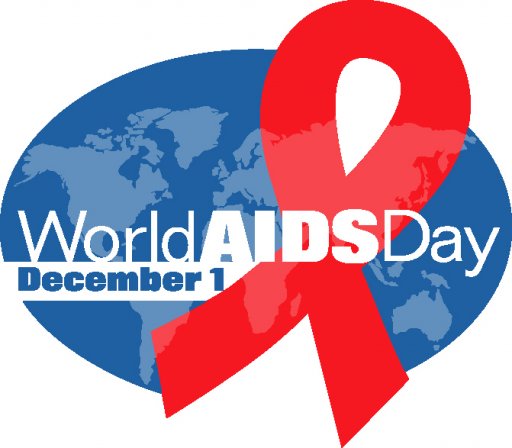
The Red Ribbon symbolizes World AIDS Day and HIV/AIDS awareness!
Proudly show that you are aware and that you care. Wear your red ribbon!
********************
Basic Facts About HIV/AIDS:
HIV is the virus that causes AIDS.
AIDS is a result of being infected with HIV.
HIV is not spread through everyday, casual contact.
A physician is needed to diagnose AIDS.
********************
Red ribbon = HIV/AIDS awareness and concern!
“It’s not who we are, but rather what we do that determines the risk factor of HIV infection.” ~ Red Cross HIV/AIDS prevention education ~
Follow protocols for reducing HIV infections:
Do not share needles, syringes or drug use tools.
Avoid contact with body fluids.
Treat everyone with care and respect.
********************
Since the first World AIDS Day observance on December 1, 1988. The date was first conceived in August, 1987, by James Bunn and Thomas Netter, two public information officers for the Global Programme on AIDS at the World Health Organisation in Geneva, Switzerland.
Each year, Popes John Paul II, Benedict XVI and Francis have released messages for both patients and health care providers on World AIDS Day. They have also publicly offered prayers for a world living with HIV.
In the USA, the White House (presidential home) began observing World AIDS Day under the administration of President Clinton and the iconic display of a 28-foot massive Red AIDS Awareness Ribbon on the North Portico of the building. It was the first banner to prominently hang from the White House since the presidency of Abraham Lincoln.
Get tested! Know your HIV status!
Remember: a latex condom every time!
********************
A Red Ribbon on World AIDS Day!
Public Testimonial
by Rohan, the Nubian-Ikigai
It was in the late autumn of 1978 that I came into this world. My mom would always tell me that I was an overdue birth; as it I didn’t want to leave the womb. I see it like being cuddled up in bed. Who’d want to leave such a comfy spot? To this very day, that has still remained my all-time favourite activity.
So being born in 1978 meant that I grew up in the 80’s. Wow! What a decade! Madonna, Punk fashions, Hurricane Gilbert and skyrocketing food prices – if you’re Jamaican – and…AIDS!
Being an island didn’t mean that we were isolated from world issues, especially when your island is renowned for its culture, its beaches, its sunshine and sex. I saw all the AIDS prevention ads on TV: “AIDS kills,” “stick to one steady partner,” “use a condom,” and “you can’t tell by looking.” I grew up scared! I grew up being scared of actually growing up!
Throughout high school, we teens would laugh about stuff pertaining to sex and sexuality, there was little or no sex education in school and what we learned came from porn, the dancehall music or the local pastor. The radio broadcast the death of Freddie Mercury. I remember that so well because I was wearing a Queen t-shirt at that very moment! I heard of Arthur Ashe; in school we talked and laughed about the death of Rock Hudson – I didn’t know who he was at that time. But the dearest tragedy for me was when I learned that Olympic diver Greg Louganis was diagnosed HIV+. I was personally touched because I knew who he was. He was my hero, a gay Olympic champion! And, of course, during the 80’s and 90’s, they constantly reminded us of the growing numbers of new cases.
Greg Louganis, Olympic gold medal winner!
So as I fast forward a bit to young adult, HIV/AIDS was less and less stranger. It was now a reality. It had faces! And faces that I knew!
I made friends with people working in the local AIDS support association and the church I attended did volunteering and outreach. Being scared didn’t shield me from the harsh realities of my life. I wasn’t going to be spared. AIDS was not going to have pity. Not on this little island boy. No sir!… Familiar faces kept vanishing, boys I fell in love with kept getting sick: Julian, Everton, Fred, Frank. A church member was dying. I saw their faces. I saw their bodies lying on the hospital beds. I saw them agonizing. I saw them dying…I loved them. I loved them as hard as I could. I held them in my heart; it’s all I could have done.
There was only love, that’s what they needed, not pity or shame, but Love. I understood that. I had that gift.
Allisson was my elder. She and I were friends, we weren’t that close. She was the first child my dad got from his first relationship, so, we were as close as two half-siblings who were ten years apart could be. She had her life and her family: boyfriend, son and daughter. I checked in with her as often as I could. I still thank God for that last moment I spent with her. It was in the local store where she worked. Allisson was standing there behind the counter. She looked so thin, so pale, so not all together there. Nothing could have prepared me for that grim phone call I’d received a few years later…AIDS took my beloved sister.
Princess Diana: first person of prominence to casually greet a person living with AIDS.
To be honest I did my best to play it safe, but I also took my fair share of risks. I even slept with the enemy. Why I didn’t remember all those faces, all those bodies I saw, covered in sores, laying on those hospital beds? Why didn’t I remember the agony? I should have ran! But I didn’t…I wanted cuddles instead. It only takes one encounter. I slept with this guy twice in the Summer of 2005 I was diagnosed in the Fall of that very same year. Painful urine and a creamy white substance leaking from my penis made me go to the doctor real quick.
I was alone when I went to the doctor’s, I was alone when the doctor broke the news, I was alone when I went to the hospital to have his diagnosis confirmed. I was alone to face the stark reality that I was not going to be living a normal life. Oddly though, the news that I was HIV positive wasn’t as earth shattering. It didn’t have that devastating effect as I had imagined. I didn’t scream, or cry, or ask God why? Maybe it’s my way of dealing with trauma: in silence.
My explanation is that, growing up gay prepared me for days like these. If I could handle growing up gay in a homophobic society such as mine, anything else would be a piece of cake. I kind of figured that, somehow it’s kind of logical, sad way to think. I agree it’s a bit fatalistic: being gay isn’t a death sentence! But for me it was. So I imagine I was accepting my fate. My mom was right. A gay life is one of damnation and hellfire. And this was exactly what I deserved.
Since then, I’ve celebrated seventeen birthdays, visited six countries and changed two jobs. I have met my beautiful niece who is also living with the disease as she was contaminated at birth and I am currently in a stable long-term relationship. I am disciplined regarding my meds and my combat still rages more than ever. I can’t say that I have had to face discrimination regarding AIDS as not that many people know. I do my best to stay healthy, “Sound Mind, Sound Body.” I workout regularly and I combat negativity. I have grown to love myself, understand and own who I am and cultivate self-worth. I was young but now I am mature, I have seen my friends fallen by the wayside but I am still here. I had to learn gratitude.
Living with HIV is a daily reminder that I need to turn fear and trauma into triumph. I have had a new beginning, renewed hope. A fighting chance. I have to believe, not only in myself but in whatever higher power there may be. I need to believe that somewhere out there and also within, there is a greater power…love! Doesn’t love conquer all?
Rohan, the Nubian-Ikigai, our guest author!
********************
I am very appreciative of Rohan, the Nubian-Ikigai for sharing his personal testimonial with all of us here on ReNude Pride on the occasion of World AIDS Day,2022. His courage and honesty is a remarkable and significant accomplishment that indeed reflects his dedication to dispelling myths and misinformation about being same gender loving (gay) as well as about living with HIV. He is a commendable guest author and I sincerely invite him to contribute whenever possible!
Naked hugs!
Roger Poladopoulos/ReNude Pride
Author’s Note: The next post entry for here is planned for tomorrow, Friday, December 2, 2022, and the proposed topic is: “Seasonal Signs!”
Actually, very few people are absolutely certain of the official proper name for this particular male garment. Every language has both an “official” (proper) name for the garment with many colloquial (unofficial) names used by the general public.
The undisputed label is “athletic supporter.” Although first used for bicyclists, the popularity of athletics for younger people caused the usage to broaden into all areas of sports.
Essentially, the garment – a form of underwear – is masculine and utilized to protect the extended anatomical offerings for that gender. Comparable to the “bra” worn by women. The purpose of this male garment is to offer support and limited protection for the testicles.
Felipe Ferreira rotating in an athletic supporter!
The name first used to promote the style of underwear was “bicycle supporter.” In the 1890’s it was sold primarily to cyclists to be worn while riding (jockey) a bicycle on bumpy, uneven and unpaved roads. The purpose was to prevent damage and/or discomfort to the man in his genitalia.
Soon, the popular garment came to be known as a “jockey strap” until the early 1960’s when the slang name (street name) was shortened to “jock strap.”
The popularity of men being commando (not wearing any underwear) under their shorts or pants has mistakenly been thought as synonymous with wearing an athletic supporter.
It is also referred to as a “genital girdle” or “genitalia girdle” although that is discouraged by the general public.
Naked hugs!
Roger Poladopoulos/ReNude Pride
Author’s Note: The next post entry for here is planned for Friday, November 18, 2022, and the proposed topic is: “Friday Footnote: Bullying!”
The significance of this date and designation is based on the design of the original Rainbow Flag for the entire gay, lesbian, bisexual, transgender and queer + (GLBTQ+) communities and our shared culture! It is also a feature of our history!
Original GLBTQ+ Rainbow flag and colour representations!
Spirit may be described as a very strong loyalty and/or dedication. Basically it is a vital principle or animating force traditionally believed to be within living beings (humans). It also is considered the aspect of a human being associated with the mind and feelings as distinguished from the physical body – a particular mood or emotional state characterized by animation and vigor.
Rainbow/peace design framed in purple!
Observation and Background:
Spirit Day is an annual GLBTQ+ awareness day of recent development. It is currently held on the third Thursday in October in conjunction with GLBTQ+ History Month and in synchronization with Unity Day for younger children. The occasion began in 2010 by Canadian teenager Brittany McMillan in response to a significant number of bullying-related suicides of same gender loving students – the most notorious being Tyler Clementi: a student at Rutgers University in New Jersey, USA, who jumped to his death from the George Washington Bridge – at the age of 18 – on September 22, 2010. On September 19, of that year, Tyler’s collegiate roommate, Dharun Ravi, had posted on Twitter a clip showing Clementi kissing another man in their dormitory room. Neither Tyler nor his partner had knowledge or given permission for the Twitter posting. Ravi and another student were both convicted in court.
Purple Spirit Day Awareness Ribbon!
Promoted by the Gay Lesbian Alliance Against Defamation (GLAAD) from the inaugural Spirit Day, participants wear the colour purple as a visible sign of awareness and support for the campaign. This program is now pursued by many as a move against all bullying in general during what is now determined to be National Bullying Prevention Month (October).
The very first Spirit Day was held on Wednesday, October 20, 2010. It was followed by a Thursday observance on Thursday, October 20, 2011, and then on Friday, October 19, 2012. In 2013, GLAAD made the decision to move the occasion from the actual date to the third Thursday of the month. Since then, it has adhered to the Thursday designation.
Purple “outsider!”
The above graphic demonstrates the popularity of the Spirit Day awareness among those of the population (especially teenagers) who strive for conformity. Hopefully, the ideals of freedom from bullying will progress forward from now and into the future.
Wrapped in purple for Spirit Day!
Personal experience:
I remember my very first Spirit Day. Aaron, my spouse, and I had just moved in together – marriage equality in 2010 was just a hope at that time – and when we learned of the event, we together made almost 500 purple awareness ribbons in honour of the occasion. The plan was to evenly divide the ribbons for distribution at his worksite (hospital) and my workplace (university).
We were both uncertain as to the response from our coworkers. Using our home computers, we created an information invitation announcing the free purple ribbon availability for Spirit Day (to combat bullying against GLBTQ+ people – real or suspected). That morning, October, 20, 2010, while we were getting ready to leave for work, before we dressed we both body-painted a purple awareness ribbon on one another’s chests. (This suggestion can be used by bare practitioners everywhere to comply and participate!)
We were both impressed with the reactions at our jobs! Every single ribbon that we had created was taken! This despite the fact that a large number of students at my university and staff at Aaron’s hospital were already wearing the colour purple!
An awesome revolution against sexual orientation bullying!
Naked hugs!
Roger Poladopoulos/ReNude Pride
Author’s Note: The next post entry for here is planned for Monday, October 24, 2022, and the proposed topic is: “Purpose?”
In everyday vernacular “barrier” is often interpreted as a blockage, an impediment and/or a challenge that must be overcome. In today’s title, bare-ier, is intended to imply that we are breaking (destroying, eliminating, eradicating, removing) the perceived challenge to being bare (clothes free, naked, nude). ReNude Pride is truly one “safe space” for body and clothes freedom!
In the early days of photography, especially here in the USA, the segregation (legal separation) of the population by racial identity was not only widely practiced but in many states (especially in the south) was mandated (required) by law. This was based on the philosophy that prevailed throughout the southern states of “separate but equal.” In reality, the separation was strictly enforced and the equality was nonexistent.
All men, vintage and together!
Photographs from the early days to the latter third of the 20th Century rarely depicted interracial individuals in contact and congeniality with one another. The laws and traditions of the American society were observed and strictly followed. Few photographers and/or models had the courage to ignore the constraints and restrictions imposed by the mainstream population. The capture of these few people all together was extremely rare, and especially if they were completely clothes free and visibly engaged as legitimate equals!
However, after the end of World War II, the executive order of then-President Harry Truman, decreed the end of enforced segregation of the entire U.S.A. military, naval and air forces. Times were changing and a few photographers and their subjects came forward to celebrate this bold progressive measure. A significant number of those brave souls were from our “closeted” (secretive) community of same gender loving men.
Bare and unashamed!
The post-war world delivered everyone into a changing life situation. Allies during the war became enemies. Enemies during the war became comrades and the regimented structure of society began to lose some of the class-consciousness that held different people apart. Gradually, familiarity replaced judgment in personal interactions. The military abandoning the racial segregation – long considered a stalwart among the majority – opened the eyes of some with foresight into a glimmer of new possibilities.
The ideal of “it is our tradition” began to weaken as the notion of “let’s see what else we can do” grew in importance. Custom and habit no longer kept individuals tied to a repressive and restricted environment.
Bare boxing!
As the walls that divided different classes (socio-economic groups) of people began to slowly disperse, the eradication of separation between persons of differing ethnic, cultural and racial backgrounds began to decline also. This change didn’t occur suddenly – it was an eventual shifting of bias, distrust and prejudices as the general society embarked on the slow, incremental process of enlightenment and evolution in a changing world order.
The late 1940’s soon became the 1950’s and economic, political and social change lost the incredibility and novelty it once generated. Colonial states moved towards independence and traditional authority concepts began to recede into obscurity. The long accepted practice of unquestioned following to the “status quo” declined.
Interracial embrace!
While these opinion and outlook shifts happened in the broader society, subtle opportunities appeared in the same gender loving world as well. Still largely illegal and isolated, small groups of “homosexual” (bisexual, gay and lesbian) persons carefully and cautiously emerged into the larger urban areas – still discreet and secretive but no longer totally isolated.
The 1960’s introduced public protests and general boycotts into the social change movement. African-Americans, women, immigrant farm workers and other minorities usually overlooked by the powered-few (white males) started their own campaigns for social acceptance and equality. The momentum for change gained strength and attention. In 1961, the state of Illinois repealed the illegality of the “homosexuals” – the first political jurisdiction in the country to outlaw the banishment and shame normally and universally thrown against the “social deviants.”
The seeds of change and progress were planted. By the end of the decade, on June 28, 1969, the lion started to roar and the march for equality and freedom for all same gender loving peoples launched itself!
Naked hugs!
Roger Poladopoulos/ReNude Pride
The next post entry here is planned for Monday, October 17, 2022, and the proposed topic is: “Autumn Arrival!”
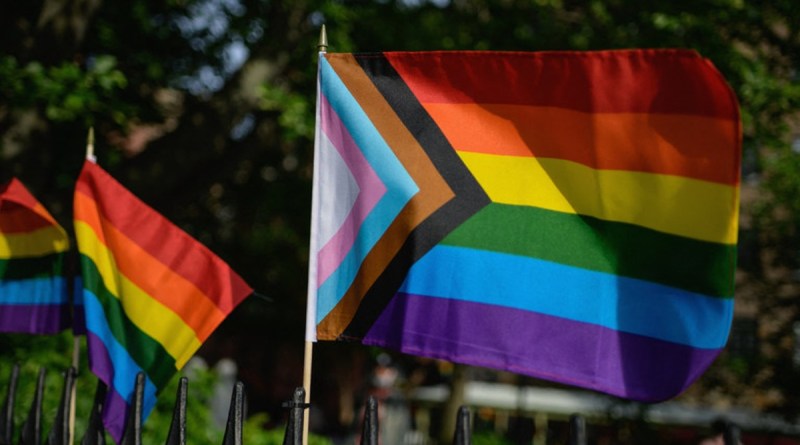
The headline photograph is the current Progress version of the GLBTQ+ pride flag that represents our community and our culture. Despite our novelty among the numerous movements in the civil rights world, we do have a history of different banners and what they symbolize waving above us. This “first Friday” of the 2022 GLBTQ+ History Month will examine and share images of these and briefly offer a story of the respective flag.
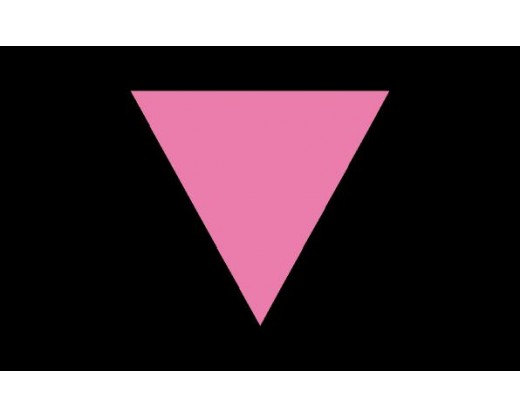
The Pink Triangle Flag:
The Pink Triangle flag!
The downward-pointing pink triangle was used by Nazi Germany as a badge of shame. It was sewn onto the shirts of homosexual (gay) men in concentration camps to identify and dehumanize them.
Homosexuality was made illegal in Germany in 1871, but it was rarely enforced. When the Nazi Party assumed control in 1933, it was made a priority in order to culturally and racially “purify” Germany. The Nazis arrested tens of thousands of GLBTQ+ individuals, the majority whom were homosexual men, whom they viewed as degenerate.
The early 1970s was when the gay rights movement began to emerge worldwide (after the 1969 Stonewall Inn riots) and various organizations reclaimed the pink triangle as an empowering symbol. It also serves as a reminder to remember the past – and to recognize the persecution GLBTQ+ people continue to suffer around the world.
The Lambda Flag:
Greek letter Lambda flag!
The Greek letter, lambda, was first chosen as a gay symbol when, in 1970, for the first anniversary of the Stonewall Inn Riots (SIR), it was adopted by New York City’s local chapter of Gay Activist Alliance as the emblem of their growing movement of gay liberation. Some identified the Greek letter with the representation of the word “liberation.”
In 1974, lambda was subsequently adopted by the International Gay Rights Congress meeting in Edinburgh, Scotland, UK, as their official symbol designating gay, bisexual and lesbian civil rights. Following this selection, lambda became internationally popular and recognized as representing the growing movement for civil rights for all people, regardless of their gender or sexual orientation.
Lambda was first designated in December, 1969, as representative of the new gay liberation movement by the graphic artist and one of the Gay Activist Alliance’s founding members, Tom Doerr. Doerr chose the letter because in chemistry it was a sign for catalyst. Others argue that lambda denoted the synergy of the growing gay movement: the idea of the whole being greater than the sum of all its parts.
Some view the lambda as being synonymous with males exclusively.
The Rainbow Flag:
The Rainbow flag!
First publicly raised on June 25, 1978, in San Francisco, California, USA, the flag flew over the United Nations Plaza in honour of then-gay pride at the 1978 San Francisco Gay Freedom Day Parade. The original flag consisted of eight coloured stripes and was designed by Gilbert Baker and hand-stitched and dyed with the help of friends and volunteers Lynn Segerblom, James McNamara, Glenne McElhinney, Joe Duran, and Paul Langlotz.
The eight-stripe original rainbow flag was soon revised to six stripes with pink (symbolizing “sex”) and turquoise (symbolizing “art and magic”) eliminated as the colours and dyes were unavailable in flag fabric. Baker conceived the flag would empower his “tribe” and a “rainbow of humanity” motif would represent the movement’s diversity.
The six stripes and what the colours represent:
Rainbow flag and symbolic colours!
The six stripes on the revised rainbow flag symbolize values held dear and not the various people comprising the community and culture.
The Progress Pride Flag:
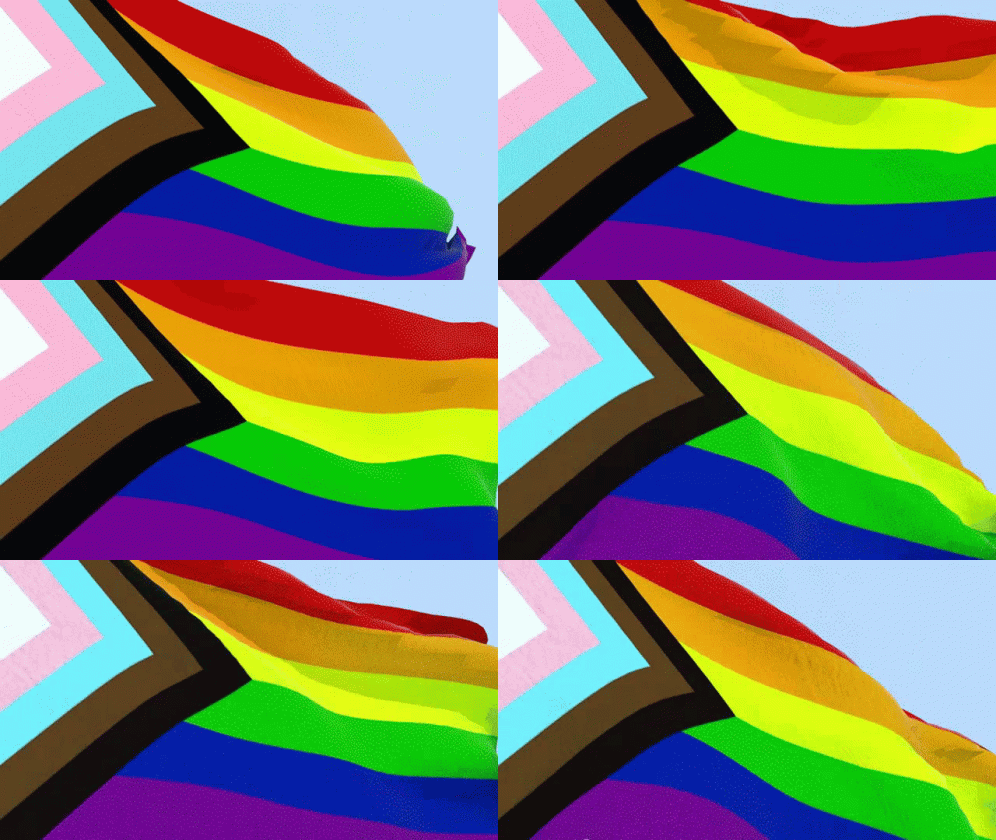
The Progress Pride flag!
The Progress Pride flag was developed by non-binary artist and designer Daniel Quasar in 2018. Based on Gilbert Baker’s 1978 Rainbow flag, Quasar’s redesign celebrates the diversity of the GLBTQ+ community and culture worldwide and encourages a more inclusive general society. The redesigned banner has increased the representation of discriminated minority identities covered by the GLBTQ+ umbrella.
Quasar’s creation placed black and brown stripes (emblems representing peoples of colour) and light blue, pink and white stripes (representing transgender, non-binary and intersex persons) in the shape of an arrow on the left of the Progress Pride flag. In Daniel Quasar’s words “…the arrow points to the right to show forward movement and illustrates that progress towards inclusivity still needs to be made.”
The black stripe has a double meaning as it is also intended for “those living with HIV/AIDS and the stigma and prejudice surrounding them and those who have died from the disease.”
Progress Pride body painted design!
The Progress Pride flag has been immediately an international success. On the evening of June 6, 2018, Quasar posted the design on social media and woke up the next morning to find that it had gone viral. It has been enthusiastically received by the GLBTQ+ community and culture all around the globe!
Naked hugs!
Roger Poladopoulos/ReNude Pride
Author’s Note: The next post entry here is planned for Monday, October 10, 2022, and the proposed topic is: “Coming Out Day!”
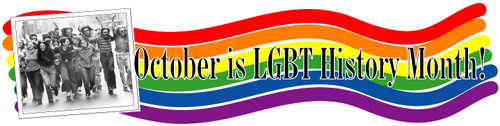
In the USA, the month of October, annually, is designated gay, lesbian, bisexual, transgender and queer+ (GLBTQ+) history month. A time to focus attention on the accomplishments, achievements and actions of members of the GLBTQ+ communities and culture that have made a constructive and positive difference not only in the USA but also in the world around us.
The concept of GLBTQ+ history month is a recent phenomenon that is both conflicting and controversial. It is opposed by many as being a recruiting tool for a lifestyle that is objectionable based on moral, philosophical and religious reasonings. Centuries of oppression and oversight have resulted in a mainstream general society that continues to ignore a specific segment of the population that it supposedly serves.
The purpose of this post entry for ReNude Pride is to introduce and examine this topic, explain the reasoning for endorsing a GLBTQ+ history month observance and offer resources and references. Hopefully, an unknown aspect of GLBTQ+ history is acquired by all reading/visiting here.
A skinny-dipping pool party, circa mid-1950’s!
Development:
In theory, at least, GLBTQ+ history is as old as the human race and has existed in parallel to society in general. Due to religious and social prejudices, this particular community was regularly oppressed and outlawed (illegal). On a regular basis, this population was ignored and intentionally forgotten. This predicament created a serious paucity of documentation of historical accomplishments and achievements regarding this culture.
Stonewall riots memorabilia!
The enthusiasm and excitement following the Stonewall Inn riots (SIR) on June 28, 1969, convinced some that documentation of events needed to happen. Too often, communities were denied essential elements of their heritage because the society in which they existed made no acknowledgment of any accomplishments of note. Of the emerging gay and lesbian populations, there came individuals who were dedicated to creating archives of what was now happening. Fledgling movements towards historical accumulation began among those witnessing firsthand the growing gay and lesbian freedom and honesty.
Protest power to the people!
In order to have complete equality within our broader society, appreciation and understanding of others must be created. Knowledge must be instilled so future generations can acknowledge and comprehend diversity. This creates an environment of awareness and encourages cultural acceptance and tolerance for all groups.
This is crucial because it celebrates and honours self-affirmation and self-actualization. It strengthens individualism as it increases nonconformity and uniqueness. It promotes social progress through educating people regarding negative social conditions which existed in the past but have since improved. It also directs it is currently necessary to empower equality and development. History is basically the story of the evolution and progress of a community or a culture.
1969 gay rights protest photo!
The USA observance was founded in 1994, by a Missouri high-school (secondary) history teacher named Rodney Wilson. His intent was to provide role models, build community and provide a civil rights statement of the efforts and accomplishments of the GLBTQ+ community and culture. In addition, he sought to establish a space where other educators could use as a resource for instructing youth concerning GLBTQ+ culture, history and community. He realized from his own, experience the serious lack of any available information on the historical accomplishments and contributions of this segment of the population.
Along with Rodney Wilson, the first coordinating committee for the 1994 GLBTQ+ History Month observance included Kevin Jennings of the Gay, Lesbian and Student Educators Network (GLSEN), Kevin Bayer of the Gerber/Hart of the Gay and Lesbian Archives in Chicago, Illinois, Paul Varnell, a journalist with the Windy Times also in Chicago, Torey Wilson, a Chicago area teacher, Johnda Boyce, a women’s studies major at Columbus University in Ohio, and Jessea Greenman of the University of California – Berkeley.
In the USA, GLBTQ+ History Month is endorsed/supported by GLAAD (Gay Lesbian Alliance Against Defamation), the Human Rights Campaign, the National Gay and Lesbian Task Force, the National Education Association (NEA), GLSEN (Gay Lesbian Student and Educators Network) and other national organizations.
A GLBTQ+ website was launched in 2006 and is maintained by Equality Forum. Equality Forum is a national GLBTQ+ civil rights organization with a strong educational focus. In addition to GLBTQ+ History Month, it also produces documentary films, sponsors high impact social initiatives and hosts an annual GLBTQ+ civil rights conference.
Logo: 2022 GLBTQ+ History Month!
The website created by the Equality Forum is linked GLBTQ+ History Month. This site features 31 honoured recipients for every year since 2006. Some of the 2022 selected ones are pictured above and all 31 are listed below on the date that they are featured. The website offers a page of information for each one. The site also contains information on ideas for discussion and activities concerning GLBTQ+ culture and history and serves as an excellent resource for educators and others seeking to inform the public about the significance of the GLBTQ+ community.
2022 Featured Recipients:
Hans Christian Anderson, Danish fairy tales author
Robina Asti, transgender rights plaintiff
Richard Avedon, prominent photographer
Ninia Baehr and Genora Dancel, marriage equality pioneers
Sue Bird, WNBA superstar
Victor Blackwell, CNN news anchor
Matt Bomer, actor
Raphael Bostic, Federal Reserve Bank CEO
Jennifer Finney Boylan, author and transgender activist
Kate Brown, Governor of State of Oregon
Nancy Carderas, Mexican writer and activist
Kitty Cone, disability rights activist
Robert Cutler, national security advisor
Andre` de Shields, actor and singer
Lea DeLaria, actor and comedian
Anna Elizabeth Dickinson, 19th century orator
Masha Gessen, Russian-American journalist
Ron Gold, gay pioneer
Radclyffe Hall, British author
Bell Hooks, author and feminist
Jazz Jennings, transgender youth activist
Mondaire Jones, first openly gay African-American congressman
Stephen Lachs, world’s first openly gay judge
Lawrence of Arabia, British military officer
Lance Loud, first openly gay reality TV star
James Merrill, Pulitzer Prize winner poet
Rudolf Nureyev, international ballet star
J. Paul Oetken, openly gay Federal judge
Amy Schneider, Jeopardy game show champion
Amy Walter, political analyst
Alice Wu, film director
Congratulations to all those above for their contributions to our community and culture. Keep with the good work!
Boxer freedom = gay and nude!
Bare Practitioner Encouragement:
It is vitally important for all of us to remember that we are a part of our community and culture’s history. Without our experiences and memories, there would be very little of our shared lives to recount to others coming after us. Whenever possible, let others know of your chapters in our story! Bare practitioners matter!
Naked hugs!
Roger Poladopoulos/ReNude Pride
Author’s Note: The next post entry here is planned for Monday, October 3, 2022, and the proposed topic is: “Bare Icon!”
Every year during the traditional gay, lesbian, bisexual, transgender and queer+ (GLBTQ+) pride celebrations, this question is continually posed to members of our community and culture, mainstream society, politicians and social commentators. The responses vary as to the background, political and religious leanings and social opinions and views of the persons asked.
Unfortunately, each year the replies increase in the expression of negativity. Aside from our community and cultural populations, the consensus grows as to the useless need for any GLBTQ+ pride commemoration. Many believe that equal rights have been obtained and flourish for all of us, regardless of our identity. However, recent actions and events indicate otherwise.
It is important to note that the visibility of our display of our pride frequently varies from individual to individual. Some feel the need for a prominent unfurling of our confidence by waving a flag or painting our bodies. Others are comfortable and content with merely publicly demonstrating their affection within our community by physically touching our otherwise engaging themselves and their nudity. There exists no concrete standard to be observed by all. My spouse, Aaron, and I use whatever method we find appropriate and available for the occasion.
Beach pride!
Immediately following the SIR (Stonewall Inn riots) in June, 1969, the emerging same gender loving communities recognized the need for celebrations in honour of all the newly “liberated” people to acquire acceptance, identification and recognition of themselves as a confident and proud culture within the mainstream population. Having survived the “closet” lifestyle for the vast majority of their secreted lives, these individuals needed to embrace themselves and build their new identity.
Pride celebrations were seen as a tool to encourage this need and in June, 1970, exactly one year after the SIR uprising, “gay liberation” events were held in New York City, San Francisco and Los Angeles to honour the occasion and to promote a fostering of community. These first observances attracted sizeable crowds of the growing community and their supporters – as well as protestors!
The initial events were determined to be successful and by the second anniversary of SIR, other municipalities were planning and staging their own festivals and parades to mark the occasion. Stonewall riots had most definitely captured and inspired our attention and our dreams for eventual equality!
Progress rainbow design body-painted on chest!
The first “gay liberation” observances soon evolved into pride festivals in order for people to celebrate their sexual freedom and identity. These witnessed the growing confidence that we felt as a community experiencing the first steps toward self-identification. We no longer accepted the archaic and derogatory label of “homosexual.” We welcomed the terms gay, lesbian and bisexual as appropriate titles of distinction and identity as constituents of the emerging culture that now entailed all of us. The decade of the 1960’s opened the doors for change and we became inspired by a new identity and hope for an improvement in our collective future. Freedom from centuries of condemnation, isolation and oppression was finally underway!
The popularity of pride events and the audiences they attracted made us aware of the fact we now numbered more than just an isolated “few.” There were now a sizable group of us and we were no longer alone. This awareness opened our eyes to the reality that we had much more in common than just our sexual situation. Others existed with similar abilities, attributes, ideals and interests. Community-building was now another development happening!
Our discovery of pride – within ourselves, in what we are and in who we are – became a solid foundation. It enabled us to become a working movement to initiate change, enhancement and growth, not only within our own society in general but throughout the world.
The original “Rainbow” flag and what the colours represent!
Despite our many differences, we acknowledge shared goals, ideals and objectives. In order to emblaze and empower our recognition and visibility, the Rainbow flag was selected to represent us. Each colour represents a common behaviour, belief and/or standard. The flag was designed by San Francisco artist Gilbert Baker and was first used in 1978. It was rapidly adopted across the globe.
The new Progress Rainbow flag in use with a background of the traditional Rainbow flags!
The Progress Rainbow flag was first unfurled in 2017 and was designed by Daniel Quasar. It includes the original banner plus the addition of insertions to represent the components of both racial and sexual diversities as well as representation of persons living with HIV/AIDS and those who died from the virus. The Progress flag is considered by many to truly reflect the majority of all persons within the GLBTQ+ culture. Many persons, both within our culture and from the outside, have commended Dan Quasar for incorporating the original Rainbow flag as a part of his design.
Author’s note:This flag is my personal favourite as I believe it is entails a greater representation of all of us – no matter what or who we consider ourselves.
Keith Haring’s “Coming Out Day” artwork!
In 1988, the GLBTQ+ culture launched National Coming Out Day on October 11, annually, in support of all people taking a “giant step” out of the closet and making themselves an example of pride. The concept is based on the personal being political – a popular idea. The emphasis is the basic form of social activism as openly acknowledging oneself to family, friends and colleagues and living life as a confident bisexual, gay or lesbian person.
The fact that homophobia thrives in an atmosphere of ignorance and silence, once people know they have loved ones – family or friends – who are themselves bisexual, gay or lesbian they will be less than willing to engage in homophobic or hateful behaviours. The goal being making the world a less repressive place.
Exiting his closet!
The examination of the title question here today, Is Pride Necessary?, provides mewith the simple response: yes! Not every one of us are raised to maturity in an environment that is accepting and supportive of a person’s prerogative to become the person that they indeed are. Not all of us are able to make that determination in our lives. Therefore, I feel that pride is not only necessary but essential.
If at least one person questioning her/his sexual identity is answered, then yes, pride is necessary.
If at least one suicide over sexual identity is averted, then yes, pride is necessary.
If at least one despondent and lonely person finds acceptance and friendship, then yes, pride is necessary.
If at least one ideal is met and achieved, then yes, pride is necessary.
If at least one person reaches out and helps another, then yes, pride is necessary.
If at least one dilemma or problem is solved, then yes, pride is necessary.
A community is based on determination, purpose and through person-to-person contact. A culture is built upon communities interacting and working together. A cultural dynamic often opens doors and initiates a positive development for humanity, then yes, pride is necessary.
Pride!
This year, on June 13, 2022, police in the state of Idaho, in the USA, arrested 31 people who had face coverings, white supremacist insignia, shields and an “operations plan” to riot and open gunfire on an GLBTQ+ Pride event in Coeur d’Alene, Idaho, a city of about 50,000 people near the border with Washington state. Police identified all those arrested as members of Patriotic Front, a white supremacist group already known for extremist tactics.
The organizers of the GLBTQ+ event said it was a family-friendly community event celebrating diversity and building a stronger and unified community for all. The sponsoring group is the North Idaho Pride Alliance and the event was entitled “Pride In The Park.”
In another incident related to the same Pride In The Park, police conducted a similar action against the Panhandle Patriots, a local motorcycle club. The cyclists were organizing a “Gun d’Alene” event to disrupt and openly assault the Pride In The Park “queers.” Firearms were seized in the motorcyclists arrests.
If law enforcement need to take actions such as the above, then yes, pride is necessary.
Our pride in ourselves!
Naked hugs!
Roger Poladopoulos/ReNude Pride
Author’s Note: The next post entry for here is planned for Monday, August 29, 2022, and the proposed topic is: “Making Memories #2!” This post is composed by my spouse, Aaron.
June 28, 1969, is a date that has become chiseled in stone for gay, lesbian, bisexual, transgender and queer+ (GLBTQ+) people worldwide due to SIR (Stonewall Inn Riots). What happened on that night first erupted and shortly exploded into a global movement for dignity, equality and respect for GLBTQ+ persons specifically and in general, everyone. The Stonewall Inn Riots were an unplanned reaction to centuries of abuse, discrimination, intimidation, oppression and violence waged against people considered as “homosexual” (man sexuals). This protest served as a flame that quickly ignited into raging fires worldwide.
The Stonewall Inn, circa 1969!
Background:
The robust and spirited social settings in the 1920’s post-Great War (World War I) era often overshadowed the climate of hatred and ridicule of the then “homosexual” (same gender loving) community. For the most part, they were largely publicly ignored. However, disdain and discrimination didn’t cease or end. It was simply temporarily replaced by the emerging “good times.”
The economic crisis and worldwide depression of the 1930’s prolonged the disregard that society held for all “homosexuals” no matter their gender. Everyone was focused on survival and the source of their next meal. Few, if any, had any curiosity, interest or time to devote to social deviants.
World War II followed the global financial situation and suddenly “homosexuality” again temporarily lost notoriety. What better way to rid humanity of this disgusting condition than to send “homosexuals” off to fight and die for freedom? The need for bodies to sacrifice trumped denying “homosexuals” the right to serve their country.
After World War II, the Cold War/Iron Curtain mentality emerged and harsh judgments on all persons and things viewed as abnormal abounded. “Homosexuals” soon became as notorious as communists as enemies of the state. Government, law enforcement, the press and society were quick to label “homosexuals” as misfits, outcasts, pariahs and perverts.
“The door of the Stonewall had wrought-iron bars across this little peephole, a little wooden thing that slid open. And the man inside would look at you and, if you looked like you belonged there, he would let you in.”
Chris Babick, describing the entrance to the Stonewall Inn, 1969
The Stonewall Inn (it was never a hotel) opened as a bar catering to the “homosexual” community in 1967. Prior to that, it had been a stable (for horses), a French bakery, a tearoom and lastly, a restaurant that had burned out of business. It opened as a bar under Mafia-affiliated management and was very connected to organized crime. The establishment consisted of two main rooms, each with its own dance floor. The front room was popular with the older clientele and the back room attracted the younger ones.
At the time of the Stonewall Inn Riots (SIR), it was unlawful for “homosexuals” to gather together in public and same gender intimacy was illegal in every state in the USA except Illinois. Same gender loving persons could and were fired from their jobs without any legal recourse. They were ridiculed and attacked publicly often without any consequence. Simply being a “homosexual” was considered an antisocial and criminal act. Everyone was required, by law, to wear clothing appropriate to their birth gender. The only exception allowed was for Halloween.
Belligerent stance!
The Raid and Ensuing Riot:
Friday evening, June 27, 1969, was a hot and humid start to a weekend. Most of the patrons gathered inside the Stonewall Inn were looking forward to a night of dancing, partying with friends, relaxing with cocktails and enjoying a summer’s night in New York City. They had no idea that they were about to witness a historical event that would change their lives – and the “homosexual” world – forever.
Both the dance floors at Stonewall Inn were full of dancing “homosexual” couples. It was now after midnight and June 28, 1969, was now in its infancy. Suddenly, the surging music stopped. The lights that were dimmed to enhance the atmosphere came back on in a bight glare that caught everyone by surprise. Almost at once, the realization dawned on the festive crowd: the police were raiding the bar.
The New York City Police Department was long familiar with conducting raids on gay and lesbian bars. It was a frequent occurrence and standards rarely varied in all boroughs throughout the city. Their process was fairly routine and all officers recognized “homosexuals” as a relatively compliant and passive population. For this reason, only one police transport vehicle (paddy wagon) and one marked police squad car were involved in the raid on the Stonewall Inn. Less than a dozen officers were assigned the tasks of managing and segregating the patrons, confiscating all the alcohol and arresting the Stonewall Inn employees.
“The police weren’t letting us dance. If there’s one place in the world where you can dance and feel yourself fully as a person and that’s threatened with being taken away, those are fighting words.”
Tommy Lanigen-Schmidt, Stonewall Inn patron and riot participant
The arrival of the police raiding force caused pandemonium to erupt inside the Stonewall Inn. Customers searched in vain for an escape route or for a place to hide. Law enforcement immediately began confiscating both beer and liquor as evidence against the establishment and segregating the crowd: bar employees, cross-dressers (transgender persons) and then the “regular homosexuals.” The bar employees and the cross-dressers were to be arrested for their violating the law. The “regular homosexuals,” once they showed officers their proper identifications, were to be given citations and then permitted to leave.
The Stonewall Riots: actual photographs!
The year, 1969, was at the end of a decade that had witnessed massive social unrests. The African-American struggles and protests for civil rights, the birth of the feminist and women’s rights movements, the anti-Vietnam war demonstrations and the equal pay marches for primarily Latino immigrant farm workers were underway during this time. The “homosexuals” who had participated in some of these public unrests were energized and many wondered when their time for equality would happen. Little did they, and the police raiding the Stonewall Inn, realize that particular moment was actually upon them.
As the police began checking the identities of those inside the Stonewall Inn, those with proper credentials were released and herded outside the bar. Only this time, instead of simply leaving the premises, they congregated on the sidewalks and at a nearby park. Once law enforcement attempted to disperse them, they grew confrontational and belligerent.
The police, completely unaccustomed to “homosexual” defiance, continued to press the order to vacate the area. The crowd, emboldened by their frustration with being treated as “deviants” and second-class citizens, began to chant and to empty trash cans and hurl the garbage at the officers.
By this time, passers-by, curious as to what was happening, joined the vocal and upset “homosexuals” to express their dissatisfaction with the raid. The crowd outside the Stonewall Inn began to grow in number, anger and frustration. Once the word of what had transpired inside the bar began to spread, even more “homosexuals” started to descend into the neighborhood and amass in the bar’s vicinity.
“There was no gay pride before Stonewall. Only gay fear and gay isolation and gay distrust and gay self-hatred.”
Edmund White, gay author
Law enforcement, confused and distracted over the reaction to the raid, soon had a very sobering moment. The gathering outside the bar had them surrounded inside the bar with little, if any, relief in sight. Those “homosexuals” who were kept inside were fast becoming as bellicose as were those gathered outside.
By now, the police trapped inside the facility understood that the situation had gotten beyond their control. They tried to call for reinforcements but were unable to reach any source for assistance. They had secured the bar but were trapped inside and the crowd outside was swelling in both fury and size. A few hundred patrons had now grown to an angry mob of several thousand and more were joining by the minute.
Stonewall Inn and sidewalk at night!
“You could hear screaming outside, a lot of noise from the protesters, and it was a good sound. It was a real good sound that, you know, you had a lot of people out there pulling for you.”
Raymond Castro, a Stonewall Inn customer being detained inside the bar during its siege
No one in the New York City Police Department had anticipated the “homosexuals,” always perceived as being meek and mild, to fight back. The years of abuse, oppression and ridicule had taken its toll and the frustration now became revolution, and the time for retribution was at hand. Unfortunately for the police, the pent-up anger at law enforcement was now being released and returned in kind. The officers were now prisoners inside the Stonewall Inn.
Slightly over two hours after the raid had started, the police and their detainees were trapped in the Stonewall Inn and no relief was in sight. The two-way communication devices between the raiding party and their office weren’t working inside the bar and the only commercial phone in the facility couldn’t connect with any local police stations. The passive “homosexuals” had finally achieved a “first” in their spontaneous riot: the raiders were contained, surrounded and all very nervous. By this time, the crowd outside the Greenwich Village bar now numbered several thousand with a full-fledged riot underway.
In an effort to relieve the inflammatory predicament, the trapped police decided to send the detainees and half the officers in the two police vehicles to the closest local precinct. There, the detainees would be formally charged with arrest and the officers could make arrangements for a police riot force to assemble and rescue the remaining law enforcement personnel. This relief effort finally returned to the bar and eventually dispersed the angry crowd of “homosexuals” and curious onlookers several hours later.
Despite damage to the Stonewall Inn and the loss of the license to sell alcoholic beverages, the bar opened for business (dancing) the following night. By Saturday evening, word of the incident had spread throughout the city’s closeted “homosexual” community (primarily by word-of-mouth). A larger than usual crowd gathered both inside and outside the Greenwich Village establishment. Most didn’t expect a repeat of the raid the night before and a significant number of those present mainly wanted to inspect the damage.
The police, however, had different ideas. They were strictly outside the bar in full force with a large number in riot gear. They had learned their lesson and were determined to remain in full control should the patrons become unruly again.
Pride!
The “homosexuals” had been empowered by the riot the previous evening and weren’t about to be bullied into submission again. As the large police presence attempted to disperse those gathered outside the Stonewall Inn the second night, they were confronted by verbal assaults and an array of street-savvy tactics that saw law enforcement chase off onlookers, only to have them run around the city block and return again. Silent obedience to uniformed policemen was no longer a fact of life for New York’s “homosexuals.” They were tired of suffering abuse, disrespect, ridicule and treatment as second-class citizens.
The second night of the Stonewall congregation wasn’t as disruptive as the one before. No further damage was done to the bar facility. However, an awakening consciousness was raised within the municipal “homosexual” community that would change the way society viewed them and – most importantly – the way they perceived themselves.
For the first time, the often assumed passive community stood up for their rights and demonstrated that they, as a full community, had “had enough!”
Happy Stonewall Inn Riot day!
Naked hugs!
Roger Poladopoulos/ReNude Pride
Author’s Note: The next post entry for here is planned for Thursday, June 30, 2022, and the proposed topic is: “Bottoms-Up! June, 2022”



















 ReNude Pride: Guys Without Boxers!