Unfurled Above Us!

Flying bold and bravely!

The headline photograph is the current Progress version of the GLBTQ+ pride flag that represents our community and our culture. Despite our novelty among the numerous movements in the civil rights world, we do have a history of different banners and what they symbolize waving above us. This “first Friday” of the 2022 GLBTQ+ History Month will examine and share images of these and briefly offer a story of the respective flag.

The Pink Triangle Flag:
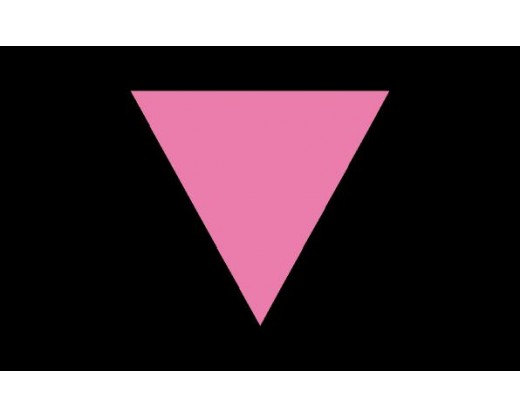
The Pink Triangle flag!

The downward-pointing pink triangle was used by Nazi Germany as a badge of shame. It was sewn onto the shirts of homosexual (gay) men in concentration camps to identify and dehumanize them.

Homosexuality was made illegal in Germany in 1871, but it was rarely enforced. When the Nazi Party assumed control in 1933, it was made a priority in order to culturally and racially “purify” Germany. The Nazis arrested tens of thousands of GLBTQ+ individuals, the majority whom were homosexual men, whom they viewed as degenerate.

The early 1970s was when the gay rights movement began to emerge worldwide (after the 1969 Stonewall Inn riots) and various organizations reclaimed the pink triangle as an empowering symbol. It also serves as a reminder to remember the past – and to recognize the persecution GLBTQ+ people continue to suffer around the world.

The Lambda Flag:

Greek letter Lambda flag!

The Greek letter, lambda, was first chosen as a gay symbol when, in 1970, for the first anniversary of the Stonewall Inn Riots (SIR), it was adopted by New York City’s local chapter of Gay Activist Alliance as the emblem of their growing movement of gay liberation. Some identified the Greek letter with the representation of the word “liberation.”

In 1974, lambda was subsequently adopted by the International Gay Rights Congress meeting in Edinburgh, Scotland, UK, as their official symbol designating gay, bisexual and lesbian civil rights. Following this selection, lambda became internationally popular and recognized as representing the growing movement for civil rights for all people, regardless of their gender or sexual orientation.

Lambda was first designated in December, 1969, as representative of the new gay liberation movement by the graphic artist and one of the Gay Activist Alliance’s founding members, Tom Doerr. Doerr chose the letter because in chemistry it was a sign for catalyst. Others argue that lambda denoted the synergy of the growing gay movement: the idea of the whole being greater than the sum of all its parts.

Some view the lambda as being synonymous with males exclusively.

The Rainbow Flag:

The Rainbow flag!

First publicly raised on June 25, 1978, in San Francisco, California, USA, the flag flew over the United Nations Plaza in honour of then-gay pride at the 1978 San Francisco Gay Freedom Day Parade. The original flag consisted of eight coloured stripes and was designed by Gilbert Baker and hand-stitched and dyed with the help of friends and volunteers Lynn Segerblom, James McNamara, Glenne McElhinney, Joe Duran, and Paul Langlotz.

The eight-stripe original rainbow flag was soon revised to six stripes with pink (symbolizing “sex”) and turquoise (symbolizing “art and magic”) eliminated as the colours and dyes were unavailable in flag fabric. Baker conceived the flag would empower his “tribe” and a “rainbow of humanity” motif would represent the movement’s diversity.

The six stripes and what the colours represent:

Rainbow flag and symbolic colours!

The six stripes on the revised rainbow flag symbolize values held dear and not the various people comprising the community and culture.

The Progress Pride Flag:

The Progress Pride flag!

The Progress Pride flag was developed by non-binary artist and designer Daniel Quasar in 2018. Based on Gilbert Baker’s 1978 Rainbow flag, Quasar’s redesign celebrates the diversity of the GLBTQ+ community and culture worldwide and encourages a more inclusive general society. The redesigned banner has increased the representation of discriminated minority identities covered by the GLBTQ+ umbrella.

Quasar’s creation placed black and brown stripes (emblems representing peoples of colour) and light blue, pink and white stripes (representing transgender, non-binary and intersex persons) in the shape of an arrow on the left of the Progress Pride flag. In Daniel Quasar’s words “…the arrow points to the right to show forward movement and illustrates that progress towards inclusivity still needs to be made.”

The black stripe has a double meaning as it is also intended for “those living with HIV/AIDS and the stigma and prejudice surrounding them and those who have died from the disease.”

Progress Pride body painted design!

The Progress Pride flag has been immediately an international success. On the evening of June 6, 2018, Quasar posted the design on social media and woke up the next morning to find that it had gone viral. It has been enthusiastically received by the GLBTQ+ community and culture all around the globe!

Naked hugs!

Roger Poladopoulos/ReNude Pride

Author’s Note: The next post entry here is planned for Monday, October 10, 2022, and the proposed topic is: “Coming Out Day!”
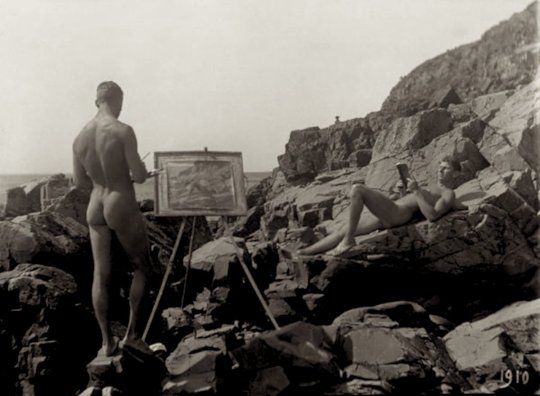
Bare Icon!

Naked painting nude!

Openly gay artist, Ainor Bagner, of Denmark – himself plainly nude – paints a fellow naked subject reading a book. The sexuality of the reader is unknown. Bagner was an admitted same gender loving man in an age that was hostile to those types of attractions and relationships. The clothing status and sexuality of the photographer is also unknown.

In the lower right-hand corner of the picture image is etched “1910.” More than a century ago. The photograph was made on the North Sea coast of Denmark.

A photographer from our past!

The artistic painter, Ainor Bagner, featured in the iconic photograph, was openly a gay man, then it is within reason to anticipate the same from both the subject model and the photographer. In the very early days of the 20th century, the tolerance for gay people was very restricted, even in a fairly progressive society such as Denmark (Scandinavia). The fact that this image survived all this time contributes to it’s historical significance.

Somewhat ironic is the fact that in the iconic photograph, a bare model is painted by a bare artist and that they are both posing on a barren (rocky) landscape. Bare – as opposed to barren – comfort and freedom for everyone!

The secondary image, above, is a vintage picture of a photographer posing with his camera on a ladder. This has no relationship to the Bagner photo except to represent the possible source of the image. This is not the actual photographer!

Naked hugs!

Roger Poladopoulos/ReNude Pride

Author’s Note: The next post entry here is planned for Friday, October 7, 2022, and the proposed topic is: “Waving Above Us!”

October: GLBTQ+ History Month!

Celebrate all October!

Background:

In the USA, the month of October, annually, is designated gay, lesbian, bisexual, transgender and queer+ (GLBTQ+) history month. A time to focus attention on the accomplishments, achievements and actions of members of the GLBTQ+ communities and culture that have made a constructive and positive difference not only in the USA but also in the world around us.

The concept of GLBTQ+ history month is a recent phenomenon that is both conflicting and controversial. It is opposed by many as being a recruiting tool for a lifestyle that is objectionable based on moral, philosophical and religious reasonings. Centuries of oppression and oversight have resulted in a mainstream general society that continues to ignore a specific segment of the population that it supposedly serves.

The purpose of this post entry for ReNude Pride is to introduce and examine this topic, explain the reasoning for endorsing a GLBTQ+ history month observance and offer resources and references. Hopefully, an unknown aspect of GLBTQ+ history is acquired by all reading/visiting here.

A skinny-dipping pool party, circa mid-1950’s!

Development:

In theory, at least, GLBTQ+ history is as old as the human race and has existed in parallel to society in general. Due to religious and social prejudices, this particular community was regularly oppressed and outlawed (illegal). On a regular basis, this population was ignored and intentionally forgotten. This predicament created a serious paucity of documentation of historical accomplishments and achievements regarding this culture.

Stonewall riots memorabilia!

The enthusiasm and excitement following the Stonewall Inn riots (SIR) on June 28, 1969, convinced some that documentation of events needed to happen. Too often, communities were denied essential elements of their heritage because the society in which they existed made no acknowledgment of any accomplishments of note. Of the emerging gay and lesbian populations, there came individuals who were dedicated to creating archives of what was now happening. Fledgling movements towards historical accumulation began among those witnessing firsthand the growing gay and lesbian freedom and honesty.

Protest power to the people!

In order to have complete equality within our broader society, appreciation and understanding of others must be created. Knowledge must be instilled so future generations can acknowledge and comprehend diversity. This creates an environment of awareness and encourages cultural acceptance and tolerance for all groups.

This is crucial because it celebrates and honours self-affirmation and self-actualization. It strengthens individualism as it increases nonconformity and uniqueness. It promotes social progress through educating people regarding negative social conditions which existed in the past but have since improved. It also directs it is currently necessary to empower equality and development. History is basically the story of the evolution and progress of a community or a culture.

1969 gay rights protest photo!

The USA observance was founded in 1994, by a Missouri high-school (secondary) history teacher named Rodney Wilson. His intent was to provide role models, build community and provide a civil rights statement of the efforts and accomplishments of the GLBTQ+ community and culture. In addition, he sought to establish a space where other educators could use as a resource for instructing youth concerning GLBTQ+ culture, history and community. He realized from his own, experience the serious lack of any available information on the historical accomplishments and contributions of this segment of the population.

Along with Rodney Wilson, the first coordinating committee for the 1994 GLBTQ+ History Month observance included Kevin Jennings of the Gay, Lesbian and Student Educators Network (GLSEN), Kevin Bayer of the Gerber/Hart of the Gay and Lesbian Archives in Chicago, Illinois, Paul Varnell, a journalist with the Windy Times also in Chicago, Torey Wilson, a Chicago area teacher, Johnda Boyce, a women’s studies major at Columbus University in Ohio, and Jessea Greenman of the University of California – Berkeley.

In the USA, GLBTQ+ History Month is endorsed/supported by GLAAD (Gay Lesbian Alliance Against Defamation), the Human Rights Campaign, the National Gay and Lesbian Task Force, the National Education Association (NEA), GLSEN (Gay Lesbian Student and Educators Network) and other national organizations.

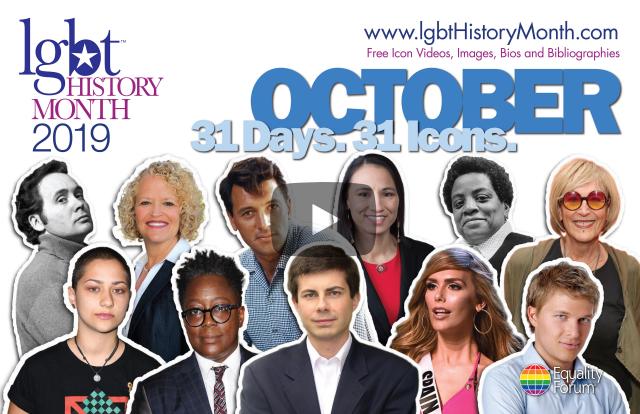
A GLBTQ+ website was launched in 2006 and is maintained by Equality Forum. Equality Forum is a national GLBTQ+ civil rights organization with a strong educational focus. In addition to GLBTQ+ History Month, it also produces documentary films, sponsors high impact social initiatives and hosts an annual GLBTQ+ civil rights conference.

Logo: 2022 GLBTQ+ History Month!

The website created by the Equality Forum is linked GLBTQ+ History Month. This site features 31 honoured recipients for every year since 2006. Some of the 2022 selected ones are pictured above and all 31 are listed below on the date that they are featured. The website offers a page of information for each one. The site also contains information on ideas for discussion and activities concerning GLBTQ+ culture and history and serves as an excellent resource for educators and others seeking to inform the public about the significance of the GLBTQ+ community.

2022 Featured Recipients:

Hans Christian Anderson, Danish fairy tales author

Robina Asti, transgender rights plaintiff

Richard Avedon, prominent photographer

Ninia Baehr and Genora Dancel, marriage equality pioneers

Sue Bird, WNBA superstar

Victor Blackwell, CNN news anchor

Matt Bomer, actor

Raphael Bostic, Federal Reserve Bank CEO

Jennifer Finney Boylan, author and transgender activist

Kate Brown, Governor of State of Oregon

Nancy Carderas, Mexican writer and activist

Kitty Cone, disability rights activist

Robert Cutler, national security advisor

Andre` de Shields, actor and singer

Lea DeLaria, actor and comedian

Anna Elizabeth Dickinson, 19th century orator

Masha Gessen, Russian-American journalist

Ron Gold, gay pioneer

Radclyffe Hall, British author

Bell Hooks, author and feminist

Jazz Jennings, transgender youth activist

Mondaire Jones, first openly gay African-American congressman

Stephen Lachs, world’s first openly gay judge

Lawrence of Arabia, British military officer

Lance Loud, first openly gay reality TV star

James Merrill, Pulitzer Prize winner poet

Rudolf Nureyev, international ballet star

J. Paul Oetken, openly gay Federal judge

Amy Schneider, Jeopardy game show champion

Amy Walter, political analyst

Alice Wu, film director

Congratulations to all those above for their contributions to our community and culture. Keep with the good work!

Boxer freedom = gay and nude!

Bare Practitioner Encouragement:

It is vitally important for all of us to remember that we are a part of our community and culture’s history. Without our experiences and memories, there would be very little of our shared lives to recount to others coming after us. Whenever possible, let others know of your chapters in our story! Bare practitioners matter!

Naked hugs!

Roger Poladopoulos/ReNude Pride

Author’s Note: The next post entry here is planned for Monday, October 3, 2022, and the proposed topic is: “Bare Icon!”

Photo-blog: GLBTQ Bare History Month Friday #4

This is another Friday, the fourth, during 2019 GLBTQ Bare History Month. The post today is the last one in this series for this annual celebration. The heading picture, shown above, features a man in the early days of color photography poolside with his beach ball. Judging from the man’s hairstyle, the picture dates from the middle 1960’s. There is no information of the photographer.

Continue reading Photo-blog: GLBTQ Bare History Month Friday #4

Photo-blog: GLBTQ Bare History Month Friday #3

As those of you who follow ReNude Pride or who visit here regularly already know, I could not allow this observation of GLBTQ Bare History Month pass without posting pictures of one of the most popular naked past-times, skinny-dipping (swimming nude). The man in the above image is bottom’s up in an indoor pool. Judging by his hair style, it is probably the late 1950’s to early 1960’s, before The Beatles became famous.

Continue reading Photo-blog: GLBTQ Bare History Month Friday #3

Photo-blog: GLBTQ Bare History Month Friday #2

Today is the second installment of this series for Fridays during 2019 GLBTQ Bare History Month here on ReNude Pride. As a reminder, every Friday in October will have a post in celebration of  our same and dual (bisexual) gender loving community heritage in honor of our bare practitioners (naturists or nudists). This post’s “heading” photograph shows us a man posing his buttocks at a photographer’s studio in New York City in the year, 1900.

Continue reading Photo-blog: GLBTQ Bare History Month Friday #2

Richmond: GLBTQ History Walking Tour

In my Reflections: End of September, 2019, published here on Friday, September 27, 2019, I shared that Aaron (my spouse) and I plus Alex, my identical twin brother and his significant other, were visiting Richmond, Virginia (where Twin and I grew up) for their GLBTQ Pride Festival on Saturday, September 28. While enjoying the event, I visited the booth sponsored by the Virginia Department of Historic Resources and picked up a map for a walking tour of GLBTQ sites in the downtown city area.

Continue reading Richmond: GLBTQ History Walking Tour

Photo-blog: GLBTQ Bare History Month Friday #1

Welcome to the 2019 Photo-blog: GLBTQ Bare History Month Friday initial posting, the first of this series. There are many opportunities to offer images and scenes of a large number of GLBTQ bare practitioners here on ReNude Pride, so it makes perfect sense to me to devote the month of October to feature images from the recent past to prove to us all that our community has been both alive and thriving for awhile now!

Continue reading Photo-blog: GLBTQ Bare History Month Friday #1

October: GLBTQ History Month

In the USA, the month of October, annually, is celebrated as Gay, Lesbian, Bisexual, Transgender and Queer History Month (GLBTQ History Month). This observance is a national time to acknowledge, focus, highlight, learn and to review the numerous and frequently overlooked contributions made by GLBTQ persons to both our national and international societies. Many of these awesome efforts were offered before what’s now the GLBTQ community was ever appreciated and recognized.

Continue reading October: GLBTQ History Month

Friday #4: Bare GLBTQ History Month

Today is the final feature in this series, GLBTQ Bare History Month, a part of the celebration of October as GLBTQ History Month here on ReNude Pride. As promised in the first installment of this series, this week’s theme is Skinny-Dipping (swimming naked). There are just some things in life that always withstand the tests of both time and generations and skinny-dipping apparently is one of those activities. Skinny-Dipping or nude swimming or natural swimming is one of those bare activities that is enjoyed and practiced all around the world.

Continue reading Friday #4: Bare GLBTQ History Month