Introduction: The Great War (what is today known as World War I) began with the declaration of war between the Empire of Austria-Hungary and the Kingdom of Serbia on July 28, 1914. The conflict expanded and finally ended on Armistice Day, November 11, 1918. The peace treaty officially bringing the devastation to an end was signed in 1919. Millions died, globally, as a result of the belligerence.
The principle combatants in The Great War were the Central Powers: The Austria-Hungary Empire, Bulgaria, the German Empire and the Ottoman Empire. The Allied Powers were: Belgium, the British Empire, France, Greece, Italy, Japan, Luxembourg, Portugal, Roumania, The Russian Empire, Serbia, and the USA (1917-1918). Battles and military engagements occurred in Africa, Asia, Europe, the Middle East and the South Pacific. This led to the designation of the conflict as World War I.
A direct consequence of The Great War was the eruption of yet another global clash, World War II, that began twenty years later, in 1939. That second conflict proved even more destructive than the first.
One of the sparks that triggered the beginning of The Great War was the assassination of the heir to the Austria-Hungary throne, Archduke Franz Ferdinand, and his wife, the Countess Sophie, by Serbians opposed to the dominance of Austria-Hungary in Balkan politics. In reality, the heir was in favour of greater self-determination of the the native Serbs, Bosnian and Croatian peoples in their own governance. Unfortunately, his death also destroyed any peaceful solution to the volatile political situation.
In discussions with my students about the origins of The Great War, I have recently noticed a growing number of them referring to the actions of the Archduke Franz Ferdinand as among the causes of the First World War. This misjudgment I attribute to faulty teaching from their secondary school instructors and try my best to keep them abreast of historical truths. I’m not familiar with all of the archduke’s personal characteristics but I am unable to identify any historical source for this misinformation.
By 1921, almost all the world that survived the destruction of The Great War was observing the anniversary of the official Armistice that ended the slaughter. In the United Kingdom and throughout the Commonwealth, the peoples joined with King George V and Queen Mary in honouring the deceased on Remembrance Day. Two minutes of complete silence was publicly held in commemoration beginning the hour of the end of the fighting: 11:00 a.m. In Western Europe, Armistice Day ceremonies were conducted at cemeteries and battlefields. In the USA, the custom of Veteran’s Day was implemented.
Battlefield remembrance!
The Red poppy flower represents consolation, remembrance and death. The poppy is a common symbol that has been used to represent everything from peace to death and even simply sleep. Since ancient times, poppies placed on tombstones represent eternal sleep.
During The Great War, much of the fighting took place in western Europe, especially in the Flanders region of the Kingdom of Belgium. The countryside was blasted, bombed and fought over repeatedly. The landscape was torn apart by trenches. The previously beautiful scenery was turned to mud: bleak and barren where little or nothing could grow. There was a notable exception to the drudgery: the bright red Flanders poppy. These resilient flowers flourished amidst so much chaos and destruction.
John McCrae was the son of Scottish immigrant parents and was born in Guelph, Ontario, Canada, in 1872. In May, 1915, he was serving in the Royal Canadian Army Medical Corps in Flanders, Belgium. On May 2, 1915, Lieutenant Alexis Helmer, a Canadian field artillary oficr and close personal friend of McCrae, was killed in the Second Battle of Ypres. Shortly afterwards, McCrae wrote the following poem, “In Flanders Fields,” in memory of his friend and honouring all the war dead.
The poem was first published on December 8, 1915, in London, United Kingdom, in the satirical magazine, Punch. It was immediately popular and widely circulated and reprinted as a fitting tribute.
In Flanders Fields
In Flanders fields, the poppies blow
between the crosses, row on row,
That mark our place; and in the sky
the larks, still barely singing, fly
Scare heard amid the guns below..
We are the Dead. Short days ago
we lived, felt dawn, saw sunset glow,
Loved and were loved, and now we lie,
In Flanders fields.
Take up our quarrel with the foe;
to you from falling hands we throw
The torch, be yours to hold it high.
If ye break faith with us who die
We shall not sleep, though poppies grow
In Flanders fields.
We remember and appreciate the efforts of John McCrae and all the fallen, wherever they lie.
Remembrance Day Poppy Campaign
Etiquette
Participation in the Remembrance Day Poppy Campaign is completely voluntary. It should never be mandatory or required.
The poppy should be worn on the left side of the body over the top of the heart or on the left lapel.
Acceptable colours for the Remembrance Day Poppy Campaign are: red (remembrance) or white (peace).
Two minutes of silence are recommended, beginning at 11:00 a.m., (local time). If prayers are to be offered, they should be voluntary and silently.
The poppy should not be worn after 11 November (exception: memorial services).
********************
Naked hugs!
Roger Poladopoulos/ReNude Pride
Author’s Note: The next post entry here is planned for Monday, November 13, 2023, and the proposed topic is: “Nakedness: Downside!”
Notation: I’m certain there are some beaches on our planet where it’s conducive to skinny-dip during the month of October!
October’s Bright Blue Weather
by: Helen Hunt Jackson
O suns and skies and clouds of June,
and flowers of June together,
Ye cannot rival for one hour
October’s bright blue weather.
When loud the bumble-bee makes haste,
Belated, thriftless, vagrant,
And golden-rod is dying fast,
And lanes with grapes are fragrant;
When gentians roll their fringes tight
to save them for the morning,
And chestnuts fall from satin burrs
Without a sound of warning;
When on the ground red apples lie
In piles like jewels shining,
And redder still on old stone walls
Are leaves of woodbine twining;
When all the lovely wayside things
Their white-winged seeds are sowing,
And in the fields, still green and fair,
Late aftermaths are growing;
When springs run low, and on the brooks,
In idle golden freighting,
Bright leaves sink noiseless in the hush
Of woods, for winter waiting;
When comrades seek sweet country haunts,
By twos and twos together,
And counts like misers, hour by hour,
October’s bright blue weather.
O suns and skies and flowers of June,
Count all your boasts together,
Love loveth best of all the year
October’s bright blue weather.
End
********************
While my identical twin brother, Alex, and I were students at the Virginia School for the Deaf and Blind residential school, we had several teachers who had us memorize poetry and then recite the poems using American Sign Language (ASL) in front of our class. Fine. Memorizing wasn’t impossible but the order of the grammar the poets used and the sense it did not make was confusing. Delightful students that we were, we simply committed the poems to our memory and put comprehension to the wayside. After all, our task was simple: complete the job and move on to the next level.
Our teachers always explained to us students and to our parents that this lesson of us reciting poetry helped us to develop comprehension of English as a language, as opposed to ASL. That may have appeared as a valid reasoning for a few but we students understood it for exactly what it was intended to be: busy work! Keep us occupied!
October foliage!
Our teacher who required us to commit this poem, “October’s Bright Blue Weather” was one of my personal favourites of my primary school years. This happened to be the very first of nine poems she assigned us. Even today, I am still able to recall the first opening lines of the poem, without hesitation.
Enjoy “October’s Bright Blue Weather!”
Naked hugs!
Roger Poladopoulos/ReNude Pride
Author’s Note: The next post entry here is planned for Monday, October 30, 2023, and the proposed topic is: “The Boys In The Band!”
The Bare Nation! The Naked Nations! The Nude Nation!
All joining their hands together. Helping hands. Cooperating. United. All for one and one for all!
Brotherhood!
Body and Clothes Freedom!
All embodied into togetherness! Bare. Naked. Nude. Not concealing their common link against artificial disguise and/or false impressions. United. Natural. Human nature. Humanity.
Shoulder support!
Confidence and Pride!
No confusion. No deception. All reality. The Bare Nation. The Naked Nation. The Nude Nation. All different yet all equal! At least there is hope for us all!
Naked truth!
No Surprise!
It takes bare practitioners (same gender loving naturists/nudists) to demonstrate to all the textile (clothed) people how to accomplish a mission of harmony, peace and respect!
The United Nations Flag!
The actual United Nations Day is celebrated tomorrow, Tuesday, October 24, 2023. This date commemorates the entry into force of the United Nations Charter in 1945. The purpose of today’s post entry is to offer the thought that bare practitioners may truly be the most creative and imaginative people around. They absolutely offer us all a prime example of the concept and ideal of a world of UnitedNations!
Hopefully, the real United Nations (UN) will strip off their clothes and march in line behind the bare practitioners!
Stripping!
A very happy and safe United Nations Day to all!
Naked hugs!
Roger Poladopoulos/ReNude Pride
Author’s Note: The next post entry here is planned for Friday, October 27, 2023, and the proposed topic is: “October’s Bright Blue Weather!”
In honour of GLBTQ+ Bare History Month, this posting is a very brief (hence the heading inclusion of synopsis) presentation of the history of bare practitioning here. The serious lack of any extensive documentation of our culture and community within the volumes of works has created a growing discrepancy in the history of us! My intent is to provide the basis for others to use in our quest for acknowledgment and legitimacy! Not knowing of our past is a step towards repeating it! In an attempt to learn a little more of ourselves and avoiding repetition, a brief look at our bare heritage!
Our nudity, be considered as us being bare, clothes free, naked, naturist, natural, nude or whatever, helps to make us all transparent. This transparency enables all others, regardless of their state of being dressed (clothed, textile) or undressed (without covering) to see our physical essence as it really is, unhampered by the artificial concealment of garments. This affords us, the bare practitioner (same gender loving naturist/nudist) the virtue of living life honestly and openly.
We don’t need or require the superficial trappings of accessories, adornment or fashion to present ourselves as someone that we’re basically not! We leave such pretentions to others. We live proudly as the men that we truly are!
********************
The Rainbow flag and our message for clothes freedom!
Background:
As committed bare practitioners (same gender loving and naturists/nudists) we are often overlooked by both the mainstream of humanity and also by our own marginalized groups. The mainstream is totally embarrassed by our existence and within our own subcultural identities we are often feared/ignored as too controversial and too eccentric. This often leaves us completely alone as the “odd-man-out” of everyone else’s communal agenda. The proverbial “no man’s land” – off the radar and left to fend for ourselves.
A shared demonstration of love!
Frequently, our same gender love is seen by the mainstream society as nothing but repulsive. Too often we are viewed as nothing but “perverted” even though our affection for others is no different from those around us except for the gender of those to whom we are attracted. If men can love women, then why can’t two men or two women love one another? After all, aren’t we all – at least theoretically – human?
For far too long our same gender love has been vastly judged as abnormal, alien, despicable, disgusting, disruptive, inhuman, offensive, and unnatural. Collectively, we are condemned and judged because we’re ourselves.
Yet, we remain ostracized. We also remain human.
A guy without boxers!
Regardless of being condemned, criticized, harassed, judged and ridiculed, we still remain human and we also elect to be naked. Completely free from the restrictions of clothing. Being ourselves and trying to be content and happy even though the majority of the clothing optional world prefers us as far from the rest of them as possible!
********************
Evolution:
From the earliest days of humanity, a certain level of comfort and relaxation has been experienced with the state of nudity by humans, no matter of their intimate physical attraction. For all of us, it is the condition of our birth. We naturists/nudists thus view it as our natural being.
Even in the early stages of our current history, our nakedness – freedom from clothing or any other type of covering – was not judged. It was a natural practice and was an option open for all to enjoy and not a condition of social determination. The earliest needs for covering were for retention of body heat rather than for any consideration of modesty. As people migrated to more difficult climates, the needs for comfort began to outweigh the freedom from clothing/covering.
Ancient cultures!
The evolution of humanity gradually introduced other conditions for the adaptation of garments. It soon became a visible token of class and social status. Our ancient civilizations of Babylon, Egypt, Greece and Rome developed and thrived during this transition of optional into mandatory concealment. The migration and relocation of humans to climates and regions less conducive to naked comfort and existence forced the need for layers of covering for protection from weather extremes. This soon reinforced the use of garments as a symbol of social class (the “haves” and the “have nots”). The evolution of society also incorporated the growth of shared belief systems that very often mandated that clothing was an absolute necessity. Judgments soon became against any nude freedom – both in private and in public.
Equatorial resident!
The needs for persons living in the Equatorial regions across the globe were not impacted by climate and/or warmth. For those who encountered people from different cultures they assumed, optionally, the custom of covering their genitalia if they made any adaptation. Those who had no contact with inhabitants or traders from different cultures or populations continued to prosper and thrive with their own tradition of nudity, whether in private or in public. This custom did not prevent them from being judged by others based on their belief systems where clothing was mandatory and nakedness was “backward.”
Eventually, the persons living in the more temperate areas of Africa, the South Pacific and South America evolved to the use of body decoration made from natural dyes instead of woven fabrics. This practice was a continuation of body comfort and freedom as opposed to modesty. When concealment was a necessity, it was easier to utilize natural products (animal hides and/or feathers) over any type of garment.
Just as there are cultural differences between the humans, there also exist differences in the belief systems that developed, particularly in the beliefs (religions) towards the traditions of allowing and tolerating nakedness. Not all beliefs outlawed shared nudity or frowned (condemned) upon expressions of body and clothes freedom. There exist some religions that have no official position on the state of being bare.
********************
Bare practitioner!
Bare Practitioners: Our Story!
Honouring the lives of some of our bare practitioner (same gender loving naturist/nudist) community and culture’s very own who were both bold enough and brave enough to live true to their sexuality (bisexual or gay) and their nature (body and clothes freedom) in an age and day when it wasn’t acknowledged and/or allowed. The essential fore-bares of our bare practitioner history!
This 2023Bare Practitioner Heritage features Lebanese-born author, artist and poet Kahlil Gibran and two early photographers, German-born Wilhelm von Gloeden and Italian-born Vincenzo Galdi. Enjoy and explore!
Our bare practitioner (bisexual or gay and naturist/nudist) heritage includes many who share our way-of-life but are completely unfamiliar with our self-identity. Their legacy to us today is our ability to own, privately and/or publicly, our existence, identities and ourselves with confidence, joy and pride. As the bare practitioner community and culture, we appreciate and are grateful for their courage, example and role-model!
Naked truth!
********************
Kahlil Gibran, circa 1913
Kahlil Gibran
Kahlil Gibran (also Jubran Khalil Jubran) was a Lebanese-born author, artist, poet and philosopher. His best known book, TheProphet (published in the USA in 1923) presents us with positive proof of his knowledge and talent that continues to influence and inspire us still today. Kahlil was born to Maronite (an Eastern Rite of the Roman Catholic Church) parents in Bsharri, Lebanon (then part of the Syria province of the Ottoman Empire) on January 6, 1883.
In 1895, he immigrated to the USA with his mother and siblings (all younger). They settled in the state of Massachusetts. He attended schools in Lebanon (primary), Lebanon and USA (secondary) and in France (graduate).
Gibran was considered a gay man and published about this although there are indications that he may have been bisexual (in correspondence with friends).
Almost all of Gibran’s early works were written in his native language, Arabic, after 1918, they were written exclusively in English – the exception being for articles he composed for several Arabic language newspapers.
Self portrait by Kahlil Gibran
On Clothes (from his book, TheProphet)
And the weaver said, “Speak to us of clothes.”
And he answered:
Your clothes conceal much of your beauty. Yet they hide not the unbeautiful.
And though you seek in garments the freedom of privacy you may find in them a harness and a chain.
Would that you could meet the sun and the wind with more of your skin and less of your raiment,
For the breath of life is in the sunlight and the hand of life is in the wind.
Some of you say, “It is the north wind who has woven the clothes to wear.”
But shame was his loom, and the softening of the sinews was his thread.
And when his work was done he laughed in the forest.
Forget not that modesty is for a shield against the eye of the unclean,
And when the unclean shall be no more, what were modesty but a fetter and a fouling of the mind?
And forget not that the earth delights to feel your bare feet and the winds long to play with your hair.
********************
His above thoughts on garments is one of many examples of Gibran’s preference for social nudity!
Kahlil Gibran died in New York City, USA, on April 10, 1931. His remains were interred in his birthplace, Bsharri, Lebanon.
********************
Wilhelm von Gloeden circa 1891
Baron Wilhelm von Gloeden
Wilhelm von Gloeden was born in Mecklenburg-Schwerin, a German grand duchy on September 14, 1856. He was trained as a painted artist but was given a gift of a camera from a friend. The camera soon provided him a career. One of the patrons of his photography was Oscar Wilde. He suffered from tuberculosis for most of his adult life and soon resettled in Taormina, Sicily, due to warmer temperatures. While living in Sicily, he took a local youth, fourteen years younger than himself, as his lover and they stayed together as a couple until his death. The youth’s name was Pancruzio Biciuni who was sometimes referred to as “Il Moro.”
During the Great War (1914 – 1918) he had to leave Italy altogether or face arrest. Some of his photographic patrons included Oscar Wilde and Albert Freidrich Krupp of the Krupp family, makers of German guns and ammunitions. Baron von Gloeden’s favourite subjects for his photographs were naked teens (males).
“The Three Graces” photograph by Wilhelm von Gloeden
“Reclining Male Nude” by Wilhelm von Gloeden
When Benito Mussolini came to power as prime minister of Italy in the 1920’s, he was put on trial for harboring pornography but was acquitted by the court in Milan. During World War II, Germany was allied with Italy so he did not have to leave because of the conflict. During the course of his trial in Milan, much of his photographs and negatives were confiscated and destroyed by the Italian police under Mussolini’s orders.
Wilhelm von Gloeden died in Taormina, Sicily, on February 16, 1931. He was buried on the grounds of his home there. He left his entire estate to his lover, Pancruzio Biciuni, who died himself in 1963.
********************
Pancrazio Buciuni (above) was the model and lover of Baron Wilhelm von Gloeden. He was born June 28, 1879 in Sicily, Italy. He was nicknamed “Il Moro” (The Moor) by von Gloeden due to his dark complexion. Upon the death of his lover, von Gloeden, he inherited his entire estate. Buciuni died on January 30, 1963.
He is pictured below with another of von Gloeden’s models in a photograph taken by a different German photographer, von Pluschow.
********************
Vicenzo Galdi photographed by Wilhelm von Gloeden
Vincenzo Galdi
Vincenzo Galdi was an Italian photographer of primarily male nudes. He was born in 1871 on the island of Sicily. His interest in photography began when he first became an enthusiastic naked model for the German photographer Wilhelm von Pluschow. He then became von Pluschow’s lover and then he progressed to his photographic assistant. He operated his own studio in Rome between 1900 and 1907 when it was officially closed by the Italian police. He is often credited with being the first professional photographer to openly and proudly take credit for his erotic pictures to nude teens, often in very suggestive poses.
Galdi was considered bisexual.
He died in 1961.
He is captured completely bare in the picture below.
Vincenzo Galdi (right) leading another man into the water.
********************
Our heritage, bare and bold!
Naked hugs!
Roger Poladopoulos/ReNude Pride
Author’s Note: The next post entry here is planned for Monday, October 23, 2023, and the proposed topic is: “United Nations Day!”
Purple: Spirit Dayis officially observed on the third Thursday of October, annually. This posting entry is offered in anticipation of the official observance!
On the Progress Rainbow Pride flag, the colour of purple at the bottom of the original rainbow field of six stripes represents the ideal of spirit. The colour also denotes pride and is considered a calming colour. It also connects us to the spiritual realm. For a great many of us, this is symbolic of our reflective nature and signifies the soul of the GLBTQ+ quest for our equality and freedom. In the United Kingdom and throughout the Commonwealth, purple is a royal colour and often is representative of the Crown.
Purple: Spirit Day is an annual anti-bullying, anti-coercion date that is held during National Bullying Prevention Month. It is particularly focused combatting damaging or threatening behaviour based on a person’s perceived or real same gender loving status. The Stonewall Inn Riots (SIR) of 1969 and the National Coming Out Day observance that commenced on October 11, 1988, reduced the suicide rate among the GLBTQ+ community and culture but it was never completely eradicated as a cause, even with the millennial transition.
A significant increase in GLBTQ+-related suicides committed not only raised the awareness of this problem within our community and culture but also in the minds of the general public. Clearly, more attention and efforts were necessary.
The commemoration of Purple: Spirit Day began on October 20, 2010, at the advocacy and inspiration of one Canadian teenager on her FaceBook social media. It is an awareness day of recent development in response to a USA suicide that gained international attention. On September 22, 2010, eighteen year old student Tyler Clementi, of Rutgers University in New Brunswick, New Jersey, USA, jumped to his death from the George Washington Bridge over the Hudson River. On September 19, Tyler’s roommate, Dharen Ravi, had posted to his Twitter social media account a clip showing Tyler kissing another man and announced to all his followers that he is gay. All of this was done without the permission of Tyler or his encounter partner.
Purple: Spirit Day!
The resulting media explosion that followed the suicide led Brittany McMillan, a secondary school student in Canada to respond to her conscience and launch the Purple: Spirit Day campaign on her own. The concept was undertaken by the Gay and Lesbian Alliance Against Defamation (GLAAD) who immediately assumed sponsorship after consulting with Brittany.
Promoted by GLAAD, participants wear the colour purple as a visible sign of awareness and support for GLBTQ+ young people and opposition to bullying (for whatever reason) in general. It is also a gesture in tribute to all GLBTQ+ victims of suicide.
Cartoon in support of GLBTQ+ Purple: Spirit Day!
The very first Purple: Spirit Day was held on Wednesday, October 20, 2010. Later observances were on Thursday, October 20, 2011, and on Friday, October 20, 2012. After that time, GLAAD enacted the official date of the thirdThursday in October as the annual occasion.
For those persons restricted by requirements of uniform, a purple awareness ribbon may be worn to show agreement with the cause. If a pre-printed purple ribbon isn’t immediately available, a plain one suffices. Use a regular safety pin to attach the ribbon to your collar or shirt.
I remember the very first Purple: Spirit Day. Aaron, my spouse and I were simply living together at the time, and there wasn’t much notice given in advance of the first occasion. We decided to make purple ribbons to distribute on our jobsites promoting the cause and spent the night before staying up late to create the awareness tokens. We assorted 150 ribbons for each of our jobs. By mid-morning the next day, we exchanged emails and we had both given out of ribbons!
Supporting Purple: Spirit Day!
For bare practitioners the event may be signified by painting a purple ribbon on the left side of the chest. It is important to promote attention to this worthy cause!
For additional information on Purple: Spirit Day! please click onto the link below:
The title of this posting here on ReNude Pride and the accompanying “rainbow flag” images are at the insistence of my beloved spouse, Aaron Michael Peterson-Poladopoulos. His choice is based on his determination of the song “Over the Rainbow” by Judy Garland in the 1939 movie The Wizard of Oz” as being a unifying factor for the entire GLBTQ+ Bare History Month culture. To be honest, he all but ordered me to follow his selection! Out of my devotion to him, my need for a nutritious breakfast and my appreciation of all of his contributions to this site, I have complied with his instruction.
As a Deaf man, I do wonder about the song portion of his choice and in the interest of family harmony, I’ll surrender to his decision. After all, “mine is not to reason why, mine is but to do or he’ll make me die!” LOL! Naked hugs! 🙂
As for the pictures featuring the rainbow flag, I totally agree with my “better half.” As they all depict a bare practitioner man with the flag, they ensure compliance with the purpose of ReNude Pride: celebrating our same gender loving naturist/nudist heritage and community and our shared confidence and pride in being what and who we really are!
********************
Background:
It is generally recognized by all concerned that the modern civil rights struggle for the majority of the gay, lesbian, bisexual, transgender and queer+ people began with the Stonewall Inn riots following a police raid on the Stonewall Inn gay bar in New York City on June 28, 1969. This action, in the militancy of the political times, led to the growth and protests that encouraged our forebears to begin advocating for our freedoms and our long-denied human rights.
Given the number of groups and causes proliferating in the 1960s, our previously closeted (secretive) community emerged from anonymous and silent to militant and radical, even vocal. Various groups and individuals came together with the intent of organizing a body to become instrumental in determining the guidance and leadership of our growing struggle for equality.
********************
Our Story:
As a population with almost no formal structure aside from local municipal concerns, the initial building of a communal harmony and unity was disorganized and haphazard. Communication was infrequent and often by chance. The commitment and dedication of the early and emerging prominent individuals in the equality movement varied from city to city and fortunately enough of the “first few” proved resourceful in building a dynamic leadership that allowed our cause to develop and grow.
Despite the chaotic and confusing inception, it soon became apparent to many of the early GLBTQ+ advocates to the benefits of and the vital need for a visual emblem or a logo for identification and/or recognition purposes. It was agreed that a colourful graphic banner or flag would better serve this function as opposed to just writing the name on a placard.
A variety of concepts, designs and suggestions were made and presented to the ever-changing leadership individuals and/or organizing committees. The most popular and long-lasting ideas are featured below along with a description and/or justification for each submission.
Our time is here!
The Rainbow flag!
The year, 1969, was at the end of a decade that had witnessed massive social unrest. The African-American protests for civil rights, the birth of the feminist and women’s rights movements, the demonstrations for ending the Vietnam war, the equal pay for primarily Latino immigrant farm workers were underway during this time. The elimination of the military “draft” (enforced military service) and unequal financial compensation were also targets. The “homosexuals” (at the time, a derogatory and offensive identification of the now GLBTQ+ persons) was the most recent social group to clamour for equality and recognition.
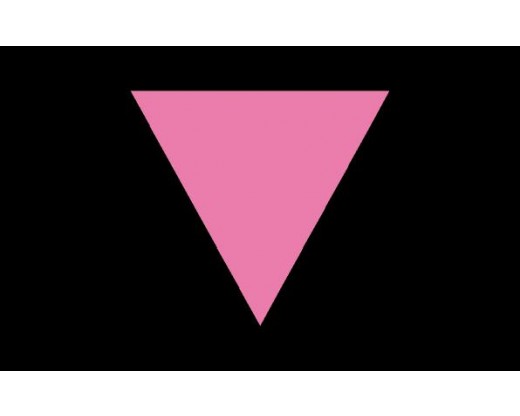
The Pink Triangle:
The downward-pointing pink triangle was prominently used by National Socialists (Nazis) in Hitler’s regime as a badge of shame and labeling of “homosexuals.” It was sewn onto the shirts of homosexual men in concentration camps to identify and dehumanize them in the eyes of the authorities and other prisoners. Other concentration camp inmates routinely lashed out against all prisoners wearing a pink triangle.
Homosexuality was made illegal in Germany under Paragraph 175 of the unification constitution in 1871, but the law was rarely enforced. It remained so until it was repealed in 1969. When the Nazi Party assumed control of Germany in 1933, they made it enforcement a priority in their goal of promoting the Aryan people as superior to all others in order to racially and culturally “purify” Germany. The Nazis arrested thousands of GLBTQ+ individuals and sent them to concentration camps. the overwhelming majority of them homosexual men. They were all seen as degenerate.
The rise of the gay, lesbian and bisexual pride movement led to the reclaiming of the pink triangle as a positive symbol of self-identity and of triumph over tragedy. In 1994, the German government formally apologized to all persons for the abuse committed against same gender loving persons throughout the country’s history, especially by the Nazis.
The pink triangle remains a strong symbol of GLBTQ+ progress towards equality and represents the journey forward worldwide. It is a tribute to all of those persecuted under bigotry and hatred. The flag is recognized globally.
The Lambda Flag:
As a symbol of same gender loving freedom from centuries of discrimination, oppression and torture, the Greek letter lambda was first designated in December, 1969, as a symbol of distinction by the graphic artist and Gay Activists Alliance founding member, Tom Doerr. He chose it because in chemistry it is a sign for “catalyst” as for the complete exchange of energy.
Others argue that the lambda denotes the synergy of the growing same gender loving movement. The idea that the whole is greater than the sum of all of its parts. Still others claim the lambda is representative of lesbian.
In December, 1974, the lambda was officially adopted by the International Gay Rights Congress at their meeting in Edinburgh, Scotland, UK, by a unanimous vote. As a representation of gay and lesbian civil rights, lambda became internationally accepted, popular and recognized.
By far, both the pink triangle and the lambda remain dominant and prominent within the GLBTQ+ community and culture today. Historically, they are the two “firsts” in our community and culture.
The criticism of the lambda emerged later as some felt it was symbolic for males only.
The Rainbow Flag:
The original Rainbow flag!
What many of us herald as the first official flag of our community and culture was first publicly raised on June 25, 1978, in San Francisco, California, USA, at the city’s United Nations Plaza in honour of the 1978 San Francisco Gay Freedom Day parade. The original flag consisted of eight coloured stripes and was designed by Gilbert Baker and handstitched and dyed with the help of friends and volunteers Lynn Sugarblum, James McNamara, Glenne McElhinney, Joe Duran and Paul Langbutz. The eight stripes were later reduced to six with the pink (denoting “sex”) and turquoise (for “art and magic”) eliminated as the colours were not available in flag fabrics.
The colour scheme!
The graphic above shows the revised eight-stripe flag reduced to six stripes and what the coloured stripes each represented.
Baker conceived the flag would “empower his tribe” and at the same time reflect a “rainbow of humanity” motif to represent the movement’s diversity.
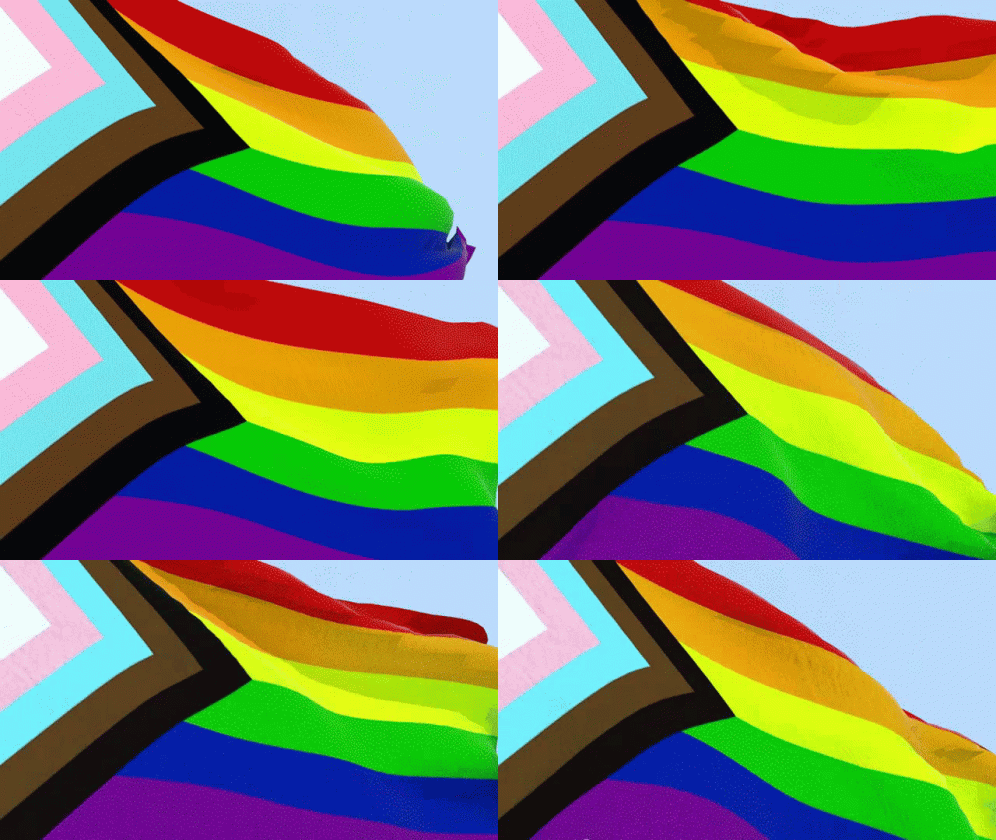
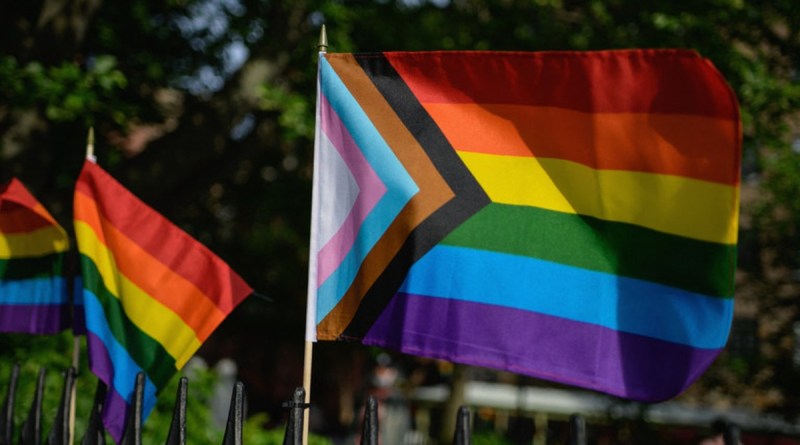
Current: The Progress Rainbow Flag!
Moving forward in progress!
The Progress Pride Rainbow flag was developed by non-binary artist and designer Daniel Quasar in 2018. Based on and incorporating Gilbert Baker’s 1978 Rainbow flag, Quasar’s redesign celebrates the diversity of the global GLBTQ+ community and culture and encourages a more accepting and inclusive general society. The redesign has invested the representation of discriminated minority identities covered by the GLBTQ+ umbrella.
Quasar’s creation placing black and brown stripes (symbolizing peoples of colour) and light blue, pink and white stripes (representing transgender and non-binary persons) in the shape of an arrow-head all pointing to the left of the Progress Pride Rainbow flag’s in the image of “forward progress.” In Daniel Quasar’s own words: “…the pointed arrow to show forward movement and illustrates that the progress towards inclusivity still needs to be made.”
The black stripe has a double meaning attached to it as it is also intended for “those living with HIV/AIDS and the stigma and prejudice surrounding them as well as all those who have been lost to the disease.”
The Progress Pride Rainbow flag was an immediate success. On the evening of June 6, 2018, Quasar posted the design on social media. He woke up the next day to find that it had gone viral.
Progress Pride Rainbow blowing in the wind!
We continue our way into the future by remembering our past. We are all together as we move forward!
Naked hugs!
Roger Peterson-Poladopoulos and Aaron Michael Peterson-Poladopoulos/ReNude Pride
Author’s Note: The next post entry here is planned for Monday, October 16, 2023, and the proposed topic is: “Purple: Spirit Day!”
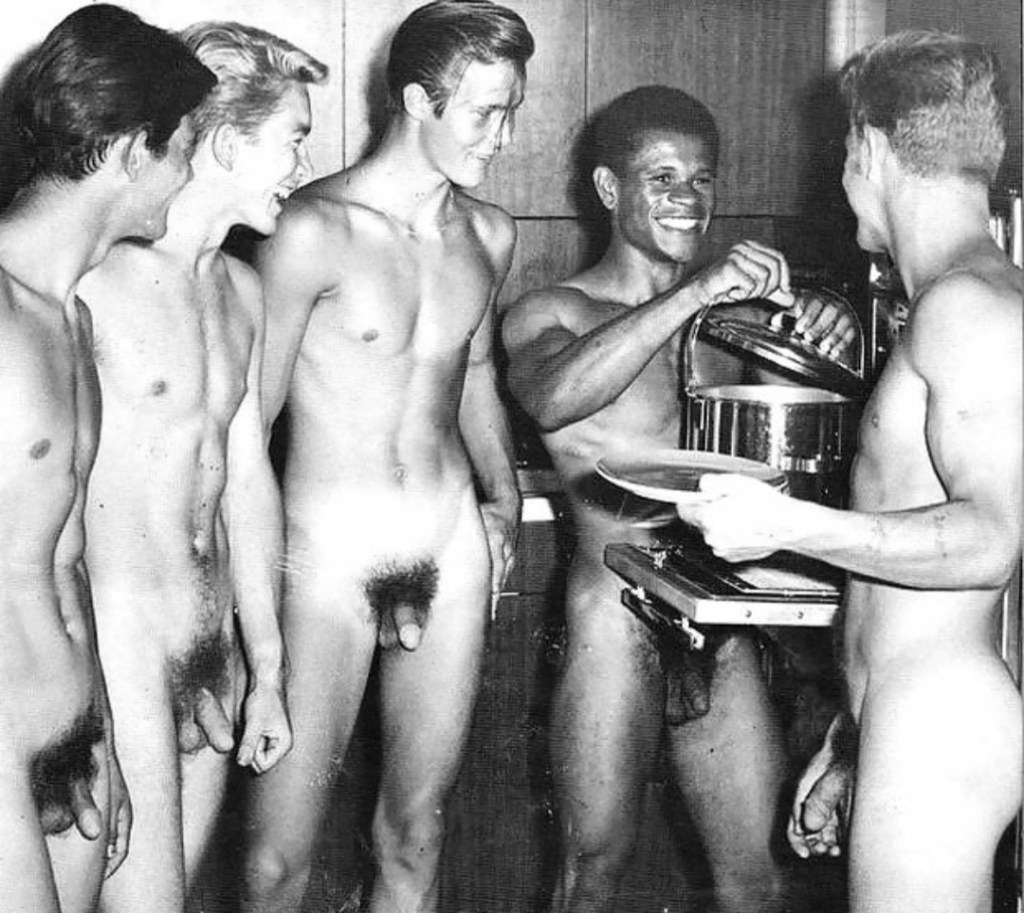
The majority of the photographs featured in this particular gallery were made during the era of segregation (a legal separation of the races) here in the USA. Not only are the subjects to be admired because of their violation of the segregation statutes, but the photographers and producers as well. Especially in the southern states, disregard for segregation laws contained severe fines and penalties. Worse consequences existed for African-American offenders.
Strength!
Judging from the hairstyles on the subjects in the above two pictures, the timing of the photography is from the early to mid-1960’s. Although the courts were by then overturning segregation laws, the practice remained prevalent.
Celebrate ourselves, our community and our culture!
Let’s all enjoy ourselves while observing our windows of opportunity viewing our past!
An interracial kiss!
Especially bold and courageous were the photographs that represented any type of physical attraction between persons of two distinctly different races. Judging from the hairstyles of the two men in the above image, the probable timeline was the late 1960s. As this was more or less around the time of the Stonewall Inn Riots (SIR), it was well before the ideals of same gender love entered into the agenda for public acceptance and tolerance. Therefore, the two men featured here are equally commended for their audacity and courage as Illinois was the only state in the USA that had decriminalized “homosexuality” while it was still ostracized by the general society!
J.C. Carter (right) and his lover!
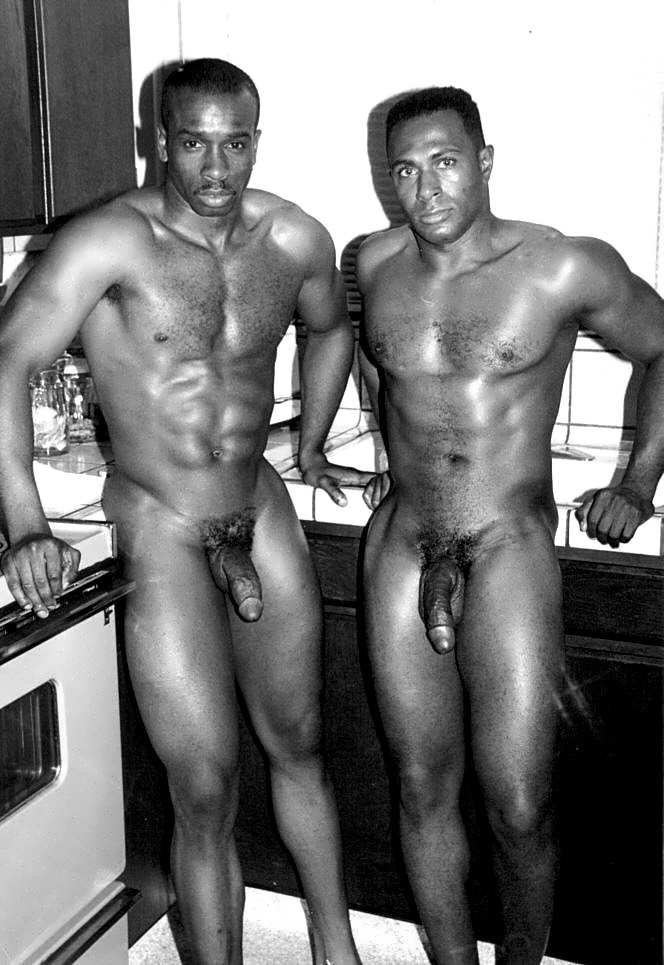
The African-American community was often hostile to images depicting two of their own comfortable with sharing not only their nakedness but also any suggestive sexual attraction. Openly gay actor J.C. Carter (above, right) posed above with his lover. The year was 1971, shortly after the SIR. This was prior to “J.C.” starting to completely shaving all of his body and head hair.
Socially nude!
Judging from the hairstyles in the above picture, these men posed for this shot in the mid-to-late 1950s. This capture was made in Chicago, Illinois, USA, and the segregation (separation) of the races was still prevalent.
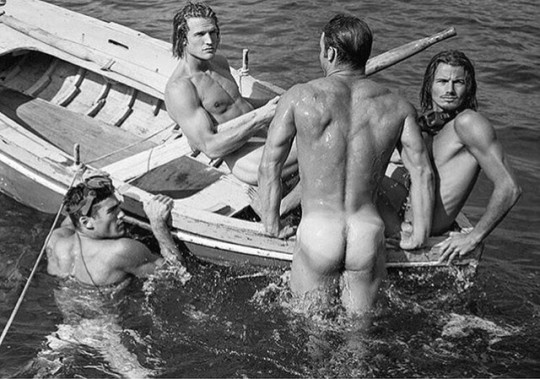
Boating “skinny-dippers!”
The above photo was dated from 1976 and aside from the buttocks of the man second from the right wasn’t anatomically suggestive.
Naked hugs!
Roger Poladopoulos/ReNude Pride
Author’s Note: The next post entry here is planned for Monday, October 9, 2023, and the proposed topic is: “National Coming Out Day!”
I humbly apologize for the unannounced delay in posting entries here for a full week. I was given an “extra” assignment for my job that was both unannounced and completely unexpected. I have fulfilled the duty and am now prepared to resume my regular posts here on ReNude Pride. I hope that I haven’t disappointed everyone! More details later.
Naked hugs!
Roger Poladopoulos/ReNude Pride
Author’s Note: The next post entry here is planned for tomorrow, Saturday, September 30, 2023, and the proposed topic is: “Bottoms-Up! September, 2023”
Before anyone is too shocked to recall, my university is located in a neighborhood of the U.S. Capitol Building in Washington, D.C. Therefore, as faculty and students at a university founded by President Lincoln and the first university funded entirely by the U.S. Congress, we are absolutely not permitted to be natural, naked or nude while instructing or delivering lectures. Nor are students permitted to attend classes unclothed.
The above image is used to maintain the theme of ReNude Pride and not to create a myth or rumour concerning a university precedence. Tolerance is a policy at my university but being realistic is also. Far be it from me to be the unwilling source of a mislead! The government is the best suited for that distinction!
Classroom seating!
Although clothing is required, the academic regimen of the university resumed this week. Whether in a formal lecture hall or in a more traditional classroom, it is now the time for me to set aside my “summer freedom” and return to work in order to prepare another group of students to take over the responsibility of preparing others to come forward and prepare themselves for all their roles in their lives.
Before everyone condemns my university as too restrictive, I do want to remind that although body and clothes freedom is not “officially” endorsed, it also is not outright banned or condemned. I did serve as a nude model for art and photography classes as an undergraduate. That allowance continues today. So freedom isn’t completely forbidden here!
A naked grin on a bare practitioner role model!
One of the benefits of a university faculty member is that we have the responsibility to honestly convey information to others. My university administration and fellow faculty members have always encouraged any of our same gender loving students as well as those who openly acknowledge their affinity or interest in nudity to share with me and proceed from there. This has presented to me the opportunity to dispel myths and misinformation and to offer guidance and direction towards discovery and guidance. It enables me to enjoy the freedom to make a positive and, hopefully, productive influence in the lives of others.
Granted, the undergraduate interest in gay, lesbian, bisexual, transgender and queer+ (GLBTQ+) concerns, issues and topics far exceeds the search for bare practitioner related circumstances, but that is routine. Once students deal with their sexuality, the nude/clothing situation usually is resolved and guidance is sought on an individual rather than group session.
This advisory role, in addition to my professorial duties, gives me satisfaction on the campus/worksite. I feel as though I am serving a constructive and useful purpose not only for each student I interact with but for my colleagues, too! A number have shared with me that I have afforded them the opportunity to serve as mentors to others who seek answers or help.
Bare class instruction!
Officially, nakedness and nudity – at least, publicly, – is not permitted on campus. The same is probably true for the majority of institutions of higher learning throughout the world. However, patience, tolerance and understanding of our roles in guiding the development and formation of our charges (students) has created here an environment that is accepting, beneficial, comfortable and tolerable for all!
Mini-Lesson: Bare Practitioner!
A bare practitioner is a same gender loving person who willingly releases their body, mind and soul of the frustrations, tensions and unnatural compulsions of always having to hide beneath the oppression of clothing. A free spirit, uncensored and uncovered, in a completely natural state!
Naked hugs!
Roger Poladopoulos/ReNude Pride
Author’s Note: The next post entry here is planned for Monday, September 11, 2023, and the proposed topic is: “Bare Aquatic Antics!”
A holiday that is now observed on the first Monday in the month of September, annually, Labour Day is designed to salute and offer tribute to the working people throughout the USA. In today’s concept, it honours all workers, no matter the nature of their contribution or their profession. There is no distinction between manual labourers and office management. Practically everyone observes the holiday! Openly bare practitioner film legend, Kory Mitchell, poses in these images with industrial construction equipment as he depicts natural tasks in the sunlight!
Kory Mitchell, construction pose #2!
Unfortunately, only a very few workers have the privilege to work while clothes free. Perhaps this should be the next distinction awarded to all for the Labour Day holiday! It is evident that the workers pictured here are carefree and happy in their clothes free jobs!
Posing for and making photography!
The existence of nude models and bare photographers is recognized on Labour Day! They are also “hard labourers” just as the rest of us!
Relaxing for the holiday weekend!
In the above photograph, our featured film-star, Kory Mitchell, models for us his skill and talent in “chilling” (laid back) and enjoying the three-day holiday weekend!
Happy Labour Day!
Naked hugs!
Roger Poladopoulos/ReNude Pride
Author’s Note: The next post entry here is planned for Friday, September 8, 2023, and the proposed topic is: “Back to School!”