My father died mid-day (11:48 a.m.) on Saturday, 10 November 2018. All of us considerably miss and mourn him, especially our mother. This year, on the anniversary of his death, our family’s church is conducting a community Memorial Service as a tribute to his life.
Mother has requested Alex (my identical twin) and I to be present along with all our family and the local population. Alex and I depart later this same day for our return to Greece. My university has officially sanctioned my instructional absence. Aaron, my spouse, and his parents leave the later part of the week to join with us.
She has also scheduled some time for my seven (7) brothers and I to decide and determine some familial issues that will have to be addressed and resolved eventually. Her preference is to be an active participant in these matters. My siblings and I agree to honour her wishes.
At this time, I assure everyone that mother’s health is fine, at least physically. Emotionally and mentally, she mourns for our father. I accept, respect and understand her reality.
I have composed and submitted a number of post entries for publication here on ReNude Pride: Guys Without Boxers! during our absence.
I ask for your patience, tolerance and understanding as Aaron and I respect my mother and offer our tribute to my father’s memory.
Naked hugs!
Roger Poladopoulos/ReNude Pride: Guys Without Boxers!
Author’s Note: The next post entry here is planned for Friday, November 7, 2025, and the proposed topic is: “Bare Celebrities #2!”
On 11 November, 1918, an Armistice (cease-fire) went into effect at 11:00 a.m. that ended the fighting in The Great War (World War I). The fighting raged throughout Europe, the Middle East, Africa and Asia.
The 11th day, 11th month, 11:00 a.m.
The Occasion:
Armistice Day is commemorated throughout the world saluting the cessation (ending) of hostilities (fighting) between the armed forces, thus bringing an end to the suffering of The Great War. The war officially was finalized by the Treaty of Versailles a year later. This date is Armistice Day in most of the world. In the United Kingdom and the Commonwealth, it is observed as Remembrance Day, an occasion to pay tribute to all the casualties of The Great War and subsequent conflicts and wars. In the USA. it is known as Veteran’s Day, in gratitude for military service.
The Great War: Eruption
On 28 June, 1914, Archduke Franz Ferdinand, heir to the Empire of Austria-Hungary (The Dual Monarchy) was assassinated, along with his wife, the Countess Sophie, while touring the city of Sarajevo, Bosnia-Herzegovina, a province of the empire. The assassins were Serbians who wanted the province united with the Kingdom of Serbia.
Tensions between the two countries escalated rapidly and exactly one month later, Emperor Franz Josef II of Austria-Hungary declared war against Serbia. Germany, Bulgaria and the Ottoman Empire (Turkey) sided with Austria against Serbia, France, Russia, Belgium, Luxembourg, Portugal, Italy, the British Empire and eventually the USA. Because of extensive colonial possessions, the fighting became global with battles raging in Europe, Africa, the Middle East, Asia and the South Pacific.
The war grew in epic strides as the aggression spread out of control. Up until this point in history, the effects became catastrophic unlike any previous war. Civilian populations suffered enormous fatalities and the very first genocide, of the Armenian peoples was raged by the Ottomans. The military casualties were exceptional and often fought over the same battlefield, time and time again. At times, entire armies and regiments were annihilated within one day’s time.
The Great War, a name earned due to the massive fatalities inflicted, was global in the horrors it produced. The devastation was without precedent.
The Armistice:
The proclamation of the Armistice of 1918 was celebrated globally by all belligerents. It included the announcement of the of the peace conference to be held the following year and the official signing of the surrender of Germany, Austria-Hungary, Bulgaria and the Ottoman Empire. The bloodbath was over, and the living reverted to living their lives.
On the first anniversary of the Armistice, in 1919, a solemnity Remembrance Day service was conducted by the Archbishop of Canterbury in London, UK, in the presence of King George V and Queen Mary. The prime ministers of the self-governing dominions of the British Empire were also in attendance. On this occasion, the red poppy was worn as a royal salute to the multitudes killed. At this observance, the entombment of an unidentified British casualty was by Royal Decree made for the Main Aisle in Westminster Abbey along with a state internment with full military honours.
Thereafter, the United States announced plans for the same once a burial site was determined. France soon followed in salutation to the fallen.
In tribute to all the military and naval deceased, a royal proclamation was enacted. Businesses and factories, parliament and courts, everyone in London was out on the streets, in parks and in public. At 11:00 a.m., on 11 November, 1919, a two-minute period of silence was implemented. Traffic halted, whether by motorcoach or driven by horses. The King and Queen bowed their heads. Complete silence prevailed. The city and the Empire remembered the dead.
At 11:03 a.m., the bands of the regiments guarding Buckingham Palace started playing God Save the King. The official tribute had been awarded to those no longer living.
Poppies and what they represent!
The Poppy
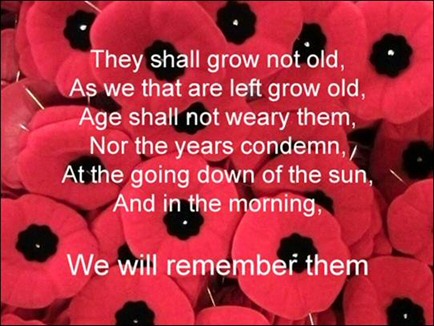
The red poppy flower represents consolation, condolences, death and remembrance. The poppy is a common symbol that has been utilized to also represent death and even, on occasion, to symbolize sleep. Since ancient times, the flower has been adorning coffins, graves and tombstones as symbolic of eternal sleep (rest).
During The Great War (World War I: 1914 – 1918), much of the actual conflict (fighting) on the Western Front happened along the trenches of northwestern Europe, especially in the Flanders region of the Kingdom of Belgium. The rural countryside was blasted, bombed and fought over repeatedly. The scenic landscape was riddled and shredded by trenches to accommodate the invading armies. The once productive and prosperous fields blackened barren where little or nothing could grow. A notable exception to this bleak horizon was the Flanders poppy, which survived and thrived in profusion. The resilient flowering flourished amid all the chaos and destruction.
Soon the red poppy naturally proliferated and adorned the hundreds of thousands of graves rapidly appearing all over the battlefields. The poppy became symbolic of divine sanctity upon the wartime casualties. Simultaneously, the flower was worn over the heart by those troops burying their fallen friends.
In 1919, the United Kingdom and the British Empire (now the Commonwealth) adopted the red poppy as the remembrance tribute to all the war dead. The British Legion (now the Royal British Legion) adopted the symbol and in 1922 created a factory to produce poppies that still operates today. In 2022, the original poppy factory was made a museum and a new poppy factory opened. King Charles III renewed the Royal warrant for the new factory to continue to create official poppies for the Royal Family.
Poppy Guidelines:
Wear on the left shoulder of the body, just above the heart.
Acceptable colours are red for remembrance and white for peace.
Not to be worn after 11 November, annually.
A field of red poppies in Flanders!
In Flanders Fields
by John McCrae
In Flanders fields the poppies blow
between the crosses, row on row,
That mark our place; and in the sky
the larks, still bravely singing, fly
Scarce heard amid the guns below.
We are the Dead. Short days ago
we lived, felt dawn, saw sunset glow,
Loved and were loved, and now we lie,
In Flanders fields.
Take up our quarrel with the foe;
to you from failing hands we throw
The torch, be yours to hold it high;
If ye break faith with us whodie
We shall not sleep, though poppies grow
In Flanders fields.
John McCrae, the Poet:
John McCrae was the son of Scottish immigrants and born in Guelph, Ontario, Canada, in and 1872. In May, 1915, he was serving as a physician in the Royal Canadian Army Medical Corps and posted in Flanders, Belgium. While there, his lifelong friend, Alexis Helmer, a lieutenant in the Royal Canadian Field Artillery was killed in the Second Battle of Ypres. Shortly afterwards, McCrae composed the poem, In Flanders Fields in memory of his friend and in honour of all the war dead of the British Empire.
The poem was first published on 8 December, 1915, in London, UK, for Punch magazine. It was immediately adopted by the Imperial War Council in honour of the deceased and incorporated into memorial services by the Church of England, the Church of Scotland and the United Church of Canada.
Veteran’s Day Poppies:
In 1918, U.S. humanitarian Moina Michael wrote: “And now the torch and poppy red, we wear in honour of our dead.” She composed this sentiment after she read the poem, “In Flanders Fields” by John McCrae.
Following the British paradigm, the American Legion was organized and adopted the red poppy and its sale on Veteran’s Day. In the USA, the symbolism of the poppy declined after World War II. With the centennial observance of the Great War in 2018, the poppy use experienced a revival. In 2017, the American Legion officially took the poppy as the image of honouring all war dead.
A very happy whatever occasion you are observing!
Naked hugs!
Roger Poladopoulos/ReNude Pride
Author’s Note: The next post entry here is planned for Friday, November 15, 2024, and the proposed topic is: “Autumn Twist!”
The date, 24 April, commemorates the enforced deportation of Armenian intellectuals in 1915 from Constantinople (now Istanbul), Turkey as the Ottomans initiated the first genocide of the 20th century, of 1,500,000 Armenians during the Great War (World War I). This removal of individuals was followed by their families and soon the massacres and starvation of multitudes of Armenians living in the Ottoman Empire. Turkey was allied with Germany and Austria-Hungary in fighting the Allies.
Tragically, this was the first genocide of the 20th century. Although not as significant as the Nazi one undertaken later in the century, it still represents the magnitude of hatred that unfortunately occurs needlessly among humanity.
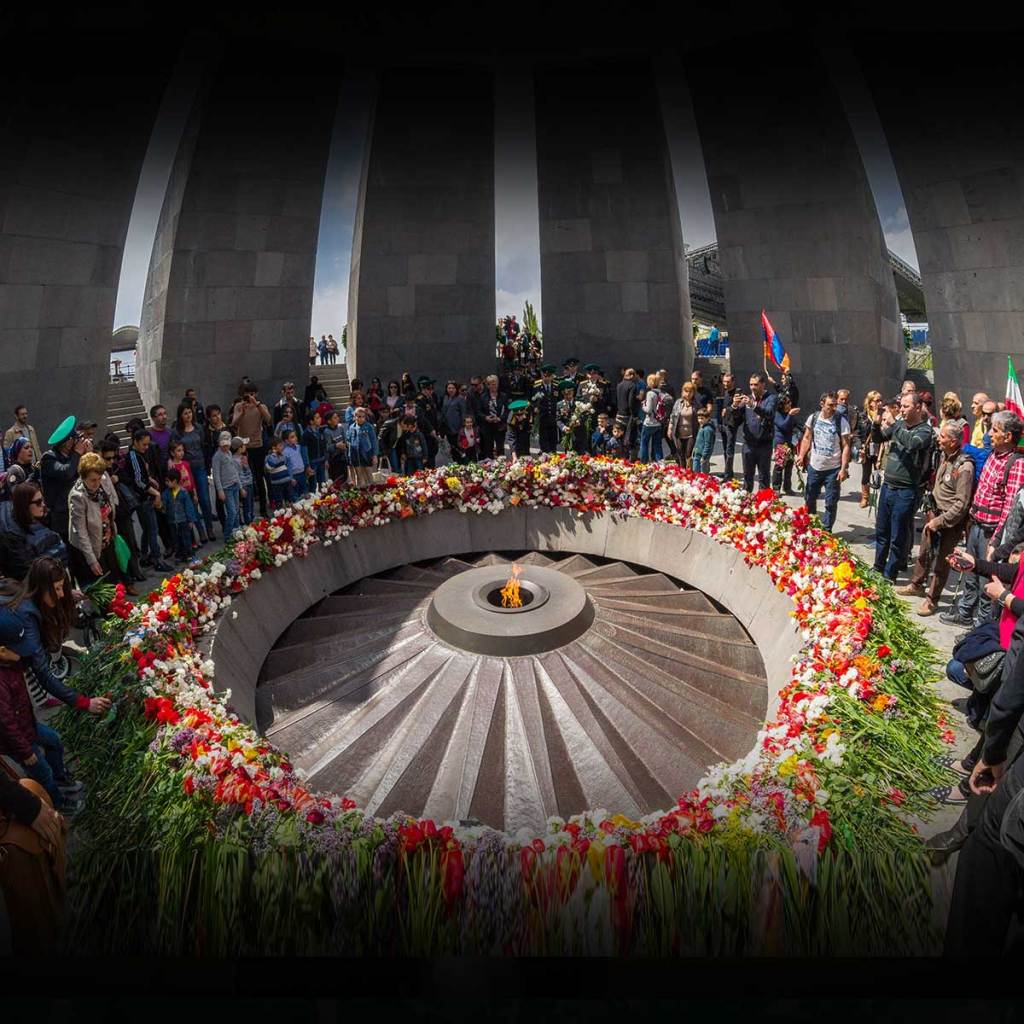
Armenia Genocide Memorial: Tsitsernakaberd!
Floral tributes to the Martyrs!
The very first commemoration of the Genocide occurred in 1919 at St. Trinity Armenian Church.
Naked hugs!
Roger Poladopoulos/ReNude Pride
Author’s Note: The next post entry here is planned for Sunday, April 30, 2023, and the proposed topic is: “Bottoms-Up! End of April!”
The entertainment world collectively mourned the loss of Aretha Franklin, affectionately known as the Queen of Soul, during this month. Ms. Franklin, born on March 25, 1942, died after entering hospice care on Thursday, August 16, 2018. She was 76 years old. I personally never knew her, but I grew up in the era of her music. Being Deaf, I never heard her sing but I did read the lyrics to her songs and fully recognize and understand her tremendous impact on the popular culture.
In the USA, today is Patriot’s Day, a time when we pause and reflect on the many thousands of lives lost and the tens of thousands of lives impacted by the terrorist attacks from the air on The Pentagon and the World Trade Center on September 11, 2001. Although not an official holiday (governments, banks and businesses remain open), it is a time for everyone to dedicate a moment out of the day and remember those who were killed and injured doing the most ordinary task and routine: living.
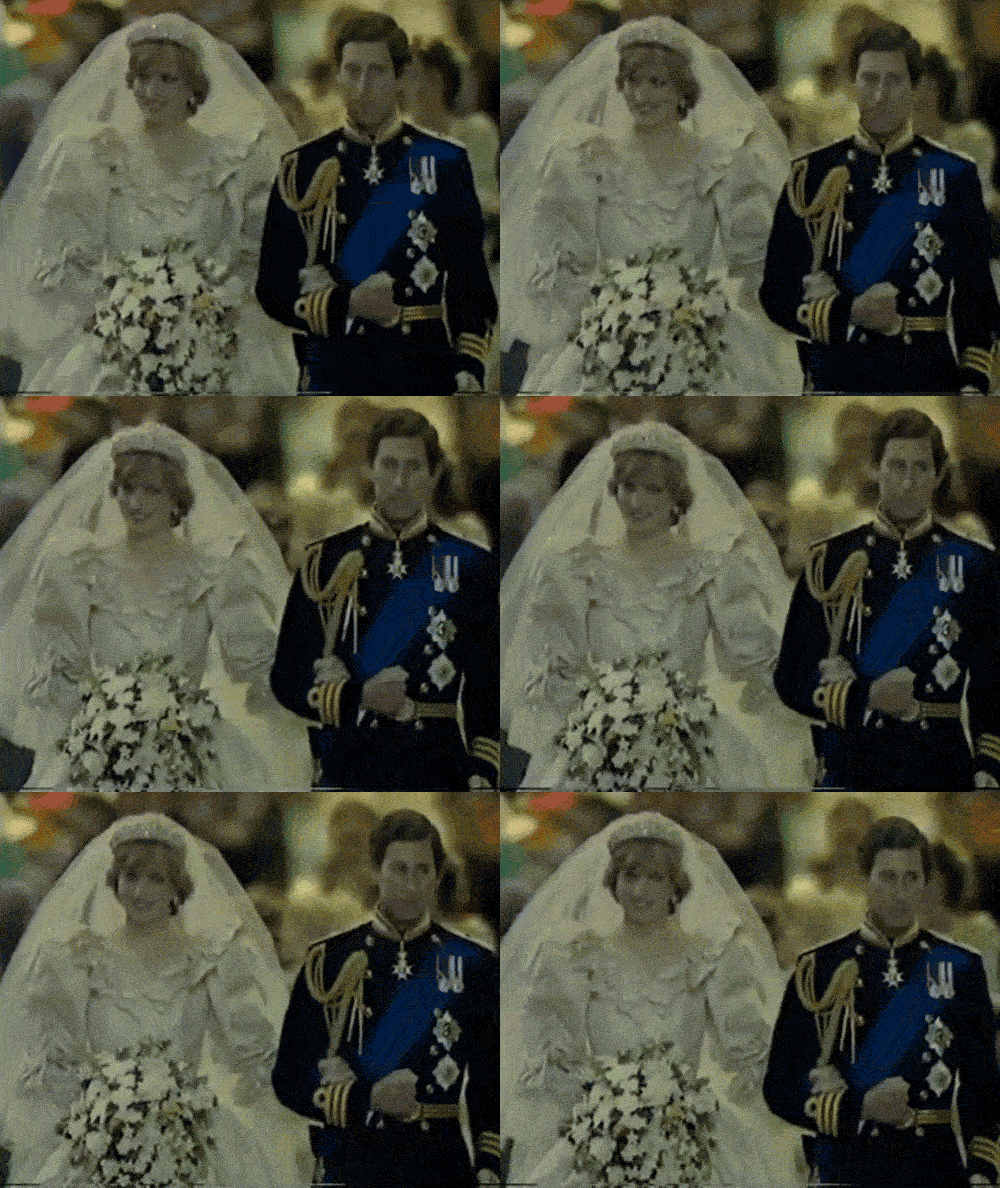
To be honest, I didn’t watch the wedding of Prince Charles and Lady Diana Spencer on the television nor was I a guest for the service in St. Paul’s Cathedral in London. I was too busy with my undergraduate pursuits at university to be bothered with such frivolity and had only a passing interest (if even that much) in the doings of the British Royal Family. They had no impact on my bare life nor my educational goals at that time.












 ReNude Pride: Guys Without Boxers!