Armistice Day/Remembrance Day!

Tomorrow, 11 November, marks the honouring of the cease-fire between the Allied Powers and the Central Powers. It ended the Great War that eventually became known as World War I.

The Great War commenced in 1914 following the assassination of Archduke Franz Ferdinand and his wife, the Countess Sophia, by Serbian nationalists in Sarajevo, Austria-Hungary. The conflict evolved into a global one with the entrance into the belligerence by both the United Kingdom and France and their immense colonial empires in defence of the neutrality of the Kingdom of Belgium.

The USA entered the war in 1917 upon discovering a German initiative to encourage the invasion of the US by Mexico.

The armistice (cease-fire) was a prelude to the signing of the Treaty of Versailles, which recognized the surrender of Germany to the Allied Powers in 1919. At that time, the Great War was the most severe conflagration in human history.

The Spanish influenza epidemic of 1918, following the armistice, added to the number of deaths induced by the conflict.

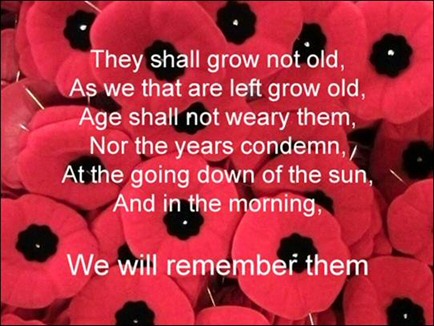
The Great War reintroduced the red poppy as a symbol of tribute to all of those who sacrificed their lives. The emblem honours both the military and civilian victims of the conflict before progressing the same recognition to those killed during World War II and beyond.

The Armistice applicable to the Great War was effective upon the 11th month (November), the 11th day at the 11th hour (11:00 a.m.).

The international conflict has various determinations referencing it. In the United Kingdom and Commonwealth it is observed as Remembrance Day, a lasting tribute for all the fallen. It is a Sunday holiday in many countries. It is known as Armistice Day in the remaining countries who fought in the war. In the US it is called Veterans Day.

The Poppy:

The red poppy flower represents consolation, remembrance and death. The poppy is a common symbol that throughout the centuries has been utilised the reflect everything ranging from peace to death and even including sleep (slumber). In ancient times, poppies were placed on graves in honour of eternal rest (sleep).

During The Great War (1914 – 1918) much of the fighting took place in western Europe, especially in the Flanders region of the Kingdom of Belgium. The countryside was blasted, bombed and fought over repeatedly. The landscape was torn apart by the existence of military trenches.

The previously beautiful scenery was reduced to mud – bleak and barren vistas where little or nothing could grow.

There was a remarkable exception to all the desolation – the bright red poppy. These resilient flowers flourished among the overabundance of nothing except destruction. The availability of the red poppy resulted in them to profusely dominate the graves of those killed during The Great War.

In Flanders Fields

The Poppy: symbolic of remembrance!

In Flanders Fields

In Flanders fields the poppies blow

between the crosses, row on row,

That mark our place; and in the sky

the larks, still bravely singing, fly

Scarce heard amid the guns below.

We are the Dead. Short days ago

we lived, felt dawn, saw sunsets glow,

Loved and were loved, and now we lie,

In Flanders fields.

Take up our quarrel with the foe;

to you from failing hands we throw

The torch, be yours to hold it high.

If ye break faith with us who die

We shall not sleep, though poppies grow

In Flanders fields.

Author: John McCrae

John McCrae was the son of Scots immigrants and born in Guelph, Ontario, Canada in 1872. In May, 1915, he was serving as a physician in the Royal Canadian Army Medical Corps in Flanders, Belgium. On May 2, Lieutenant Alexis Helmer, a Canadian field artillery officer and close friend of McCrae, was killed in the Second Battle of Ypres. Shortly afterwards, McCrae wrote the above poem in memory of his friend and honouring all the war dead.

The poem was first published on 8 December 1915, in London, UK, in the satirical magazine, Punch. It was immediately popular, widely circulated, and reprinted as a fitting tribute to all the deceased.

Have a safe and meaningful Remembrance Day/Armistice Day/Veterans Day!

Naked hugs!

Roger Poladopoulos/ReNude Pride: Guys Without Boxers!
Author’s Note: The next post entry here is planned for Friday, November 14, 2025, and the proposed topic is: “Bare Celebrity Role Model #3!”

October’s Bright Blue Weather

A bare practitioner couple, a mountain view!

October’s Bright Blue Weather

A poem by Helen Hunt Jackson

O suns and skies and clouds of June,

and flowers of June together,

Ye cannot rival for one hour,

October’s bright blue weather.

When loud the bumble-bee makes haste,

belated, thriftless, vagrant.

And golden-rod is dying fast,

and lanes with grapes are fragrant.

When gentians roll their fringes tight

to save them for the morning,

And chestnuts fall from satin burrs,

without a sound of warning;

When on the ground red apples lie

in piles like jewels shining,

And redder still on old stone walls

are leaves of woodbine twining;

When all the lovely wayside things

their white-winged seeds are sowing,

And in the fields, still green and fair,

late aftermaths are growing.

When springs run low, and on the brooks,

in idle golden freighting,

Bright leaves sink noiseless in the hush

of woods, for winter waiting;

When comrades seek sweet country haunts,

by twos and threes together,

And count like misers, hour by hour,

October’s bright blue weather.

O suns and skies and flowers of June,

count all your boasts together,

Love loveth best of all the year

October’s bright blue weather.

********** The End **********

A tropical view of October’s Bright Blue Weather!

About the author:

Helen Hunt Jackson was born in Amherst, Massachusetts, on 15 October 1830 and died in San Francisco, California, on 12 August 1885. She was a U.S. poet and writer who became an activist for improved treatment of the Indigenous peoples by the USA national government.

Educational poetry:

My identical twin brother, Alex, and I were required to memorize the above poem in our 6th level class (primary) at the Virginia School for the Deaf and Blind. Our teacher, who was one of our all-time favourites, used poetry to improve our English writing skills as well as our general comprehension of the English language. With our school located in Virginia and this poem reflected landscape and wild natural growths common to Massachusetts.

Unfortunately, there were no American Sign Language (ASL) manual signs for almost all the items, therefore, we had to fingerspell manually virtually the entire poem. Alex loved the poem but resented the fingerspelling aspect. He still remembers his remark that he felt as a child in kindergarten learning the ABC’s because of all the fingerspelling involved. As this was our first poem to memorize, our teacher always inspected every other poetic assignment to make certain fingerspelling didn’t dominate the process again.

An October, riverside!

Enjoy your last week of October’s Bright Blue Weather!

Naked hugs!

Roger Poladopoulos/ReNude Pride: Guys Without Boxers!

Author’s Note: The next post entry here is planned for Friday, October 31, 2025, and the proposed topic is: “Bottoms-Up! October, 2025!”
Bare*Ability!

Same gender bromance!

Bare Practitioner: same gender loving and embracing nakedness as both community and culture. An enthusiastic advocate of the right to love and of body and clothes freedom.

Body and clothes freedom!

Naked is defined as without clothing on the body. Without addition, concealment, disguise or embellishment. Nude.

Nude is defined as without clothing or naked. The condition of being unclothed.

Introduction:

Mutual body and clothes freedom!

Bare! Body! Clothes free! Naked! Natural! Naturist! Nude! Nudity! Nudist! All of these terms/words refer to the fact that we are uncovered (without clothing)! We are completely visible without even a single thread concealing any part of our natural body. Identical to the state of our birth. Not a single one of us were born wearing anything! Hallelujah!

Yours truly at a local park in Arlington, Virginia, USA!

My name is Roger Peterson-Poladopoulos. As many of you already know, I am the co-author and the creator of this site: ReNude Pride: Guys Without Boxers! I am a same gender loving (SGL) man – gay – Deaf and of direct Greek heritage (both of my parents were born in the Kingdom of Greece).

Aaron, my spouse!

This is Aaron M. Peterson-Poladopoulos, my spouse. He is also the co-author and photographer of this site. Obviously, he is also SGL and is of African-Canadian descent. Aaron’s family is of the Yoruba ethnic tribe from the city of Ibadan, located in western Nigeria. Both Canada and Nigeria are Commonwealth entities. We have been legally married since 2015, a year after marriage equality was officially adopted here in the USA, our country of residence.

The both of us are confidently and proudly bare practitioners (SGL and naturist/nudist). We wear clothes when necessary but both of us prefer being without any garment whatsoever! As enthusiastic bare practitioner advocates, we are equally responsible for the theme of today’s post entry here.

Honest and simple advice!

We sincerely encourage all of you here today to join with us in nakedness and pride whenever possible!

*************************

Bare Practitioners:

Bare practitioners!

As an integral component grouping of the gay, lesbian, bisexual, transgender, and queer+ community and culture, bare practitioners often encounter awkward and discomforting situations not only because of our SGL status, but also due to our textile (clothing) – or our lack thereof. We are neither forcing nor intimidating anyone into our body and clothes freedom world, instead we are celebrating the enablement to just be ourselves: SGL and nakedness!

Progress Pride Flag body painted on himself!

Our man in the above photograph is very confident and proud of his bare practitioner identity. He has our SGL Progress Pride rainbow flag body painted on his nakedness while he’s participating in the London, UK, World Naked Bike Ride (WNBR)! His smile demonstrates his comfort and joy in being honest and open about his body freedom and his sexuality! Both Aaron and I salute his brotherhood, reality and sincerity! Take care and stay bare, our friend!

*************************

Our Confidence Is Evident:

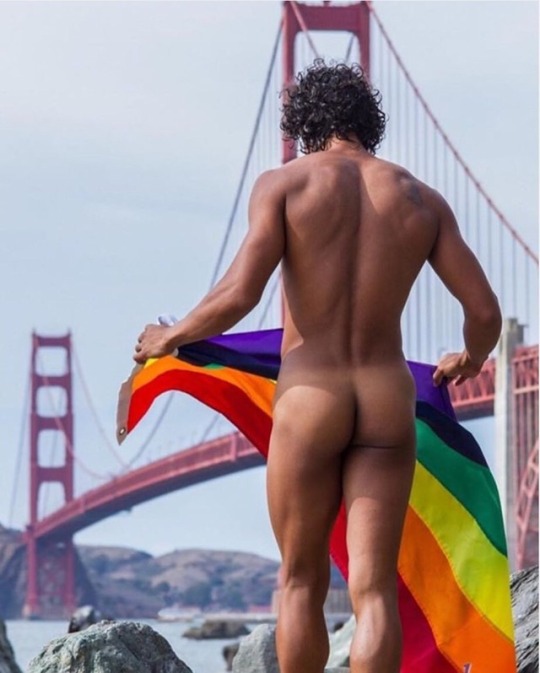
Bare under the bridge!

Our man in this series of pictures here is not only proud of his sexuality, he’s also assured and bold in sharing publicly his bare practitioner affiliation!

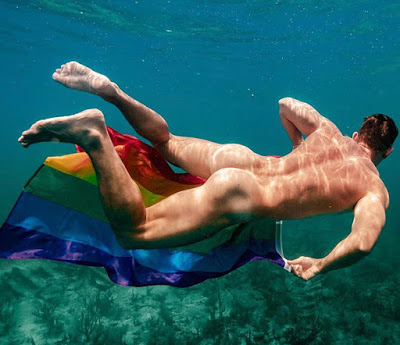
Submerged bare practitioner pride!

He combines his SGL nature and his body and clothes freedom preference and skinny dips (swims naked) without a care in the world!

His rainbow pride colours raised high!

He confidently flaunts both his bare body and his sexuality while posing and promoting his message: “I am my own man without guilt and/or shame!”

Bottoms-up! near the underwater bottom!

A philosophy that many of us who are bare practitioners endorse and proclaim wholeheartedly!

*************************

Confidence and Pride!

Compatibility!

Being a bare practitioner isn’t an obligation to publicly reveal one’s personal character and identity. Each person determines their own comfort level in presenting themselves to others. The majority of us, bare practitioners or otherwise, are more amenable to others who we perceive as most like us and similar to ourselves. This is a human instinct that most of us believe, feel, nurture and share among ourselves.

Our bare practitioner affinity and appreciation aren’t based on or defined solely by our willingness to allow others to interpret or judge our nakedness and/or our sexuality. Our being what and who we are is determined completely by our private discretion, personal emotional capacity, and self-acceptance. If we need to confide in another, it is our choice, and we need to engage in the dialogue when we are comfortable. Otherwise, we await on our respective decision to proceed.

For everyone!

*************************

Poetic Justice:

An important message inked on his genital area!

Reign is the stage name of our bare practitioner brother welcoming us here. Just above his pubic hairline, he has “unashamed” tattooed on his skin. His meaning is obviously visible for all. There is no embarrassment, guilt or shame associated with either his nakedness and/or his sexuality!

He prefers nakedness over clothing and has no issue in publicly endorsing both body and clothes freedom and his exclusive same gender loving sexuality. Reign is a very honest and open man who lives his life being himself and “unashamed!”

My Naked Life

by Roger Poladopoulos

I am naked and I am me.

I am the man the man I want to be.

When I am naked, I am nude,

Living life with a positive attitude.

I am naked and I am me.

I am the man I want to be.

When I am nude, I am also proud,

Whether alone or among a crowd.

I am naked and I am me.

I am the man I want to be.

When I am nude, I am living free,

I know that clothes are not for me.

I am naked and I am me.

I am the man I want to be.

When I am nude, I clear my mind,

Gone are the clothes that hide and bind.

I am naked and I am me.

I am the man I want to be.

The End. Composed on 5 July, 2011 at a clothes free beach.

*************************

Naked hugs!

Roger Poladopoulos/ReNude Pride: Guys Without Boxers!

Author’s Note: The next post entry here is planned for Monday, June 9, 2025, and the proposed topic is: “Swinging It All: Bat and Buttocks!”

WNGD!

Indoor plant garden!

WORLD NAKED GARDENING DAY!

Saturday, 3 May, 2025

This is observed annually on the very first Saturday of the month of May. It was first celebrated in 2005 on 10 September and the following year on 9 September, 2006. After the second event, it was decided to change the date to the month of May. The first Saturday of the month was determined to be the best time for gardening.

Since the beginning, it has always been identified as World Naked Gardening Day – a simple and self-explanatory title. Now, it has evolved to International World Naked Gardening Day. Redundant? Yes! Necessary? No!

Aaron, my spouse, and I have hosted a WNGD “planting” for indoor houseplants in our condominium since we began living together. We didn’t hold them during the coronavirus COVID-19 pandemic and resumed in 2023. Initially, we invited acquaintances and friends, and our small condo unit would be quite congested. Since the coronavirus concerns, we now only ask a few other bare practitioner couples to join us. Aaron serves as chef, and I take responsibility for cleaning afterwards.

Indoor gardening!

World Naked Gardening Day maintains a website and the link is:

world naked gardening day

Visit the site for additional information on World Naked Gardening Day. When I was composing this post entry, the site the last update as being 2017. The webpage does contain links to other naked gardening applications.

*************************

The Evolution of a Bare Gardener!

Based on the poem: “Seasonal Interchange” by Michael Aitkin, World Naked Gardening Day webpage.

In Winter, when the trees are bare,

We mortals don our winter wear.

In Spring, when trees begin to dress,

We mortals then start wearing less,

Until, for some, with Summer’s heat

The role reversal is complete.

Happy World Naked Gardening Day!

Naked hugs!

Roger Poladopoulos/ReNude Pride: Guys Without Boxers!

Author’s Note: The next post entry here is planned for Monday, May 5, 2025, and the proposed topic is: “Mayhem!”

Charge!

Alternate Title: The Charge of the Bare Brigade!

A Photo-Essay of the Foreseeable Future!

Introduction:

Today’s post entry here on ReNude Pride: Guys Without Boxers! is based on the original narrative poem by Alfred, Lord Tennyson, “The Charge of the Light Brigade” in tribute to the tragic heroes of the Battle of Balaclava in the Crimean War (1854 – 1856).

This posting is in anticipation of the wild rush to skinny-dip (swim naked) once the warmer outside temperatures begin to thrive! It won’t be a very long wait – hopefully!

Please understand that there is no disrespect intended towards any of the valiant cavalry or defenders of the actual Balaclava participants.

Half a league, half a league,

Half a league onward,

All into the beach

Ran the six hundred.

“Forward the Bare Brigade!

Charge for the fun!” he said.

Into the beach

Ran the six hundred.

“On Dasher and Dancer,

and Prancer and Vixon!

On Comet and Rudolph…”

Oh no! Wrong poem! Also, the terribly incorrect season of the year! Sorry for my mistake! The beach scenery just got me too excited!

The consolation is that bare beach days are almost back in season here!

Naked hugs!

Roger Poladopoulos/ReNude Pride: Guys Without Boxers!

Author’s Note: The next post entry here is planned for Wednesday, April 30, 2025, and the proposed topic is: “Bottoms-Up! April, 2025!”

Armistice Day/Remembrance Day!

Poppies and a gravesite!

also known as Veteran’s Day (in the USA only)

On 11 November, 1918, an Armistice (cease-fire) went into effect at 11:00 a.m. that ended the fighting in The Great War (World War I). The fighting raged throughout Europe, the Middle East, Africa and Asia.

The 11th day, 11th month, 11:00 a.m.

The Occasion:

Armistice Day is commemorated throughout the world saluting the cessation (ending) of hostilities (fighting) between the armed forces, thus bringing an end to the suffering of The Great War. The war officially was finalized by the Treaty of Versailles a year later. This date is Armistice Day in most of the world. In the United Kingdom and the Commonwealth, it is observed as Remembrance Day, an occasion to pay tribute to all the casualties of The Great War and subsequent conflicts and wars. In the USA. it is known as Veteran’s Day, in gratitude for military service.

The Great War: Eruption

On 28 June, 1914, Archduke Franz Ferdinand, heir to the Empire of Austria-Hungary (The Dual Monarchy) was assassinated, along with his wife, the Countess Sophie, while touring the city of Sarajevo, Bosnia-Herzegovina, a province of the empire. The assassins were Serbians who wanted the province united with the Kingdom of Serbia.

Tensions between the two countries escalated rapidly and exactly one month later, Emperor Franz Josef II of Austria-Hungary declared war against Serbia. Germany, Bulgaria and the Ottoman Empire (Turkey) sided with Austria against Serbia, France, Russia, Belgium, Luxembourg, Portugal, Italy, the British Empire and eventually the USA. Because of extensive colonial possessions, the fighting became global with battles raging in Europe, Africa, the Middle East, Asia and the South Pacific.

The war grew in epic strides as the aggression spread out of control. Up until this point in history, the effects became catastrophic unlike any previous war. Civilian populations suffered enormous fatalities and the very first genocide, of the Armenian peoples was raged by the Ottomans. The military casualties were exceptional and often fought over the same battlefield, time and time again. At times, entire armies and regiments were annihilated within one day’s time.

The Great War, a name earned due to the massive fatalities inflicted, was global in the horrors it produced. The devastation was without precedent.

The Armistice:

The proclamation of the Armistice of 1918 was celebrated globally by all belligerents. It included the announcement of the of the peace conference to be held the following year and the official signing of the surrender of Germany, Austria-Hungary, Bulgaria and the Ottoman Empire. The bloodbath was over, and the living reverted to living their lives.

On the first anniversary of the Armistice, in 1919, a solemnity Remembrance Day service was conducted by the Archbishop of Canterbury in London, UK, in the presence of King George V and Queen Mary. The prime ministers of the self-governing dominions of the British Empire were also in attendance. On this occasion, the red poppy was worn as a royal salute to the multitudes killed. At this observance, the entombment of an unidentified British casualty was by Royal Decree made for the Main Aisle in Westminster Abbey along with a state internment with full military honours.

Thereafter, the United States announced plans for the same once a burial site was determined. France soon followed in salutation to the fallen.

In tribute to all the military and naval deceased, a royal proclamation was enacted. Businesses and factories, parliament and courts, everyone in London was out on the streets, in parks and in public. At 11:00 a.m., on 11 November, 1919, a two-minute period of silence was implemented. Traffic halted, whether by motorcoach or driven by horses. The King and Queen bowed their heads. Complete silence prevailed. The city and the Empire remembered the dead.

At 11:03 a.m., the bands of the regiments guarding Buckingham Palace started playing God Save the King. The official tribute had been awarded to those no longer living.

Poppies and what they represent!

The Poppy

The red poppy flower represents consolation, condolences, death and remembrance. The poppy is a common symbol that has been utilized to also represent death and even, on occasion, to symbolize sleep. Since ancient times, the flower has been adorning coffins, graves and tombstones as symbolic of eternal sleep (rest).

During The Great War (World War I: 1914 – 1918), much of the actual conflict (fighting) on the Western Front happened along the trenches of northwestern Europe, especially in the Flanders region of the Kingdom of Belgium. The rural countryside was blasted, bombed and fought over repeatedly. The scenic landscape was riddled and shredded by trenches to accommodate the invading armies. The once productive and prosperous fields blackened barren where little or nothing could grow. A notable exception to this bleak horizon was the Flanders poppy, which survived and thrived in profusion. The resilient flowering flourished amid all the chaos and destruction.

Soon the red poppy naturally proliferated and adorned the hundreds of thousands of graves rapidly appearing all over the battlefields. The poppy became symbolic of divine sanctity upon the wartime casualties. Simultaneously, the flower was worn over the heart by those troops burying their fallen friends.

In 1919, the United Kingdom and the British Empire (now the Commonwealth) adopted the red poppy as the remembrance tribute to all the war dead. The British Legion (now the Royal British Legion) adopted the symbol and in 1922 created a factory to produce poppies that still operates today. In 2022, the original poppy factory was made a museum and a new poppy factory opened. King Charles III renewed the Royal warrant for the new factory to continue to create official poppies for the Royal Family.

Poppy Guidelines:

Wear on the left shoulder of the body, just above the heart.

Acceptable colours are red for remembrance and white for peace.

Not to be worn after 11 November, annually.

A field of red poppies in Flanders!

In Flanders Fields

by John McCrae

In Flanders fields the poppies blow

between the crosses, row on row,

That mark our place; and in the sky

the larks, still bravely singing, fly

Scarce heard amid the guns below.

We are the Dead. Short days ago

we lived, felt dawn, saw sunset glow,

Loved and were loved, and now we lie,

In Flanders fields.

Take up our quarrel with the foe;

to you from failing hands we throw

The torch, be yours to hold it high;

If ye break faith with us who die

We shall not sleep, though poppies grow

In Flanders fields.

John McCrae, the Poet:

John McCrae was the son of Scottish immigrants and born in Guelph, Ontario, Canada, in and 1872. In May, 1915, he was serving as a physician in the Royal Canadian Army Medical Corps and posted in Flanders, Belgium. While there, his lifelong friend, Alexis Helmer, a lieutenant in the Royal Canadian Field Artillery was killed in the Second Battle of Ypres. Shortly afterwards, McCrae composed the poem, In Flanders Fields in memory of his friend and in honour of all the war dead of the British Empire.

The poem was first published on 8 December, 1915, in London, UK, for Punch magazine. It was immediately adopted by the Imperial War Council in honour of the deceased and incorporated into memorial services by the Church of England, the Church of Scotland and the United Church of Canada.

Veteran’s Day Poppies:

In 1918, U.S. humanitarian Moina Michael wrote: “And now the torch and poppy red, we wear in honour of our dead.” She composed this sentiment after she read the poem, “In Flanders Fields” by John McCrae.

Following the British paradigm, the American Legion was organized and adopted the red poppy and its sale on Veteran’s Day. In the USA, the symbolism of the poppy declined after World War II. With the centennial observance of the Great War in 2018, the poppy use experienced a revival. In 2017, the American Legion officially took the poppy as the image of honouring all war dead.

A very happy whatever occasion you are observing!

Naked hugs!

Roger Poladopoulos/ReNude Pride

Author’s Note: The next post entry here is planned for Friday, November 15, 2024, and the proposed topic is: “Autumn Twist!”

October’s Bright Blue Weather!

October’s Bright Blue Weather

by Helen Hunt Jackson

O suns and skies and clouds of June,

And flowers of June together,

Ye cannot rival for one hour

October’s bright blue weather.

When loud the bumblebee makes haste,

Belated, thriftless vagrant,

And goldenrod is dying fast,

And lanes with grapes are fragrant;

When gentians roll their fringes tight

To save them for the morning,

And chestnuts fall from satin burrs

Without a sound of warning;

When on the ground red apples lie

In piles like jewels shining,

And redder still on old stone walls

Are leaves of woodbine twining;

When all the lovely wayside things

Their white-winged seeds are sowing,

And in the fields still green and fair,

Late aftermaths are growing;

When springs run low, and on the brooks,

In idle golden freighting,

Bright leaves sink noiseless in the hush

Of woods, for winter waiting;

When comrades seek sweet country haunts,

By twos and twos together,

And count like misers, hour by hour,

October’s bright blue weather.

O suns and skies and clouds of June,

Count all your boasts together,

Love loveth best of all the year,

October’s bright blue weather.

One of the purposes for us as students in a state-maintained residential school for the Deaf and Hard-of-Hearing to learn and memorize poetry was to help us gain an appreciation, knowledge and understanding of the English language. American Sign Language (ASL) and English are two distinctly different languages that may share a vocabulary (words) and little else. Twin and I can remember this poem as it was one of the first we had to commit to memory but it was also a major challenge.

The references to all of the varieties of flowering growth was not something easy for us to deal with. None of the plants were familiar to us, either in Virginia or in Greece. In order to finger-spell the names of all the different types, we had to first learn how to properly spell the actual name. We both recall the relief and satisfaction we both felt once this task was finished and we performed our assigned recital, in front of our class. Over and done!

Neither one of us have any particular attachment, appreciation, attraction or desire for anything related to the month of October! It’s another month, one out of twelve annually!

Naked hugs!

Roger Poladopoulos/ReNude Pride

Author’s Note: The next post entry here is planned for Friday, October 11, 2014, and the proposed topic is: “Coming Out/Awareness Day!”

ReNude Arbor!

Our own spokes-model, Phoenix Fellington, leans against his tree!

Background:

Arbor Day is a secular holiday that is designed to encourage communities and individuals to plant trees to improve not only our environment but also the quality of life. In the USA, this year it is observed on Friday, 26 April, 2024.

In our header image (above photograph), ReNude Pride’s official unofficial spokes-model, our bare practitioner open adult actor, Phoenix Fellington, proudly poses leaning against a tree. Obviously proud of both his nakedness, his sexual orientation and his appreciation of our world! In the .gif image below, he reminds us of the joys of nakedness in a park surrounded by trees!

“I love to be naked, outside, surrounded by nature!” ~ Phoenix Fellington ~ official unofficial ReNude Pride spokes-model; bare practitioner; gay porn star

2024 Arbor Day: 26 April, 2024

As published in the previous post entry here, there are an increasing number of neighbourhood communities and municipal localities that are combining Arbor Day and Earth Day events. As both occasions involve the benefit of our natural environment, this union provides for an exchange of information, resources and talent into a combined effort. This also eliminates competition, confusion and the duplication of services.

Admiring the trees!

ReNude is a playful substitute for the word renewed which represents a rejuvenation and/or a recharging. As in the title of this blog post entry and of this site, it reflects another opportunity for our confidence and our pride in not only ourselves and our environment, but our nakedness, too! What better way to pay tribute to nature than by celebrating our “natural” bodies?

It is our Springtime rejuvenation of us as both a distinct community and culture of bare practitioners within our much broader gay, lesbian, bisexual, transgender and queer+ (GLBTQ+) population.

In the Northern Hemisphere, we are now officially into our Spring season. A transition period between the winter and the summer. A three-month scope of time when our natural environment return from the bleakness of winter and invigorates our surroundings with a rebirth of colour, of foliage, of life and of promise! There is a future and we are now filled with hope!

The Spring season is an ideal time for us, as a neighborhood or as a municipality to forge a reunion with our natural world. Joining in the renude (renewed) spirit, we can look all around us for a task or a project to engage in that helps our environment to restore itself and replenish nature not only in our landscape but also within ourselves!

My spouse, Aaron, and I donated and participated in a tree planting in a local park in 2019. We gave two mimosa saplings to the park and planted them. Now that (hopefully) the coronavirus COVID-19 is finally downsiding, we will repeat that endeavour again this year.

Stripping for Arbor Day!

Trees

by Joyce Kilmer (1886 – 1918)

I think that I shall never see

A poem lovely as a tree.

A tree whose hungry mouth is prest

Against the earth’s sweet flowing breast:

A tree that looks at God all day,

And lifts her leafy arms to pray;

A tree that may in summer wear

A nest of robins in her hair;

Upon whose bosom snow has lain;

Who intimately lives with rain.

Poems are made by fools like me,

But only God can make a tree.

*************************

Naked hugs!

Roger Poladopoulos/ReNude Pride

Author’s Note: The next post entry here is planned for Friday, April 26, 2024, and the proposed topic is: “Camaraderie!”

Armistice/Remembrance Day!

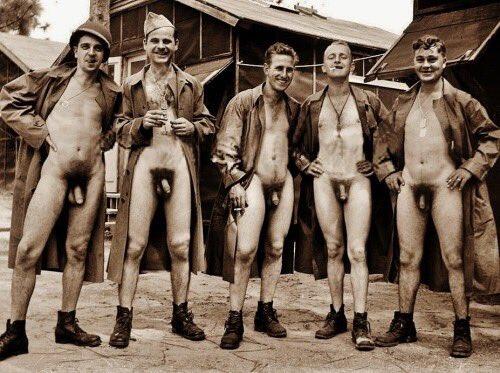
Vintage military!

Introduction: The Great War (what is today known as World War I) began with the declaration of war between the Empire of Austria-Hungary and the Kingdom of Serbia on July 28, 1914. The conflict expanded and finally ended on Armistice Day, November 11, 1918. The peace treaty officially bringing the devastation to an end was signed in 1919. Millions died, globally, as a result of the belligerence.

The principle combatants in The Great War were the Central Powers: The Austria-Hungary Empire, Bulgaria, the German Empire and the Ottoman Empire. The Allied Powers were: Belgium, the British Empire, France, Greece, Italy, Japan, Luxembourg, Portugal, Roumania, The Russian Empire, Serbia, and the USA (1917-1918). Battles and military engagements occurred in Africa, Asia, Europe, the Middle East and the South Pacific. This led to the designation of the conflict as World War I.

A direct consequence of The Great War was the eruption of yet another global clash, World War II, that began twenty years later, in 1939. That second conflict proved even more destructive than the first.

One of the sparks that triggered the beginning of The Great War was the assassination of the heir to the Austria-Hungary throne, Archduke Franz Ferdinand, and his wife, the Countess Sophie, by Serbians opposed to the dominance of Austria-Hungary in Balkan politics. In reality, the heir was in favour of greater self-determination of the the native Serbs, Bosnian and Croatian peoples in their own governance. Unfortunately, his death also destroyed any peaceful solution to the volatile political situation.

In discussions with my students about the origins of The Great War, I have recently noticed a growing number of them referring to the actions of the Archduke Franz Ferdinand as among the causes of the First World War. This misjudgment I attribute to faulty teaching from their secondary school instructors and try my best to keep them abreast of historical truths. I’m not familiar with all of the archduke’s personal characteristics but I am unable to identify any historical source for this misinformation.

By 1921, almost all the world that survived the destruction of The Great War was observing the anniversary of the official Armistice that ended the slaughter. In the United Kingdom and throughout the Commonwealth, the peoples joined with King George V and Queen Mary in honouring the deceased on Remembrance Day. Two minutes of complete silence was publicly held in commemoration beginning the hour of the end of the fighting: 11:00 a.m. In Western Europe, Armistice Day ceremonies were conducted at cemeteries and battlefields. In the USA, the custom of Veteran’s Day was implemented.

Battlefield remembrance!

The Red poppy flower represents consolation, remembrance and death. The poppy is a common symbol that has been used to represent everything from peace to death and even simply sleep. Since ancient times, poppies placed on tombstones represent eternal sleep.

During The Great War, much of the fighting took place in western Europe, especially in the Flanders region of the Kingdom of Belgium. The countryside was blasted, bombed and fought over repeatedly. The landscape was torn apart by trenches. The previously beautiful scenery was turned to mud: bleak and barren where little or nothing could grow. There was a notable exception to the drudgery: the bright red Flanders poppy. These resilient flowers flourished amidst so much chaos and destruction.

John McCrae was the son of Scottish immigrant parents and was born in Guelph, Ontario, Canada, in 1872. In May, 1915, he was serving in the Royal Canadian Army Medical Corps in Flanders, Belgium. On May 2, 1915, Lieutenant Alexis Helmer, a Canadian field artillary oficr and close personal friend of McCrae, was killed in the Second Battle of Ypres. Shortly afterwards, McCrae wrote the following poem, “In Flanders Fields,” in memory of his friend and honouring all the war dead.

The poem was first published on December 8, 1915, in London, United Kingdom, in the satirical magazine, Punch. It was immediately popular and widely circulated and reprinted as a fitting tribute.

In Flanders Fields

In Flanders fields, the poppies blow

between the crosses, row on row,

That mark our place; and in the sky

the larks, still barely singing, fly

Scare heard amid the guns below..

We are the Dead. Short days ago

we lived, felt dawn, saw sunset glow,

Loved and were loved, and now we lie,

In Flanders fields.

Take up our quarrel with the foe;

to you from falling hands we throw

The torch, be yours to hold it high.

If ye break faith with us who die

We shall not sleep, though poppies grow

In Flanders fields.

We remember and appreciate the efforts of John McCrae and all the fallen, wherever they lie.

Remembrance Day Poppy Campaign

Etiquette

Participation in the Remembrance Day Poppy Campaign is completely voluntary. It should never be mandatory or required.

The poppy should be worn on the left side of the body over the top of the heart or on the left lapel.

Acceptable colours for the Remembrance Day Poppy Campaign are: red (remembrance) or white (peace).

Two minutes of silence are recommended, beginning at 11:00 a.m., (local time). If prayers are to be offered, they should be voluntary and silently.

The poppy should not be worn after 11 November (exception: memorial services).

********************

Naked hugs!

Roger Poladopoulos/ReNude Pride

Author’s Note: The next post entry here is planned for Monday, November 13, 2023, and the proposed topic is: “Nakedness: Downside!”

October’s Bright Blue Weather!”

Bright Blue: Ocean and Sky!

Notation: I’m certain there are some beaches on our planet where it’s conducive to skinny-dip during the month of October!

October’s Bright Blue Weather

by: Helen Hunt Jackson

O suns and skies and clouds of June,

and flowers of June together,

Ye cannot rival for one hour

October’s bright blue weather.

When loud the bumble-bee makes haste,

Belated, thriftless, vagrant,

And golden-rod is dying fast,

And lanes with grapes are fragrant;

When gentians roll their fringes tight

to save them for the morning,

And chestnuts fall from satin burrs

Without a sound of warning;

When on the ground red apples lie

In piles like jewels shining,

And redder still on old stone walls

Are leaves of woodbine twining;

When all the lovely wayside things

Their white-winged seeds are sowing,

And in the fields, still green and fair,

Late aftermaths are growing;

When springs run low, and on the brooks,

In idle golden freighting,

Bright leaves sink noiseless in the hush

Of woods, for winter waiting;

When comrades seek sweet country haunts,

By twos and twos together,

And counts like misers, hour by hour,

October’s bright blue weather.

O suns and skies and flowers of June,

Count all your boasts together,

Love loveth best of all the year

October’s bright blue weather.

End

********************

While my identical twin brother, Alex, and I were students at the Virginia School for the Deaf and Blind residential school, we had several teachers who had us memorize poetry and then recite the poems using American Sign Language (ASL) in front of our class. Fine. Memorizing wasn’t impossible but the order of the grammar the poets used and the sense it did not make was confusing. Delightful students that we were, we simply committed the poems to our memory and put comprehension to the wayside. After all, our task was simple: complete the job and move on to the next level.

Our teachers always explained to us students and to our parents that this lesson of us reciting poetry helped us to develop comprehension of English as a language, as opposed to ASL. That may have appeared as a valid reasoning for a few but we students understood it for exactly what it was intended to be: busy work! Keep us occupied!

October foliage!

Our teacher who required us to commit this poem, “October’s Bright Blue Weather” was one of my personal favourites of my primary school years. This happened to be the very first of nine poems she assigned us. Even today, I am still able to recall the first opening lines of the poem, without hesitation.

Enjoy “October’s Bright Blue Weather!”

Naked hugs!

Roger Poladopoulos/ReNude Pride

Author’s Note: The next post entry here is planned for Monday, October 30, 2023, and the proposed topic is: “The Boys In The Band!”